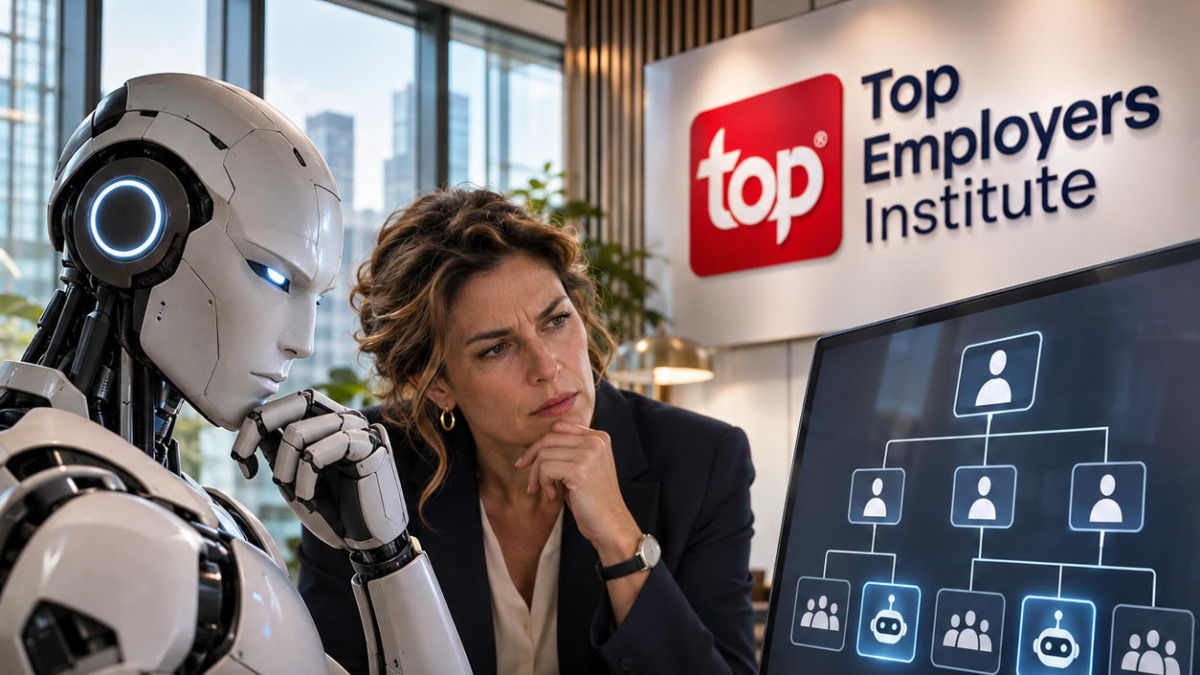

For Patrick Gailhard, France Director of Top Employers Institute, the question of which jobs artificial intelligence will replace is no longer sufficient. With the rise of agentic AI, it is the organization of work, and first and foremost the role of managers, that is at the heart of the transformation.
Unlike tools that assist employees with isolated tasks, agentic systems can chain actions, interact with various tools, and coordinate end-to-end processes. For leaders, the challenge is therefore to decide what can be delegated to AI, what must remain under human control, and how to distribute responsibilities between employees and systems.
Contrasting Visions
Dario Amodei, co-founder and CEO of Anthropic, warns of the risk that AI capabilities will advance faster than our ability to frame and control them. Sam Altman, CEO of OpenAI, describes AI agents becoming ‘virtual colleagues,’ taking on a growing share of intellectual work. Elon Musk, CEO of Tesla and SpaceX and founder of xAI, imagines a world where AI and robotics could eventually make work optional, a perspective also explored by Daniel Susskind in his book A World Without Work.
These scenarios should not be taken as certain predictions. Nevertheless, they raise a concrete question: if organizations manage to produce more with less labor, how should productivity gains be distributed and the possibility for everyone to contribute, learn, and be recognized be preserved? Work, the author reminds us, citing Anne de Guigné, author of Les Français veulent-ils encore travailler ?, is not just a means of earning a living; it is also a source of meaning and social connection.
What the Top Employers Study Reveals
According to the study Designing Work in the Age of Agentic AI, conducted based on insights from nearly 2,500 Top Employers certified organizations worldwide, nearly one in two European Top Employers indicates that agentic AI is already part of the professional daily life. Yet, fewer than 40% report measurable productivity gains. Usage is advancing, but results are not necessarily following.
According to the author, many companies are adding agents to existing processes without deeply reviewing roles, decisions, performance indicators, or managerial practices. The next step would be to link AI capabilities to explicit operational outcomes, robust governance, and a human contribution that retains its meaning.
The Daily Life of Managers
In a customer service department, an agent can classify and prioritize requests at high speed, but the manager must define processing criteria, control quality, detect biases, and identify situations requiring human judgment. Their role is shifting: less supervision of each task, more definition of rules and management of exceptions.
In the sales function, an agent can prepare summaries before meetings, write follow-ups, and update the CRM, i.e., the customer relationship management tool. However, the time freed up does not replace understanding the customer, negotiation, or judgment in complex situations. For the author, trust must also be integrated into the operational model rather than reduced to a communication exercise: managers must explain the meaning of the change, involve teams in redesigning processes, and identify cases where AI adds burden instead of simplifying it.
The question, according to him, is no longer whether AI will transform work, but whether leaders will choose to shape this transformation or let existing structures decide its effects. An ‘intentional’ organization, in the sense understood by Top Employers Institute, deliberately chooses where AI should create value and which responsibilities should remain human.
