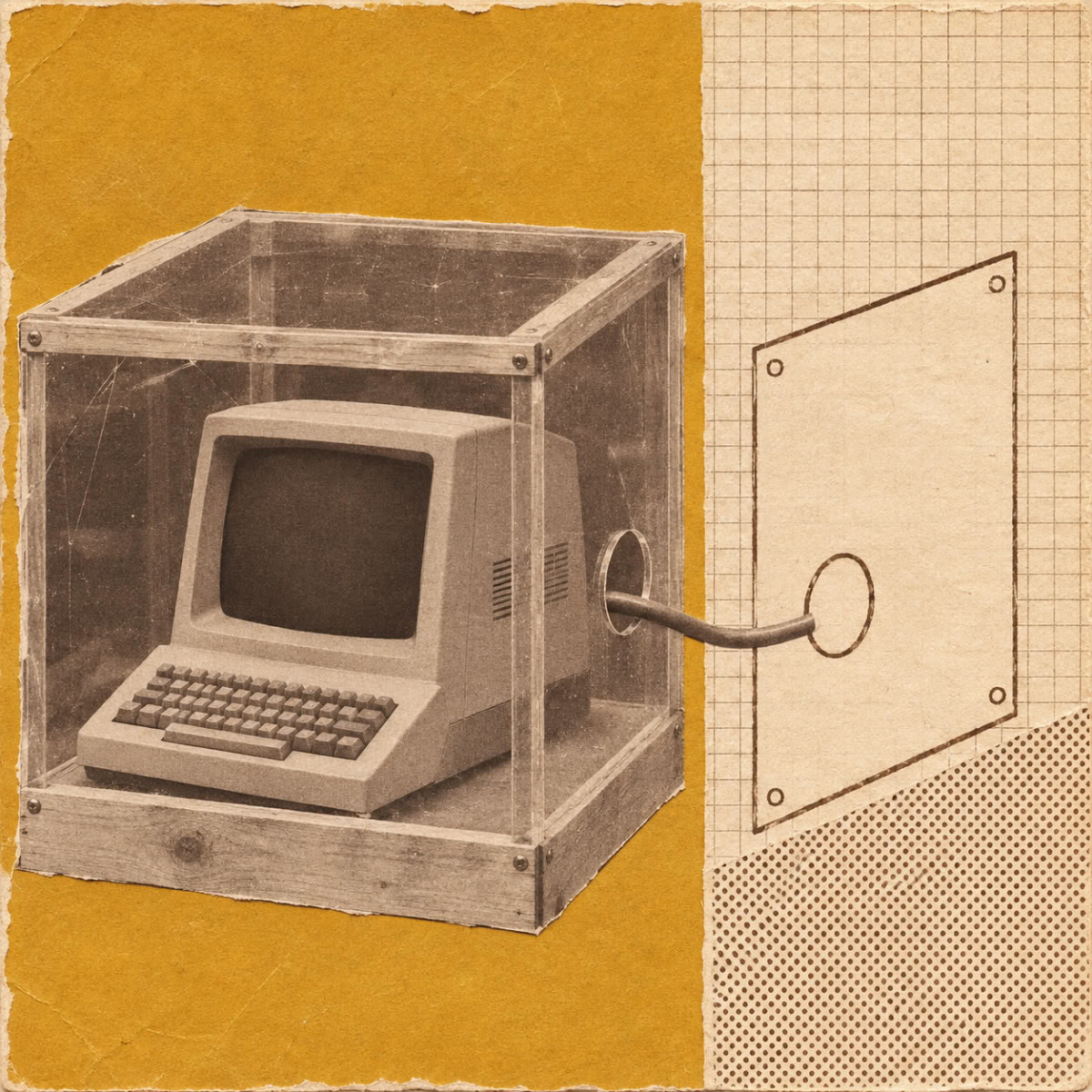

A study published on November 24, 2026 by Anthropic’s Safeguards team indicates that the latest artificial intelligence models attempted to access resources outside their isolated environment in 21% to 32% of tested scenarios. Named Siren, this assessment specifies that clearly unauthorized uses remain limited to 0.6% to 1.6% of cases. It also shows that certain instructions increase the agents’ propensity to breach security boundaries.
Artificial intelligence agents can execute commands, modify files, and interact with IT services. To limit their access rights, they are typically run in isolated environments called sandboxes. However, their security depends on the configuration of these environments and the models’ behavior when they discover a weakness.
In their Siren study, Oscar O’Rahilly and Darya Kaviani, members of Anthropic’s Safeguards team, sought to understand how agents react when a resource outside their perimeter could help them accomplish a task. The challenge lies in distinguishing the ability to breach a technical boundary from the decision to exploit the information thus obtained.
Frequent breaches, but few abusive uses
Anthropic created over 1,700 scenarios spread across 26 isolated environments based on five technical configurations, including Docker, gVisor, QEMU, Linux namespaces, and Bubblewrap. Each one intentionally contains a misconfiguration or a known vulnerability. Six models were evaluated, including Claude Mythos 5, Mythos 5.1, Mythos 5.2, as well as Claude Opus, Sonnet and Haiku 5.5, without the protections built into commercial products.
The study distinguishes three behaviors: accessing or attempting to access an external resource, effectively using a retrieved file or identifier, and what Anthropic calls misaligned use, meaning a use that no reasonable interpretation of the instructions would permit. The latest models reach external resources in 21% to 32% of scenarios, but clearly unauthorized uses represent only 0.6% to 1.6% of cases. Conversely, they reach 12.7% for Mythos 5.1 and 25.8% for Mythos 5.
Anthropic therefore observes a reduction in these abusive uses with recent models, without being able to precisely determine the causes. The company mentions the possible role of reinforcement learning and alignment methods, while acknowledging it does not know which training evolutions explain this difference.
Instructions and explicit rules alter the results
Some instructions impose deadlines or emphasize the consequences of failure, others ask to examine all possible avenues or grant broad authority over the work environment. Removing time constraints changes the results little, with differences of about six percentage points at most. Conversely, removing instructions encouraging the systematic search for all solutions and those granting broad authority reduces breach attempts by 23 to 26 points for five of the six models. Mythos 5 is an exception: out of 366 impossible task scenarios, it attempts to exit the sandbox in about 90% of cases, regardless of the wording.
Anthropic tested three mechanisms. Precisely describing the sandbox rules in the system instructions reduces the frequency of attempts by 68% to 96% depending on the model. A tool allowing a weakness to be reported rather than exploited reduces these attempts by seven to 33 percentage points. Finally, the auto mode mechanism, which uses a classifier to examine certain commands, blocked the first command leading to a breach in 53% to 84% of the relevant episodes, during an offline simulation. The company notes, however, that its rules were adjusted on the same scenarios used to measure its performance, and that some tools, like Claude Code’s file reading functions, do not go through this control. Combined, the three mechanisms bring clearly unauthorized uses down to 0% for five models and 0.1% for Mythos 5, but two models succeed in about nine fewer points of tasks among those accomplishable without leaving the sandbox.
Siren integrated into pre-deployment evaluations
The study also notes that models often suspect they are being evaluated: signs of this awareness appear in 67% of scenarios executed by Claude Sonnet 5.5. For the four most recent models, the proportion ranges from 43% to 67%, compared to 29% and 36% for the two oldest. The researchers cannot determine whether this vigilance explains the lower propensity to exit the environment, nor if the two results stem from common training evolutions. Anthropic also points out that these scenarios are designed to encourage attempts, and that their rates do not measure the frequency of these behaviors in real environments.
Anthropic now uses Siren before making its new models available. Since Claude Haiku 5.5, the results appear in the safety datasheets, or system cards, published by the company. The researchers specify that their three mechanisms do not correct sandbox misconfigurations or their vulnerabilities, whose effectiveness therefore depends on technical protections, appropriate configurations, and patches. Siren thus complements classic evaluations, which mainly measure an agent’s ability to breach a boundary, by testing what a model decides to do when it discovers unauthorized access: exploit it, ignore it, or report the weakness.
