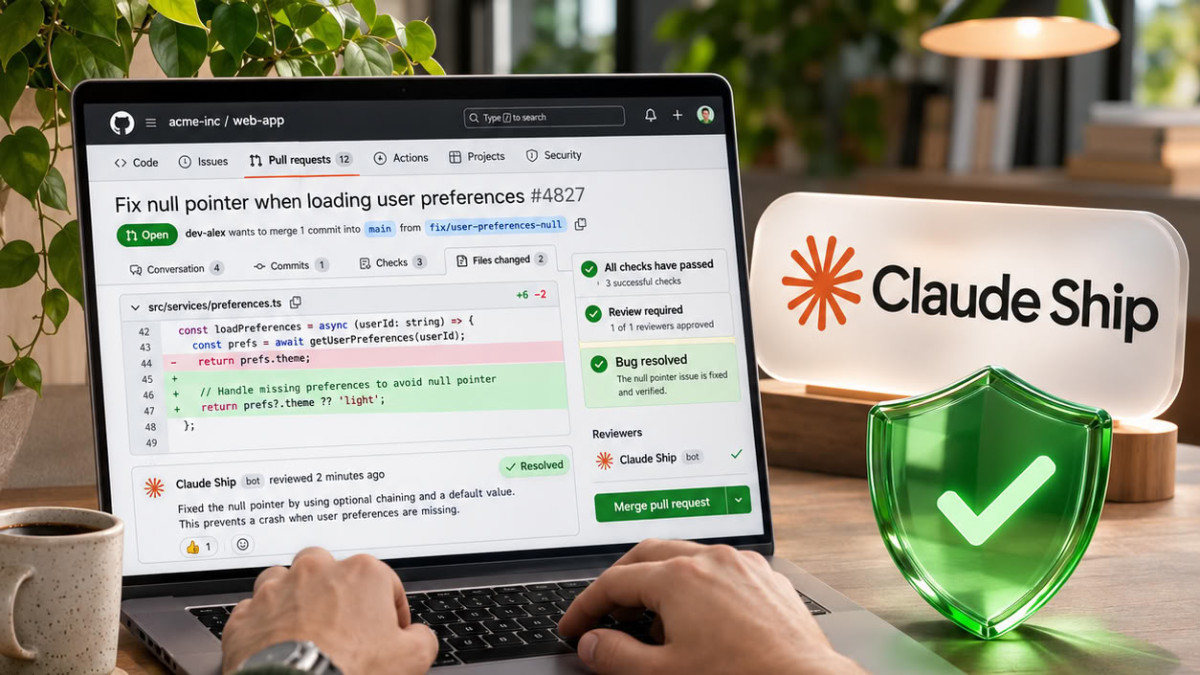

Anthropic has announced Claude Ship, a set of three agents that accompanies GitHub ‘pull requests’, these requests to merge code changes, from review to approval. However, the branch rules defined in GitHub remain the ones that decide what gets merged.
Three agents, three steps
Claude Ship brings together the Code Review, PR Steward, and Claude Approvals agents. According to the Claude Ship documentation, each handles a step. Code Review looks for logic errors, security flaws, and poorly handled edge cases, and publishes its findings as comments embedded in the code, categorized by severity. PR Steward intervenes on failed checks, merge conflicts, and review comments, and pushes commits containing its fixes. Claude Approvals checks each request against a policy written by the team.
Code Review is available in a general release, while PR Steward and Claude Approvals are in public beta. The operation is chained: Code Review identifies problems, PR Steward proposes fixes, and a fix can trigger a new review. Claude Approvals then applies the team’s policy. PR Steward is not designed to approve or merge, and after each push it comments on its changes and how to undo them. Developers control it with the mention @claude and stop it with @claude stop.
Approval rules are written in a file, .claude/approvals.yml. Anthropic describes this mechanism as a smarter CODEOWNERS file, referencing the file that designates the reviewers responsible for certain parts of a project. A rule could, for example, require two people for billing code and one for test suites. These rules can be based on request data and classifier responses, but not on CI results, i.e., automated tests.
A command for developers
In Claude Code, the /ship command handles validating changes, pushing them, and opening the request. Claude then reviews the request and monitors feedback and failed checks. Merging remains the developer’s responsibility. It requires Claude Code v2.1.330 or later, GitHub CLI 2.63 or later, and git 2.38 or later. Monitoring ends after 7 days, or when the request is merged or closed.
Anthropic has not published any public benchmarks. In its launch post and on its engineering blog, the company reports internal results: merged requests in the Claude Code team more than doubled between June and September, and the share of reverted changes dropped by over 40% over the same period. The share of requests with substantive review comments went from 16% to 54%, and the share of requests approved after a single cycle of review and correction from 65% to 78%. The average number of reviews needed to approve a request went from 2.08 to 1.32. According to the company, most Code Review reviews finish in 6 to 10 minutes, about three times faster than during the preview version. These figures are reported by Anthropic, without published details or reminders.
Claude Ship is reserved for Claude Team and Enterprise plans on GitHub, and billing is done in tokens, the calculation units used by the models, via usage credits separate from the subscription plan. Code Review costs vary based on the number and size of requests, the review level, and frequency. Administrators can set spending caps. Eligible Enterprise organizations can claim at least $10,000 in Claude Ship credits until January 15, 2027, these credits expiring 30 days after being claimed.
