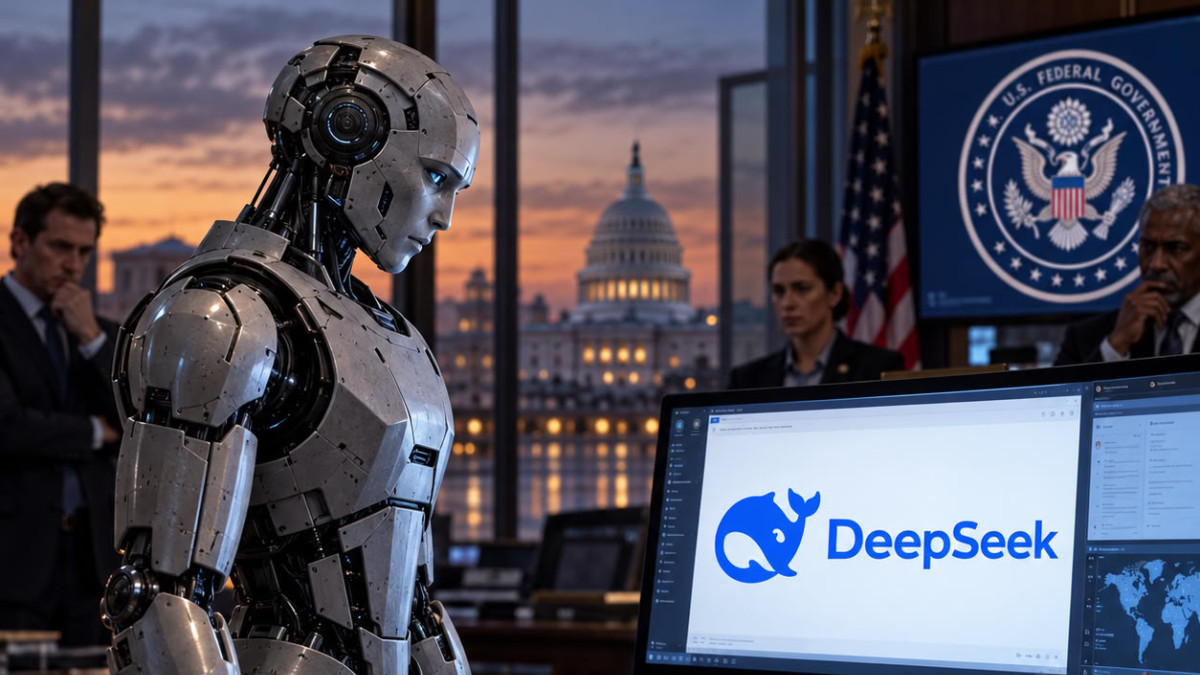

The United States is extending to the computer systems of civilian federal agencies the restrictions targeting DeepSeek. A Department of Homeland Security order requires these administrations to remove the Chinese company’s products and services, as well as third‑party solutions built on its technologies, and to cease acquiring them.
The issue is not limited to a conversational interface. The measure also targets products from companies affiliated with DeepSeek and services from third‑party providers that rely on its implementations. Administrations must therefore verify the technological components integrated into their IT tools.
The decision rests on two obligations: exclude the concerned products from civilian federal agencies’ public purchases, and remove the targeted technologies from their systems. The official text links these two aspects. The Treasury, State and Justice departments are among the affected administrations, while the Defense Department is excluded from this order. This distinction defines its administrative scope; it does not mean that the military services, moreover, permit the use of DeepSeek.
The timeline also includes several dates. The order was initially issued on July 24, 2026. Its public release occurred on Monday, October 19, while the notice announced a publication in the Federal Register on October 20.
A succession of restrictions
This measure is part of a series of decisions already taken. According to Bloomberg, the U.S. agency responsible for defense information systems blocked access to DeepSeek models in January 2025. Reuters reported in March that several offices of the Commerce Department prohibited their use on government devices. Congress also decided in December 2025 on a restriction for intelligence‑community systems.
Sensitive data at the heart of concerns
The Department of Homeland Security presents DeepSeek models as capable of exposing administrations to several categories of threats. Its concerns include a possible Chinese authority access to sensitive information and the possible presence of cybersecurity weaknesses. According to the administration, the feared scenario involves the transfer to China of U.S. government data that could provide intelligence on citizens or federal programs.
These points remain risks identified by the administration. The available narrative does not demonstrate that a specific transfer of federal data has occurred, nor that a determined espionage operation has been established. The department likewise cites the possible presence of malware and other vulnerabilities, referencing public research that identified several critical flaws in DeepSeek’s iOS application. These concerns alone do not allow one to assert that every model or product using this technology contains malicious code.
An exception mechanism is provided. Agencies may request a waiver, notably an additional compliance deadline, by submitting a written justification to the Department of Homeland Security. The mentioned timeframe is 60 days from the issuance of the order.
The decision comes amid a technological rivalry between Washington and Beijing. Asked by Reuters, the Chinese Ministry of Foreign Affairs said it wants to defend the rights and interests of its companies. Its spokesperson denounced an excessive extension of the national‑security argument and the politicisation of scientific, technological and commercial issues.
