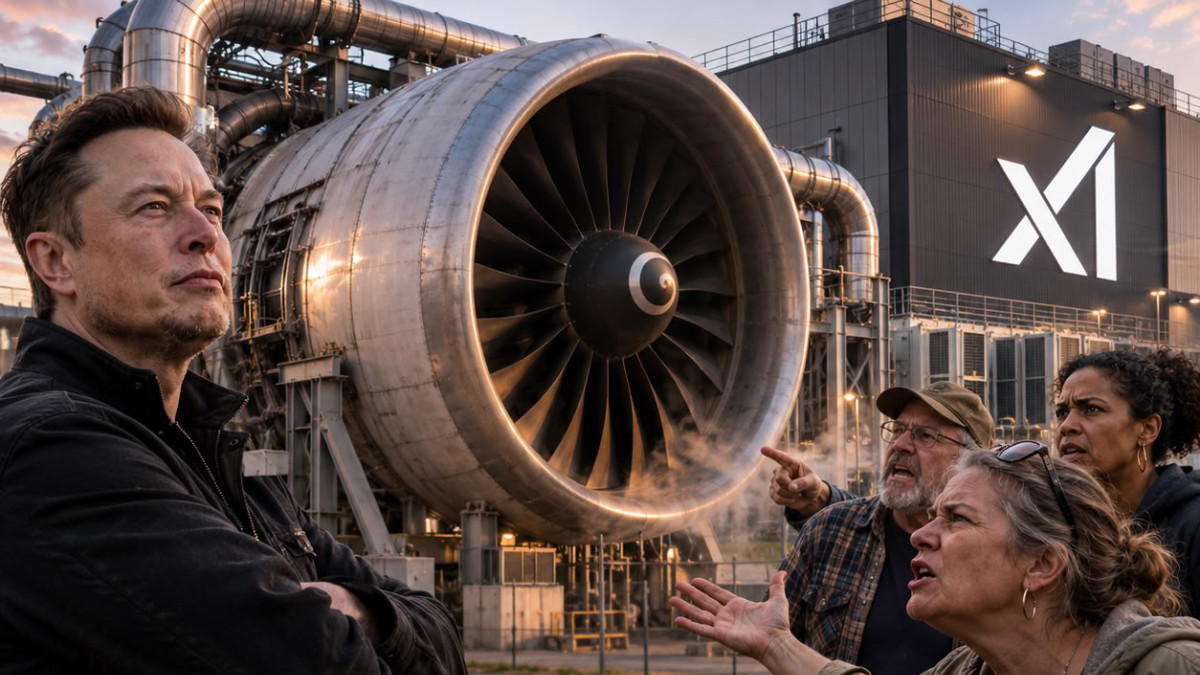

xAI, Elon Musk’s artificial intelligence company, has installed eight turbines built from aircraft engines, the same type used on Boeing 747s, in Mississippi to power its Colossus 2 data center. The NAACP and two residents’ groups are challenging the permit granted for these machines, which allows them to emit more pollutants than the other turbines on the site.
Aircraft Engines at the Southaven Site
The New York Times revealed, based on official documents and satellite images, that xAI had installed eight turbines manufactured by ProEnergy, a Missouri-based company, at its power plant in Southaven, in northern Mississippi. This plant powers Colossus 2, xAI’s data center located in Memphis, just across the border in Tennessee.
Each turbine, a machine that generates electricity by burning gas, uses the refurbished core of a GE CF6-80C2 engine. ‘If you’ve ever flown on a Boeing 747, it’s exactly the same aircraft engine,’ explained Landon Tessmer, a ProEnergy executive, at a conference in Denver in September. According to the permit issued by the state of Mississippi, each unit can produce 50 megawatts, totaling 400 megawatts for all eight.
A Permit More Lenient Than for Other Turbines
The state of Mississippi issued this permit on March 11, 2026. It authorizes the ProEnergy turbines to emit up to 4 ppm (parts per million) of carbon monoxide, twice the limit for the plant’s 33 other turbines, as well as 25% more volatile organic compounds. According to the New York Times, ProEnergy provided ‘no guarantees or documentation’ regarding its emissions of other pollutants, such as formaldehyde.
The NAACP and two local groups, represented by the Southern Environmental Law Center (SELC), have appealed this permit. A hearing is scheduled before the Mississippi Permit Board on November 9, with a possible continuation on the 10th. ‘Electricity generation should get cleaner over time, not dirtier,’ said Patrick Anderson, an attorney at SELC. For his part, Southaven Mayor Darren Musselwhite stated on the city’s website on October 1 that the company had ‘complied with all federal, state, and local laws.’
A Lawsuit and Other Similar Projects
This is not the first time xAI’s turbines have been challenged in court. In April 2026, the NAACP sued xAI and its subsidiary MZX Tech, accusing them of installing 27 gas turbines last year without the permits required by the Clean Air Act, the U.S. federal air quality law. According to the SELC, these facilities would emit more than 5,000 tons of nitrogen oxides, 400 tons of fine particulate matter, and 47 tons of formaldehyde annually. xAI claimed its turbines were mobile sources and thus exempt from permitting, but on Friday, October 30, a federal judge rejected that argument and refused to dismiss the lawsuit. ‘Our position has always been clear: xAI cannot operate gas turbines without the required permits,’ responded Abre’ Conner, director of environmental and climate justice at the NAACP.
xAI is not the only company betting on this equipment. In April 2026, the startup Crusoe, which is building the Stargate campus in Abilene, Texas, ordered 13 converted units from ProEnergy. According to Audun Martinsen, an analyst at Rystad Energy, these turbines can power a data center in 24 months, whereas the International Energy Agency estimates it takes about seven years to connect 100 megawatts to the power grid in northern Virginia. However, they are less efficient and more polluting than turbines designed for conventional gas-fired power plants, requiring more of them to be installed for the same output.
