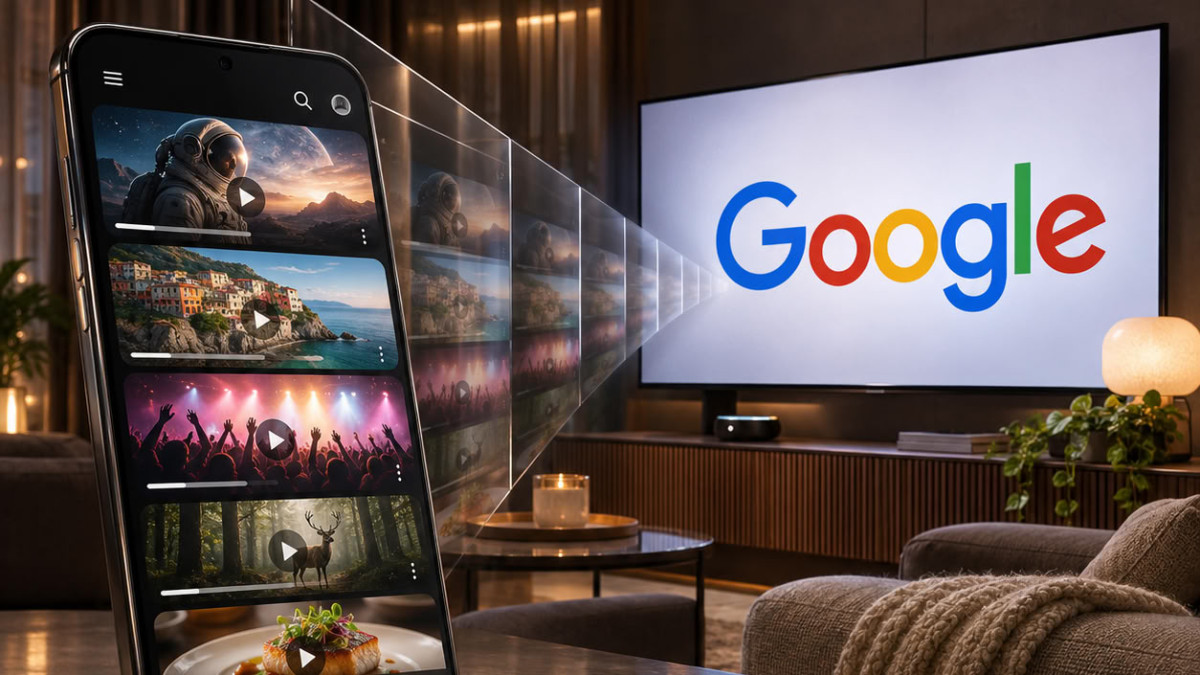

Google has filed a patent for a system called My Channel, designed to compose streams of videos and advertisements generated by artificial intelligence, personalized from the information the company holds about its users. The patent was rejected, but Google could appeal or file a modified version, leaving open the possibility of bringing the service to market.
Spotted by Patentlyze, the document describes a precise operation. My Channel would use a person’s demographic data and viewing history to create its own queries, which would then be sent to an LLM, i.e., a large language model, to generate videos tailored to their interests. The system would also take into account contextual data from the device, such as IP addresses, GPS positions, or the user’s age. Queries could also be based on current events, including sports results and topics trending on social media. All video generation would take place on Google’s servers.
According to the patent, My Channel could produce full-length films in various genres. A user who watches many videos about The Odyssey by Christopher Nolan could thus be offered a film like Odysseus: The Fall by Ash Koosha. The document also mentions the possibility of connecting to other streaming services, which would give the system more information about users and, presumably, access to data useful for training video generation models.
Avatars at the Heart of the Narrative
The most striking point of the patent concerns digital avatars. My Channel could create digital doubles of users and make them “the protagonist or main character” of the produced content. To do this, the system would use photos, videos, and audio clips of the individuals concerned.
The analysis of the patent highlights that this type of service seems far removed from what gives a work its value. Projecting oneself into a fiction to understand what characters feel can be a pleasure, whereas the system would offer an infinite supply of tailor-made content, which does not encourage imagining or putting oneself in the characters’ shoes. According to this reading, the patent gives the impression that Google believes viewers would be entertained simply by seeing themselves on screen.
The text also highlights another risk: that of locking users into their presumed tastes. By reusing existing content from other platforms, the service could retain them long-term, a goal that, the analysis reminds, all streaming platforms seek, but to the detriment of discovering works that do not match their habits.
The Debate on Generative Creation
When we talk about ‘slop’ to refer to AI-generated videos, the analysis reminds, we point to the absence of creative intent inherent to generative models, which makes stories produced by humans so compelling. Video generation models can imitate the visual elements of the data they were trained on, i.e., films and series, but they cannot think or feel like directors, screenwriters, or actors do.
This observation makes the discourse from companies in the sector, platforms, and studios, who claim this technology will profoundly transform the industry for the better, all the more surprising. For the author of the analysis, it seems far more likely that generative AI will continue to flood the internet with content that no one wants to watch.
