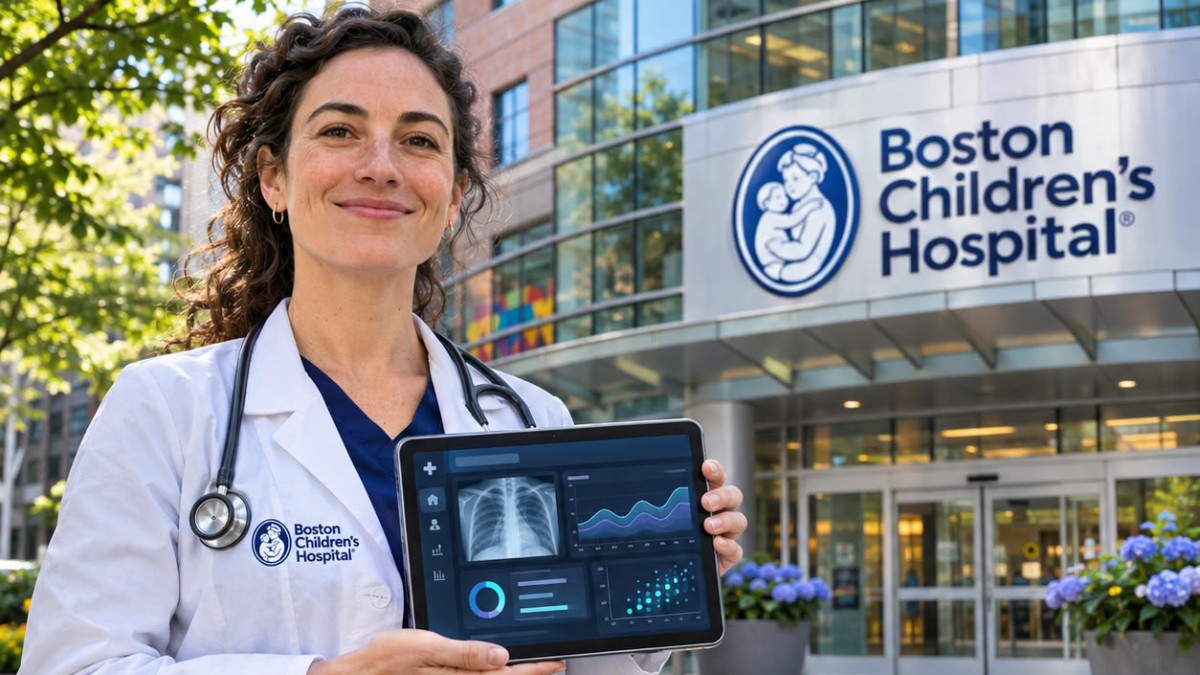

Dinesh Rai applied in 2023 for a ‘prompt engineer’ position advertised by Boston Children’s Hospital, not expecting to be hired. Starting in August 2023, he now holds the role of clinical AI engineer, a position that moves well beyond simply writing instructions for language models. His career path highlights the rapid evolution of jobs related to generative AI.
At the time of his recruitment, prompt engineering was presented as one of the new flagship jobs in generative AI. Companies were seeking profiles capable of getting the best responses from large language models (LLMs, systems trained on vast volumes of text) by carefully crafting their prompts, examples, and the context given to the model. ‘Knowing how to formulate queries to an AI was going to become the professional skill of the future,’ says John Brownstein, the hospital’s chief innovation officer.
Since then, according to John Brownstein, more capable models have reduced the importance of elaborate prompts. The work now focuses on integrating AI into care systems and verifying the reliability of its responses. The questions have shifted: ‘How do you integrate these tools into your daily operations? How do you build agents to literally manage everything you do?’
Between Medicine and Engineering
Trained in emergency medicine, Dinesh Rai had first studied management as an undergraduate. He began teaching himself programming in 2014, the year he entered medical school. During his studies, he created a platform called Academius, designed for students to track their residency interviews and establish their rank order lists.
After training in clinical informatics, a discipline at the interface of medical practice and computer systems, he joined Pieces, an AI for health company, in 2022, where he worked on the clinical use of LLM-based medical summarization. He then suspended his medical practice. ‘Stopping was a really difficult decision,’ he confides. He has since reactivated his medical license and hopes to resume clinical activity in the coming year.
At Boston Children’s Hospital, his day is roughly split in two: half with developers, focused on code and the technical advancement of projects, and half with clinicians, to determine their actual needs.
Clinical ‘Doppelgangers’
The clinical doppelgangers project aims to help doctors treating complex patients find comparable cases in the hospital’s historical data. Medical recommendations are generally based on large populations, whereas a child with a rare or complex disease may not match the profiles presented in published studies.
The system is meant to identify past patients with similar characteristics, examine their progression, and see how different interventions played out. It does not aim to replace randomized clinical trials, but to provide an additional source of information when published literature offers few reference points.
Dinesh Rai recently encountered a difficulty of this type in another project. The clinical and development teams had to decide how much of a patient’s medical record to pass to an AI model tasked with identifying elements relevant to a given clinical outcome. Developers thought any data could be useful, while clinicians assumed the model would discard irrelevant information. However, according to Dinesh Rai, a biological anomaly is not necessarily relevant, and an LLM cannot be assumed capable of recognizing that: it can produce a plausible explanation even when the record does not justify it. ‘That dual perspective was invaluable, not just for bridging the teams, but for spotting when an approach that seems reasonable on both sides rests on assumptions that shouldn’t be made.’
Beyond the Prompt
In the medical field, the questions asked after the query now take precedence over its wording. Is the model’s output consistent with the underlying data? How to evaluate its results? Will the clinician using it know how to spot an error? For the clinical note drafting tool developed by his team, the doctors who were to use it reviewed a batch of generated notes before any validation. ‘People trust it more when they’ve seen its mistakes than when we just tell them it’s good,’ he concludes.
