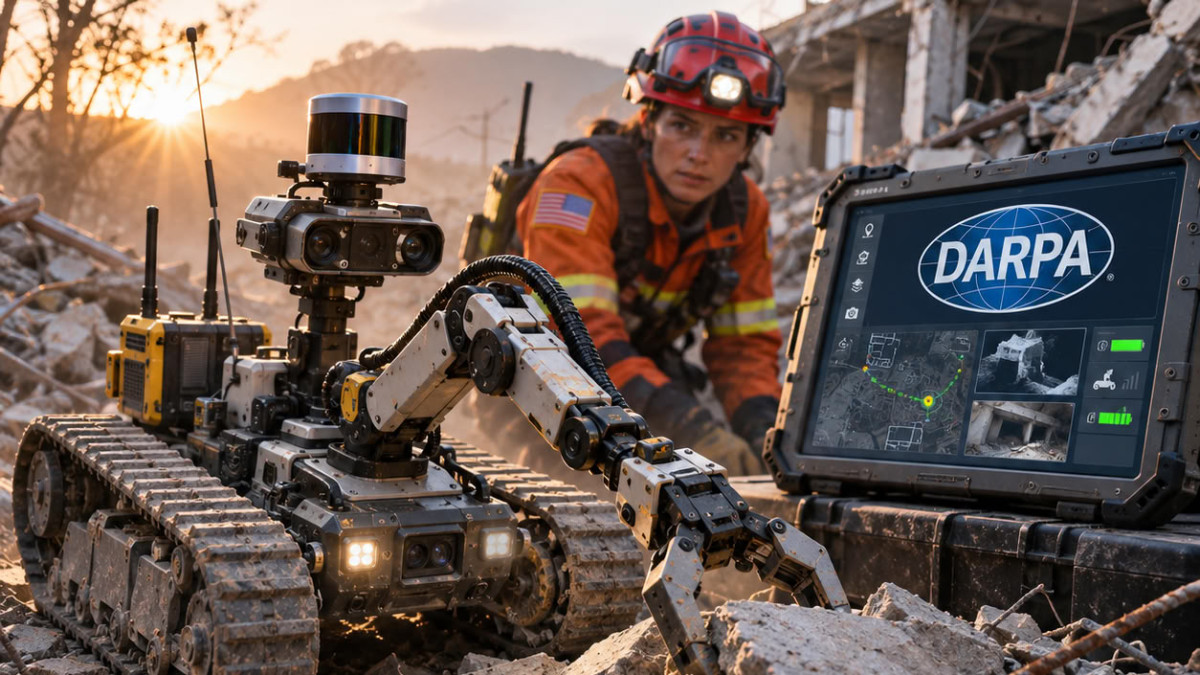

Ten teams competed in the final of the DARPA Triage Challenge, a nine-day event held on November 5 in College Station, Texas, where robots and humans had to work together in simulated disasters. The RoboScout team from the University of Maryland won the $1.5 million grand prize out of a total prize pool of $2.5 million.
The trials took place in Disaster City, a 52-acre mock town. The scenarios replicated a marketplace ravaged by a tornado or a nighttime attack on a military base. This competition, run for three years by the U.S. agency DARPA, aims to save more lives during mass casualty events.
Triaging Victims with Robots
Triage involves assessing injuries and deciding who should receive care first. During a mass casualty event, first responders must do this with limited resources and little time. “Triage is all about resources,” explained Jeremy Pamplin, a critical care physician and retired colonel who spent 28 years in the U.S. Army and led the competition for DARPA.
The teams designed systems combining ground robots and autonomous drones, tasked with locating simulated victims and helping determine the care they needed. Gabriela Garcia Dolagaray, associate medical director for emergency preparedness at Massachusetts General Hospital and Brigham and Women’s Hospital in Boston, sees these technologies as a potential aid for real-world decisions. “Finding people can sometimes be dangerous,” she noted, and mobilizing enough rescuers to search a disaster area takes time.
A Final Marked by the Unexpected
A self-funded team of students from Delhi Technological University, called Unmanned Aerial Systems, traveled from India with 22 checked bags containing hand-assembled drones and wheeled robots. Upon arrival, they discovered broken motors and chassis, as well as missing camera parts and screws. Nishant Chandna told IEEE Spectrum they were still assembling their equipment just days before the event. The team did not meet the threshold for autonomous control, but they achieved the top score in a sub-competition, earning them $300,000.
RoboScout, which chose to detect victims from the ground using Boston Dynamics’ Spot robot dogs, was initially slowed by software bugs related to the competition timer and Wi-Fi, before rallying during the final human-machine team phase. “We peaked at the right time,” said Derek Paley, a professor of aerospace engineering. During these trials, a human-only team located an average of 50% of victims in a daytime simulation, while the Maryland team’s robots found all of them in one round paired with human rescuers. During the championship course, humans provided life-saving care to 25% of simulated victims who needed it, compared to 74% for RoboScout. “That’s a few lives saved,” commented Jeremy Pamplin. “A few people who didn’t die that day.”
Several participants told IEEE Spectrum they plan to use their AI algorithms in other contexts, including hospital trauma bays, regional medical emergencies, and responses to chemical attacks.
