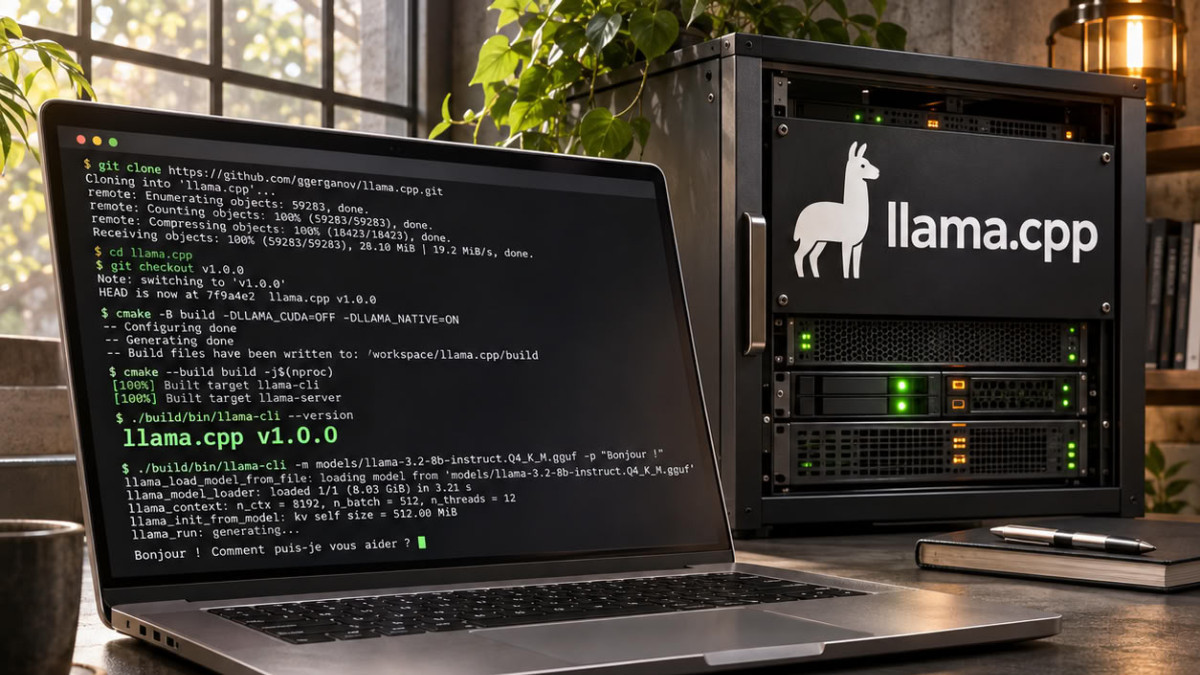

The library llama.cpp has moved to version 1.0.0. This project enables the execution of large multimodal language models (LLMs) on a wide range of hardware, from personal computers to enterprise servers. Its maintainers see this as a significant milestone for the developers who depend on it.
According to the team, llama.cpp relies on quantization, a technique that reduces the precision of a model’s parameters to lighten it, on optimized backends, meaning components tailored to each type of hardware, and on a portable C/C++ implementation. They claim this combination makes the library the “lightest, most versatile, and most sensible” platform for developing cross-platform, privacy-respecting AI products.
Over the 3.5 years since its creation, the project has grown, and many downstream applications already depend on it. The team expects this trend to continue as local AI and privacy protection gain importance in daily life. Each new integration increases the number of developers relying on the library’s interfaces, making a flexible and stable API, or application programming interface, essential.
It is in this context that the libraries are released as version 1.0.0. In the future, llama.cpp and ggml will signal API and ABI incompatibilities, the binary interface between software, with a major version change. The team indicates it will be stricter to make these boundaries visible to library users.
Explicit versioning rules
The semantic versioning rules applied across all ggml-org projects distinguish three types of updates. A MAJOR version corresponds to a breaking change in the public C API of the include directory. A MINOR version adds a backward-compatible feature, a backend update, support for a model, or an addition to the API. A PATCH version fixes a bug without modifying the API.
On the distribution side, the team says it wants to broaden the ways the organization’s software reaches developers and end users. Pre-release artifacts are available for Linux, macOS, Windows, Android, and iOS. The project is also offered via Docker, Debian, Homebrew, conda-forge, MacPorts, Winget, and XCFramework, according to the platforms indicated in the source.
Development and infrastructure
The team highlights a community of contributors it describes as highly skilled. Faced with the rapid rise of AI capabilities in software engineering, it indicates it is integrating LLMs into its development cycle “in a thoughtful and reasonable manner.” It believes that maintaining a high-quality codebase, controlling the architecture, and understanding implementation details will remain its priorities.
To keep up with this pace, the team is investing more resources in continuous integration infrastructure. Thanks to Hugging Face technologies, specifically HF Buckets and HF Jobs, it says it can increase the capacity needed to verify each change merged into the main branches. With hardware support from NVIDIA, AMD, Qualcomm, Arm, IBM, and Intel, it continues to add self-hosted runners on major platforms.
The underlying machine learning engine, ggml, is designed to run on virtually any existing hardware. Each backend can be compiled as a dynamic library and loaded at runtime. llama.cpp supports over 150 architecture variants as well as the full range of speculative decoding methods, a technique that speeds up text generation. The team thanks its long-time maintainers and all contributors, and sees this 1.0.0 release as a milestone that would not have been possible without their collective efforts.
