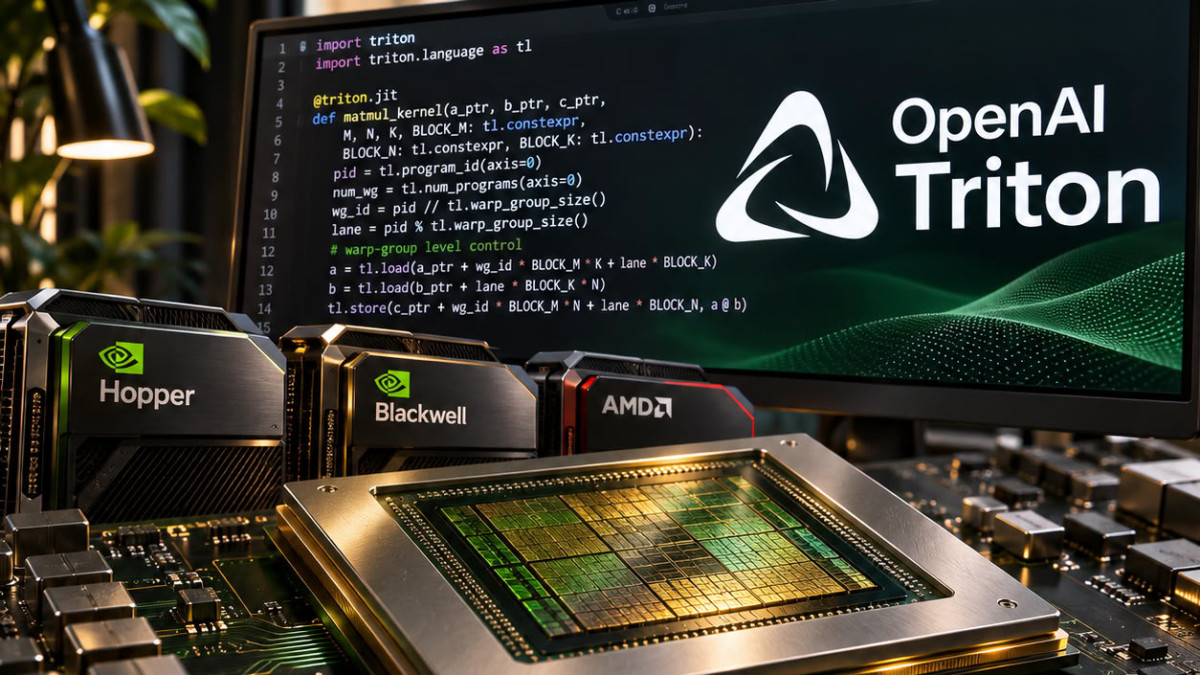

Meta has published a detailed report on TLX (Triton Low-Level Extensions), the extension of the Triton GPU compiler used to write compute kernels, called kernels, for its machine learning models in production. According to the company, it allows Python code to benefit from control close to that of CUDA without leaving Triton.
TLX is not a new language but an extension of Triton. It exposes to Python kernels the warp groups, barriers, TMA (Tensor Memory Accelerator, a data transfer accelerator), and clusters. It targets NVIDIA GPUs Hopper (H100) and Blackwell (B200, GB200), as well as AMD MI300 and MI350. The project is released under the MIT license.
An intermediate level between block and thread
Triton programs GPUs at the block level, while CUDA does so at the thread level. Hopper introduced warp specialization and TMA, and Blackwell added tensor memory (TMEM), cluster execution, and paired CTA execution. Meta believes CUDA can express these patterns, but only at the cost of a large amount of architecture-specific code.
TLX is based on a model researchers call MIMW (Multi-Instruction, Multi-Warp), in which the warp group becomes the basic unit of orchestration. Triton continues to define what executes, and TLX defines how it is orchestrated. Developers thus write classic Triton and add TLX calls only where control matters.
The extension adds five domains. Warp groups receive roles, such as producer, consumer, or epilogue. Synchronization is done via hardware mbarriers, while thread-level synchronization remains managed by the compiler. Programmers have direct access to TMA, asynchronous tensor core operations, and TMEM. CTAs can cooperate in clusters via distributed shared memory. Finally, layouts are inferred by the compiler and only modified for speed gains. The matrix multiplication example on Blackwell notably uses tlx.local_alloc, tlx.alloc_barriers, tlx.async_task, tlx.async_dot, and tlx.barrier_wait.
Self-declared performance
All figures below are provided by Meta. On H100, in FP16 GEMM (matrix multiplication) across six shapes, TLX ranges between -0.9% and +3.7% of cuBLAS. On 8192x8192x8192 matrices, it reaches 577.0 TFLOPS versus 582.3 for cuBLAS. On MI350, it exceeds rocBLAS by 11.8% to 15.2% on square shapes from 256 to 2048.
On B200, Meta’s Jagged Flash Attention kernel outperforms FlashAttention-4 by about 13% in forward and about 50% in backward on production jagged shapes. On dense LLM-type shapes, forward reaches about 87% of FA4. This kernel has about 3.2K lines, with Meta estimating FA4 at 10K lines in CuTe DSL. Researchers indicate TLX lags most on smaller causal-forward cases, with the gap narrowing as sequence length increases.
Production uses at Meta
The engineering report cites three case studies. For training the Generative Ads Model (GEM), Meta reports 20% to 25% end-to-end MFU on thousands of GPUs, with up to 2x gain in forward for Generalized Dot Product Attention. For In-Kernel Broadcast Optimization (IKBO), a specialized linear compression kernel achieves 4x acceleration on H100, and FlashAttention under IKBO reduces net latency of intensive computations by up to two thirds. The third case concerns a distributed grouped GEMM, which fuses mixtures of experts multiplications with communications for LLM pretraining on Blackwell, with no gain figures published.
Meta also compared CUTLASS, CuTe DSL, and TLX on Blackwell for GEM. According to the company, TLX offers the best balance between productivity and performance for most kernels, though no figures were shared.
TLX is available in Meta’s Triton fork, facebookexperimental/triton, under third_party/tlx/, and as triton-utlx on PyPI, as a plugin for upstream Triton. AMD has published a guide on GEMM with activation for CDNA4 using TLX. No independent benchmarks are yet available, and all figures remain self-declared by Meta at this stage.
