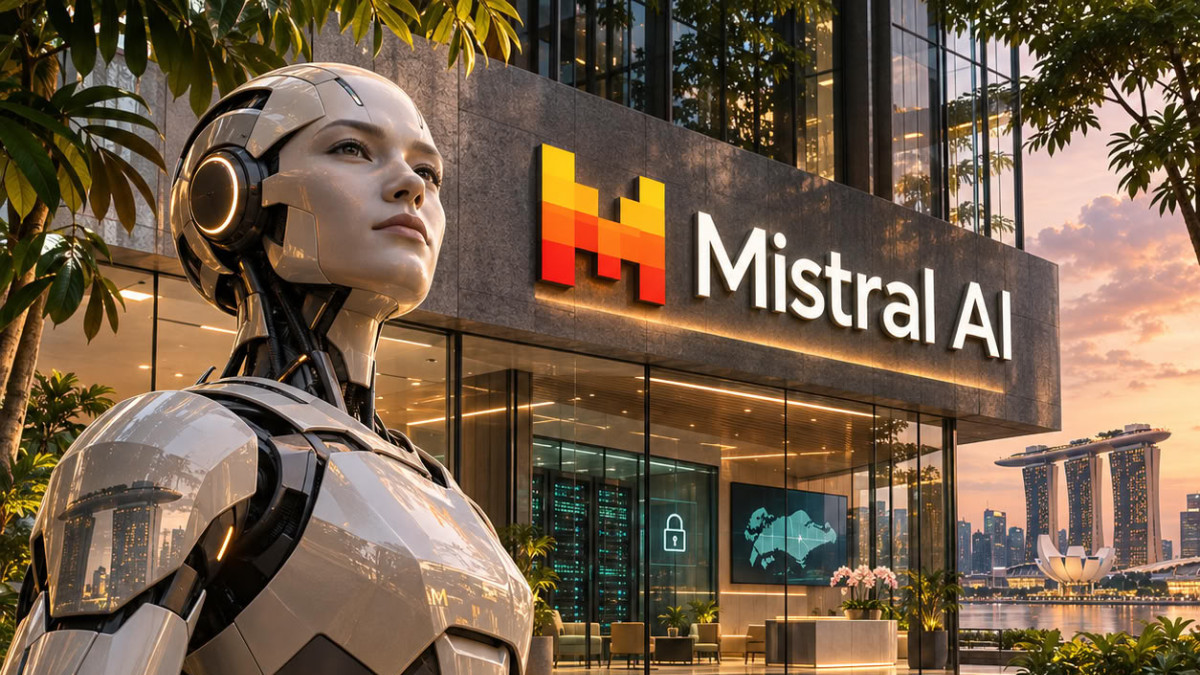

Mistral AI announced on November 20, 2026, the opening of its Asia-Pacific headquarters in Singapore. Beyond a commercial presence, this office is intended to become a research and development center dedicated to sovereign artificial intelligence and the specific needs of public and private actors in the region.
Three areas will concentrate the work of this center: sovereign AI solutions for the public sector, applications for the high-tech industry, and robotics. The goal is notably to develop, train, and deploy specialized models, adapted to the operational and regulatory constraints of different Asia-Pacific countries.
200 Employees Planned by 2027
To support this strategy, Mistral AI plans to increase its workforce in the region to 200 people by 2027, more than double its current teams. Recruitments will primarily concern scientific research, engineering, applied AI, and robotics.
This ramp-up is meant to strengthen local capabilities for model development and customization. It also fits into a strategy aimed at bringing research teams closer to end users, particularly administrations and industrial players. “Our ambition is to make Singapore a strategic location enabling governments and businesses across Asia-Pacific to retain ownership of their infrastructure and their intelligence,” explains Arthur Mensch, co-founder and CEO of Mistral AI.
Local Partnerships with International Ambition
The choice of Singapore is based in part on collaborations already underway with two institutional actors: DSO National Laboratories, the Singaporean defense research lab, and HTX, the science and technology agency of the Ministry of Home Affairs. These partnerships are among the first model customization collaborations concluded by Mistral AI on a global scale. They have notably contributed to the company’s work on specialized models and on artificial intelligence applications adapted to operational needs.
With HTX, developments include, among others, the Phoenix models and initiatives in embodied AI, meaning artificial intelligence integrated into a physical body, like a robot. The agency aims to equip the Home Team services, responsible for internal security, with technologies capable of responding to complex situations. For Ang Chee Wee, AI Director and Deputy Director-General Digital & Enterprise at HTX, the establishment of Mistral’s regional headquarters should facilitate the continuation of this work and strengthen exchanges between the two organizations.
Open-weight and Infrastructure Control
Sovereignty constitutes one of the main pillars of this establishment. Mistral AI intends to offer governments in the region open-weight models, whose parameters are accessible and which can be customized and deployed in their own environments. This approach should allow them to retain control over data, intellectual property, models, computing infrastructure, and operational conditions. The company promotes an integrated offering combining language models, physical AI solutions, enterprise deployment tools, and sovereign computing infrastructure.
Mistral AI also intends to develop its activities in robotics. The company cites, for example, Robostral Navigate, an 8-billion parameter model unveiled in July 2026, designed to enable a robot to navigate autonomously in complex environments using a simple RGB camera. Developed internally and trained in simulation, this model is presented as compatible with different types of robots. In the high-tech industry, work will also focus on engineering simulation, industrial process optimization, and productivity improvement.
