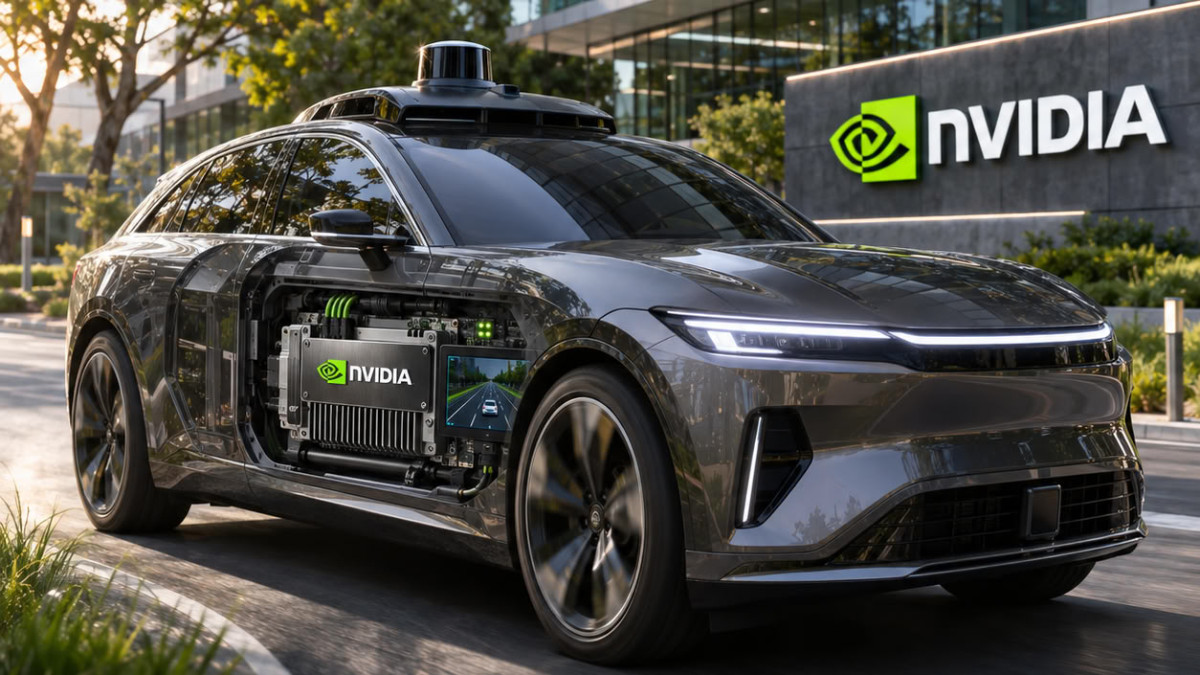

NVIDIA has released Alpamayo 2 Edge, a compact reasoning VLA model (a model combining vision, language, and action) for autonomous driving. Presented as a 2-billion parameter model, it plans trajectories and explains them directly on-board the vehicle, and it targets the NVIDIA DRIVE AGX Thor platform rather than a data center GPU.
Alpamayo 2 Edge is the embedded member of the Alpamayo family, alongside the cloud-based Alpamayo 2 Super model, which has 34 billion parameters. According to the model card published on Hugging Face, the 2.45-billion parameter backbone combines a 1.96-billion parameter language model with a 0.41-billion SigLIP2 encoder, plus a 0.2-billion diffusion action expert. Hugging Face metadata indicates 3 billion parameters, while NVIDIA markets the model as a 2-billion parameter model.
To predict a trajectory, the model receives six cameras and 22 images per observation: the two front cameras provide five images each, the other four provide three images each. It also takes a navigation instruction and 20 historical vehicle poses. As output, it produces 64 waypoints, spaced from 0.1 to 6.4 seconds. The action expert predicts acceleration and curvature, which a so-called ‘unicycle’ model then integrates to obtain the trajectory. The model also produces reasoning text, called a Chain-of-Causation (CoC) trace, and can answer free-form questions about a driving scene.
Situationally activated reasoning
In normal driving, the model does not write a full trace: it emits special tokens (the text units manipulated by a model) named . The CoC trace is only generated when the scene requires it. According to the source, fewer tokens means less computation per planning cycle.
Training first relies on offline distillation, from CoC annotations automatically generated by Alpamayo 2 Super. NVIDIA states it used approximately 115,000 hours of multi-camera driving videos and about 3.7 million CoC traces. A closed-loop reinforcement learning post-training phase was then conducted in AlpaGym, where the model learns from its own actions in simulation.
Announced performance on Thor
NVIDIA announces a latency of 160 to 190 ms between input image and output trajectory, depending on the amount of reasoning produced. The reference configuration pairs a DRIVE AGX Thor-X, DRIVE OS 7.2.7.0, CUDA 13.4 and TensorRT 11.3.1.9. In a company demonstration, the PyTorch version in BF16 plans at 0.76 Hz, while the optimized FP8 pipeline reaches 13.02 Hz in AlpaSim. Partner Embedl claims to have reached 10 Hz on AGX Thor in less than 48 hours.
On a workstation, the card recommends at least 16 GB of GPU memory. NVIDIA measured a peak of 12.06 GiB of process memory on an H100, with six trajectory candidates. Other GPU architectures are not yet validated.
Compared to Alibaba’s Qwen-Drive-1.0 4B model, NVIDIA reports 15.15 km traveled between two incidents attributable to the model, versus 0.25 km, or about 60 times more. The open-loop minADE reaches 0.53 m, versus 1.68 m. These comparisons come from NVIDIA’s own tests. The card also indicates a score of 75.2 on the LingoQA (Lingo-Judge) benchmark, versus 79.2 for Alpamayo 2 Super, and 48.67 on the nuReasoning numeric score.
NVIDIA also publishes AlpaJudge, a judge calibrated with human evaluators, which scores reasoning traces. Used as a reward for reinforcement learning, it improved reasoning quality by 10.2% according to the automatic judge and 11.4% according to humans. The model weights are distributed under the OpenMDW-1.1 license, and the code under the Apache 2.0 license. The model accepts fine-tuning.
