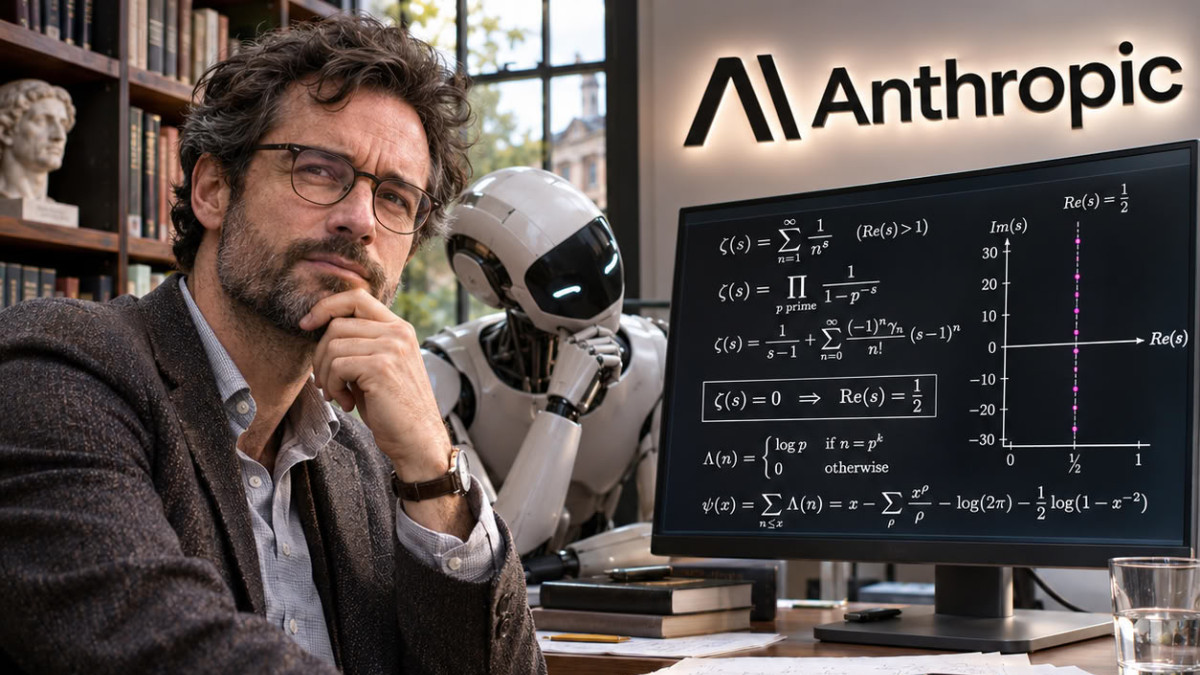

Researcher Levent Alpöge claims to have solved the Riemann Hypothesis, considered by some as the world’s most important mathematical problem, with the help of Claude, the artificial intelligence (AI) model from Anthropic. His proof has not yet been verified by other mathematicians, and this announcement comes two months after the resolution of the Navier-Stokes equation by an OpenAI model.
Turkish-American researcher and Anthropic employee Levent Alpöge published an account of his work on his personal website on Friday, but not the full proof. According to him, it spans over 250,000 pages, and no other mathematician has been able to verify it.
A few hours later, Ravi Vakil, a mathematics professor at Stanford University, reported that a postdoctoral student from the same faculty had independently submitted his own proof. Contacted by AFP, the researchers involved did not respond immediately.
A Problem Over a Century and a Half Old
The Riemann Hypothesis, formulated in 1859 by German mathematician Bernhard Riemann, concerns the distribution of prime numbers. Many theorems and algorithms are based on it. It is among the seven so-called ‘Millennium Problems,’ a list established in 2000 by the Clay Mathematics Institute research organization, which promised one million dollars for solving one of them.
The Navier-Stokes equation, also part of this list, was solved in early September by one of OpenAI’s AI models in less than four days. Australian mathematician Tristan Buckmaster then published a message questioning this project, which he had heard about. Seeing similarities with his own work, he suspected plagiarism. He was working with Levent Alpöge, the same researcher who reported his findings on the Riemann Hypothesis on Friday.
Researchers’ Reactions
OpenAI announced in early October that it had solved 377 different problems. Brian Conrey, considered one of the leading authorities on work related to the Riemann Hypothesis, has not yet been able to verify the proof. He nevertheless commented to AFP: ‘This is a monumental moment in human history.’ He added: ‘This is the most important thing we have ever seen in mathematics. Some will disagree, but this is something major.’
Levent Alpöge only indicated that he used the Claude interface, without specifying which version. For Nestor Guillen, a professor at NYU (New York University), ‘this result in itself will not have an immediate impact, (…) but the understanding it brings will have many, many applications in the coming months and years.’ He also considers that the proof of the Riemann Hypothesis is the result of the work of a researcher assisted by an AI model, and not the pure product of an AI alone, which makes it, in his view, ‘more respectful of scientific method and practices.’
Contacted by AFP, Anthropic did not respond immediately.
A Warning for Some
For others, this proof illustrates an increasingly powerful AI, which presents increased risks. On the social network X, researcher Eliezer Yudkowsky, among the most alarmist figures in tech regarding the threats AI could pose to humanity, wrote: ‘The Riemann Hypothesis was the challenge most often cited as a warning.’
