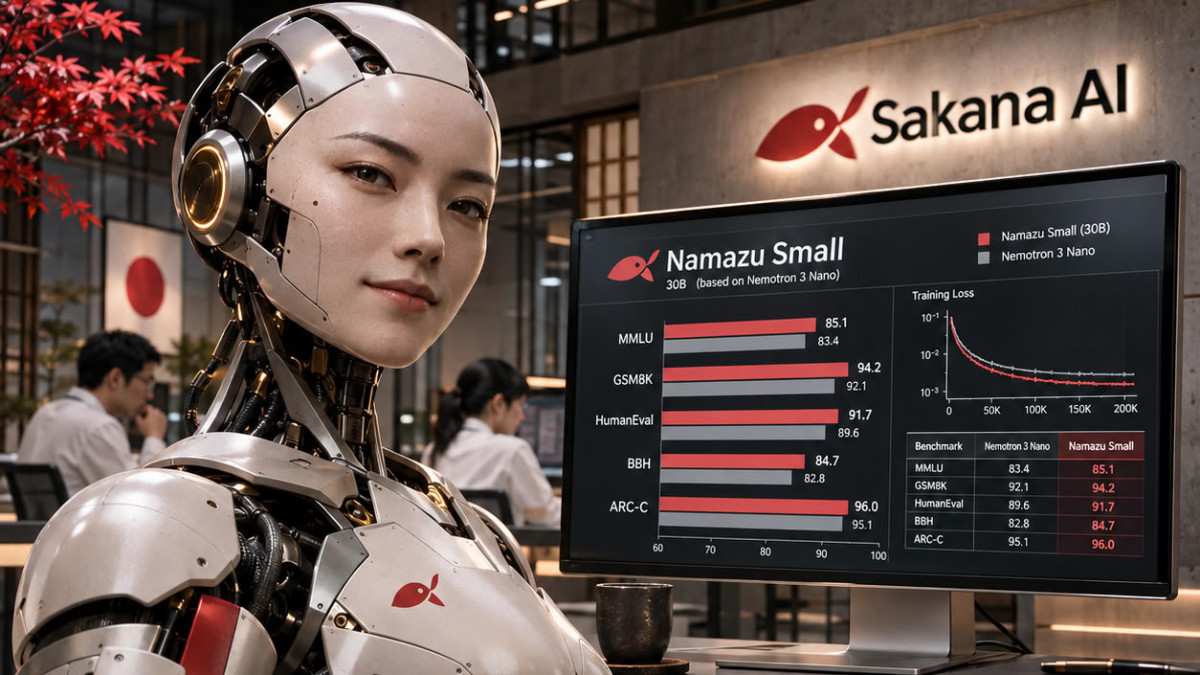

Japanese lab Sakana AI has announced Sakana Namazu Small, a 30-billion-parameter reasoning model built on NVIDIA Nemotron 3 Nano. According to the company, it outperforms the 120-billion-parameter Nemotron 3 Super on the average of 25 benchmark tests.
Sakana Namazu Small belongs to a family of models that Sakana builds from open models, before finishing them with its own post-training, i.e., a fine-tuning phase after the initial training. The larger model in the family, Sakana Namazu, is based on Kimi K2.6, while Namazu Small is its compact version. Sakana targets three types of uses: everyday conversation, web-augmented search, and long document reading. The model was designed as a reasoning model, which organizes the information it needs and proceeds step-by-step towards an answer.
For training, Sakana started from the pre-trained base of Nemotron 3 Nano, not the post-trained version published by NVIDIA. The company applied continued pre-training, as well as post-training techniques designed for this version, which rely on methods developed for the original Sakana Namazu. Nemotron 3 Nano is a hybrid Mamba-Transformer architecture with a mixture of experts, a type of model that only activates a portion of its parameters for each query. NVIDIA states it has 30 billion total parameters, with 3 billion active, and a context window of up to 1M tokens, i.e., the amount of text, segmented into units called tokens, that the model can process at once.
Strong results in web search
Sakana compared its model to two NVIDIA models, Nemotron 3 Nano and Nemotron 3 Super, on a suite of 25 benchmarks divided into three groups. All scores are self-reported by Sakana. The strong point is web search: on BrowseComp, Namazu Small scores 73.5, versus 36.1 for Super and 29.3 for Nano. On DeepSearchQA, it reaches 84.3, versus 65.4 for Super.
Tasks involving answering from long documents, supported by sources, also show improvement. On LLM-jp LongBench, the model reaches 86.0, versus 67.0 for the Nano base. On FaithEval, it scores 78.3, versus 59.1 for Super. It also achieves 80.2 on LongBench-Cite and 60.2 on ALCE, two tests focused on source citation.
Knowledge without web access lags behind
Knowledge recall without external search is the weak point. On SimpleQA Verified, the model scores 6.8, versus 18.1 for Super and 9.1 for Nano. On the Japanese version of SimpleQA, it reaches 8.0, versus 24.9 for Super. On HealthBench, it drops to 40.6, versus 47.5 for Nano. Sakana itself acknowledges that tasks relying solely on the model’s internal knowledge have not improved much.
Across all 25 tests, Namazu Small outperforms Super in 13 cases and Nano in 22 cases. The source does not specify the model’s context window, the hardware required to run it, or its license. According to the comparison table published by Sakana, the model weights are not yet released, and details about on-premises deployment are expected in December 2026.
