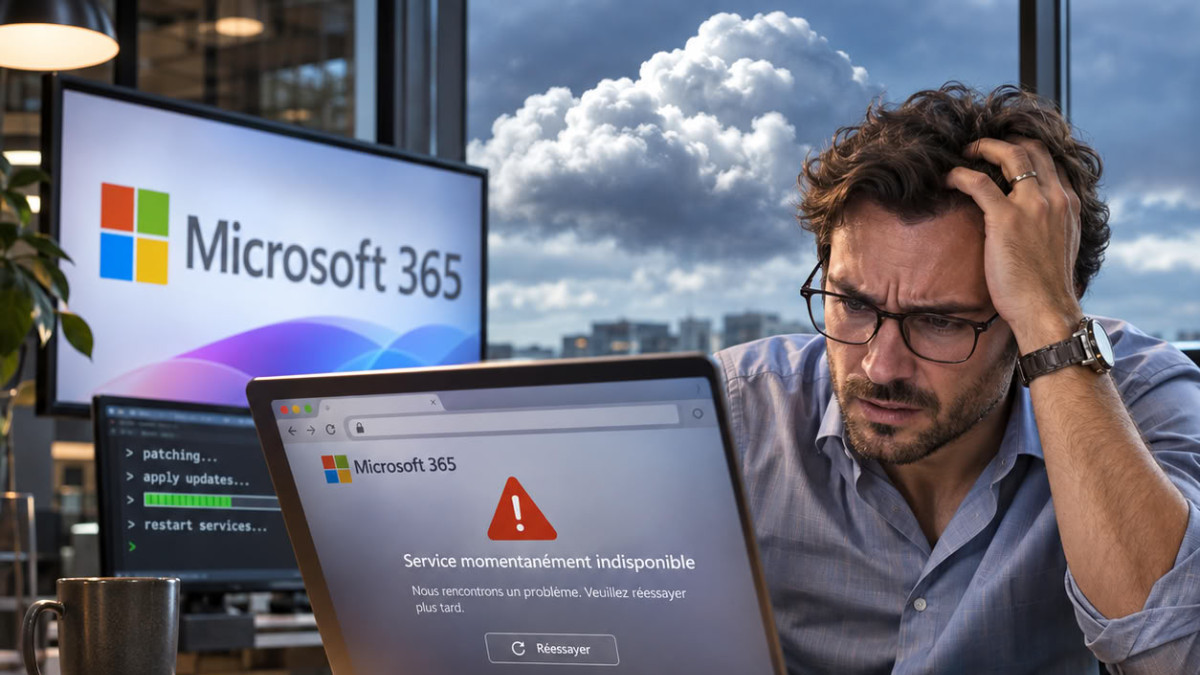

A series of major outages hit the United States, disrupting email, air traffic, banking services, and government operations. Authorities say they have no evidence of a cyberattack or a link between these incidents.
Among the reported episodes are a near-day-long Microsoft 365 outage, a nationwide air traffic halt ordered by the FAA (Federal Aviation Administration), a technical issue at JPMorgan Chase that slowed transactions for other banks, and an outage affecting the NSA’s classified internal network. United Airlines and Apple also experienced disruptions.
Official explanations differ. Microsoft attributes its outage to a months-old software bug, the FAA to a recently installed router, and the NSA to routine maintenance. However, National Intelligence Director Jay Clayton linked the NSA outage to patching a vulnerability in the PHP language, discovered with the help of artificial intelligence. Senator Mark Warner, for his part, suggested that AI-driven vulnerability detection is pushing organizations to patch many systems at once, straining infrastructures not designed for such a pace of change.
A patch can also cause an outage
Industry professionals have seized on the topic. Gil Tene, CTO and co-founder of Azul, says he has ‘strong reasons to believe that the accelerated pace of patching is already causing major operational incidents.’ He explains that the urgent deployment of OpenJDK updates, which are not limited to security, has already caused stability incidents for his clients. According to him, ‘the risk does not come from the vulnerabilities themselves, but from the volume of changes imposed by compressed deadlines.’
Ken Barth, CEO of Catalogic Software, notes that Microsoft patched over 1,400 vulnerabilities in its October security update, a monthly record, and 1,094 in November. For him, each patch remains a modification to a live system, and a higher volume leaves less time to test it. He adds that waiting is not a safer solution, as Google reported that attackers are using AI to analyze patches and quickly derive exploits from them. He advocates for a verified restore point and a tested rollback plan before any deployment.
Samuel Hassine, CEO and co-founder of Filigran, believes these outages look more like a change management problem than an AI problem. He asks a question: ‘who is accountable for the choice between leaving a vulnerability open for a few more days and risking service by closing it tonight?’
Backup systems that are not independent
Benny Czarny, CEO and founder of OPSWAT, points out that several recent failures stem from systems cloned with their weaknesses. When a primary system and its backup use the same software, receive the same update, and depend on the same network, ‘they are not truly independent.’ He cites the example of an aircraft cockpit, where primary and secondary systems use different hardware and software.
Patrick Harr, CEO of DataVisor, insists on testing the entire customer journey after a patch. He gives the example of a bank whose login patch might close a vulnerability while preventing its customers from authenticating in the mobile app. He recommends deploying patches in stages.
