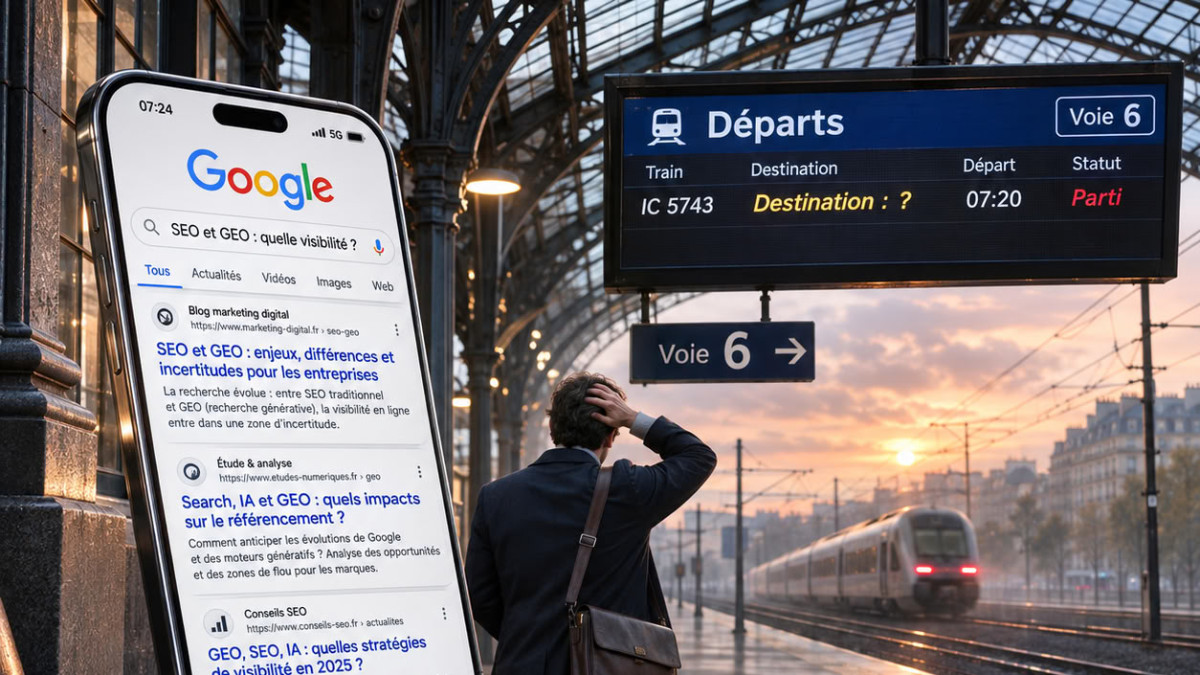

At the NDD Camp in Rennes on Friday, November 20, Victor Lerat, representing Abondance, painted a deliberately bleak picture of the year 2026 for SEO professionals. Google updates, the rise of AI Overviews, and the growth of GEO are disrupting the practices of agencies, freelancers, and brands.
A Year of Google Updates
For Victor Lerat, 2025 was a rather quiet year, while 2026 will remain the year of major changes. The first half of the year was marked by a succession of updates: Discover in February, a spam update then a core update in March, a new core update in May, and a spam update in June. For many sites, rankings shifted several times within a few months.
Summer brought the most visible change. AI Overviews, the AI-generated answer blocks displayed above classic search results, arrived in France on July 22. On sites monitored with Monitorank, they initially appeared for 30 to 50% of queries, and in certain verticals, they are displayed for 100% of them.
The back-to-school period then changed search results pages in Europe. To comply with the DMA, Google changed its display on September 8: for certain searches (hotels, flights, products), comparators like Booking or Expedia are highlighted. Google itself speaks of “the biggest degradation of its search engine in 29 years.” Two spam updates, in August and September, as well as a core update in November, still ongoing at the time of writing, complete this picture.
Many sites have lost a significant portion of their traffic, especially on informational queries, which the AI answers directly on the search results page. For many companies, the question becomes strategic: what role should a website play if its visits are declining?
GEO, a Discipline in Its Own Right
GEO (Generative Engine Optimization) became a discipline in its own right in 2026. Ranking well on Google is no longer enough: a brand must also appear in ChatGPT’s responses and those of other AI assistants. New specialized players have raised significant funds, and traditional SEO tools have integrated AI monitoring.
GEO poses an unprecedented question. A brand can be recommended by an AI without the user ever visiting its site. It then exists in responses it doesn’t always see and doesn’t control, representing a real cultural shift for teams accustomed to managing their visibility click by click.
Agencies and Marketing Teams Facing AI
The third change affects marketing professionals, whether in agencies, freelancing, or in-house. It’s necessary to train the entire team, rethink the organization, and create or adapt tools (MCP, API…) to increase productivity. When AI reduces the time needed for a deliverable, billing by the hour makes less and less sense, according to Victor Lerat. Some clients now handle part of what they used to entrust to their agency themselves.
This burden is accompanied by fatigue. Shirley Almosni Chiche, a tech recruiter, describes it in an article published on Prompt humain as the result of a cumulative effect: contradictory demands (go faster without losing quality), ethical tension, and organizational ambiguity. Victor Lerat highlights two risks: exchanges between colleagues are becoming rarer, and the tasks that served to learn the trade, like a first audit or keyword research, are the ones AI most easily takes over.
To measure GEO, one must accept managing with a set of indicators. Logs show which pages are read by assistant bots, like ChatGPT-User, and prompt tracking indicates when a brand is mentioned and against which competitors. OpenAI’s Business Hub is, according to him, a first step towards a real Search Console for ChatGPT, but it remains limited. GEO also involves monitoring platforms that AIs read, like Reddit, YouTube, or Wikipedia, and breaking down silos between teams. As Gwenneg Marié from Hellowork summarizes:
“You have to see each platform as an asset to develop.”
