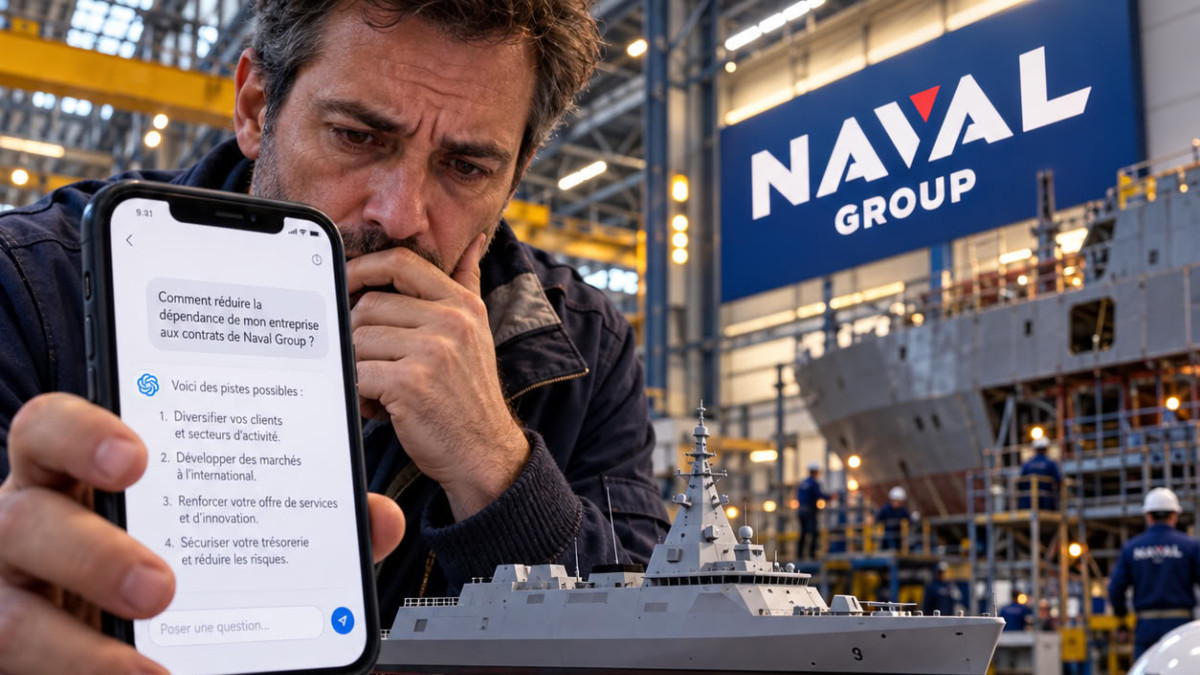

For an SME subcontractor, the main risk would not be a lack of reputation, but its dependence on a major client or a single sector of activity. In a column dedicated to GEO, the optimization of a company’s visibility in artificial intelligence responses, the author draws on the example of an SME from Lorient and a mini-audit conducted with three assistants.
On October 30, Naval Group is due to deliver the Nearchos to the Greek navy, the second of four FDI frigates ordered by Athens. In Lorient, the shipyard’s activity is particularly high, with French, Greek, Swedish, and possibly Danish programs. Naval Group mobilizes over 1,000 subcontractors (2024 data), from large engineering groups to specialized SMEs.
A company whose skills exceed its reputation
The author takes the example of Ateliers Mécaniques Lorientais (AML). Founded in 1994, this SME of around twenty people initially developed around the naval mechanics of the Lorient fishing port. In 2006, it opened an Industry department. It now states that half of its activity is in shipbuilding and repair, and the other half in industry, notably energy production, boiler-making, and piping.
Its website presents a range of services: maintenance and repair of industrial equipment, refurbishment of engines and machines, boiler-making, piping for various fluids, mechanical work, and alignment.
AIs that know the company without always citing it
To verify this image, the author questioned ChatGPT, Gemini, and Perplexity. When asked about Breton companies that could handle industrial piping for energy installations, the three tools cited various providers, without ever mentioning AML. When the request was about high-qualification naval piping, all three spontaneously cited the company. When asked about Naval Group’s industrial partners in Lorient, only ChatGPT cited it among the mechanical and piping companies in the Lorient area.
When asked directly to describe AML, the three models listed its skills in mechanics, boiler-making, and industrial piping. ChatGPT and Perplexity noted its development towards industry, and Perplexity repeated the activity breakdown announced by the company. The author specifies that this test is not an in-depth audit, but it highlights a discrepancy: an SME is well understood when named, yet can remain absent from responses when a buyer searches for a skill without mentioning its original sector.
Distinguishing commercial dependence and reputational dependence
According to the author, one must distinguish commercial dependence, which relates to strategy and risk management, from reputational dependence, when a company is only known through a client, a supply chain, or a historical sector. The two can reinforce each other, even if one does not necessarily imply the other. The client remains proof of competence, but it “cannot be its only definition.”
The column proposes four notions for building an autonomous reputation: clarity of skills and references, consistency of discourse from one market to another, corroboration by independent sources, and continuity over time. The author emphasizes that a company cannot wait for a client to need it to become known, and that reputational preparation consists of “not having to start from scratch” the day new opportunities become necessary.