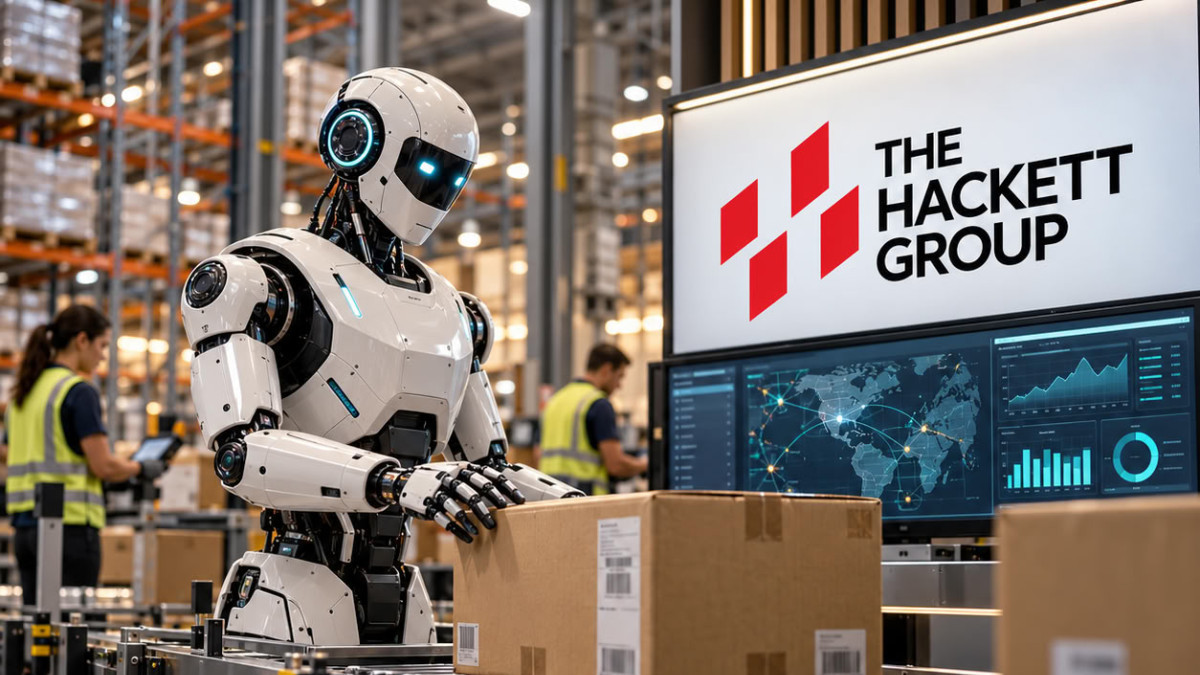

Artificial intelligence could improve supply chain performance, provided that processes are rethought rather than merely automating existing tasks, according to a modeling by The Hackett Group. Presented on 12 October 2026 in its study “AI World Class Supply Chain”, this transformation could reduce costs, inventories and logistics lead times.
- AI can improve supply chain performance only if processes are redesigned, not just automated.
- The model projects 59% fewer urgent orders, 52% fewer forecast errors, and up to 41% lower inventory carrying costs.
- Adding separate tools does not sustainably transform overall performance.
- These figures are estimates of potential gains, not measured results.
AI in the supply chain is entering a new phase. After the first projects focused on task automation or forecast improvement, the challenge now lies in end‑to‑end operational transformation. The study highlights a potential performance gap between organisations that reorganise their processes around AI and those that merely add tools to their existing operations.
Gains at every stage
The firm’s projections illustrate the scale of possible improvements. By redesigning their planning and delivery processes around AI, the most advanced organisations could cut forecast errors by 52% and urgent orders by 59%. Inventory carrying costs would fall by up to 41%, while the time between order preparation and shipment could be shortened by 38%.
More reliable forecasts would allow better adjustment of stock levels and their distribution across the network. Warehouses would then face fewer constraints, facilitating order picking and limiting expedited shipments used to compensate for delays.
The model also estimates that the costs of the “Plan‑to‑Deliver” process, which spans planning through delivery, could drop by 12 to 17%, and resource needs could shrink by 15 to 24%. The challenge is to free teams from data‑reconciliation, exception‑monitoring and urgency‑management tasks, redirecting them toward higher‑value activities. These figures describe a target performance scenario, whose achievement depends on existing processes, digital maturity level and the scale of transformations undertaken.
A redesign of operations
For The Hackett Group, the accumulation of specialised solutions is not enough to sustainably transform performance. Dedicated tools can improve forecast accuracy or facilitate a one‑off decision, without significantly altering the overall performance of the chain.
The study illustrates this evolution with the case of a global energy‑technology manufacturer operating more than 100 plants and working with 20,000 suppliers. The company has deployed AI agents, programs capable of chaining actions semi‑autonomously, on inbound delivery and order‑confirmation processes. According to the document, the systems would process roughly two million delivery lines and three million purchase‑order lines each year, and each of these two processes would have achieved its return on investment in four months or less.
A transformation to measure
To harness this potential, the group recommends first establishing a performance baseline, then prioritising use cases based on expected benefits, cost and complexity. The redesign of processes and the operating model must then precede large‑scale deployment. Results should be tracked using concrete metrics such as financial capital tied up in inventory, delivery reliability, logistics costs and processing times, in order to link investments to measurable gains rather than merely the number of tools deployed.
The study is based on a comparative modelling that pits median levels observed among peers against target scenarios dubbed “AI World Class”. The Hackett Group states it draws on 30 years of benchmark data, process analysis and transformation experience. These are therefore estimates of potential gains, not a survey measuring results actually achieved by a representative sample of companies. The firm does not disclose the sample size used for each metric.
