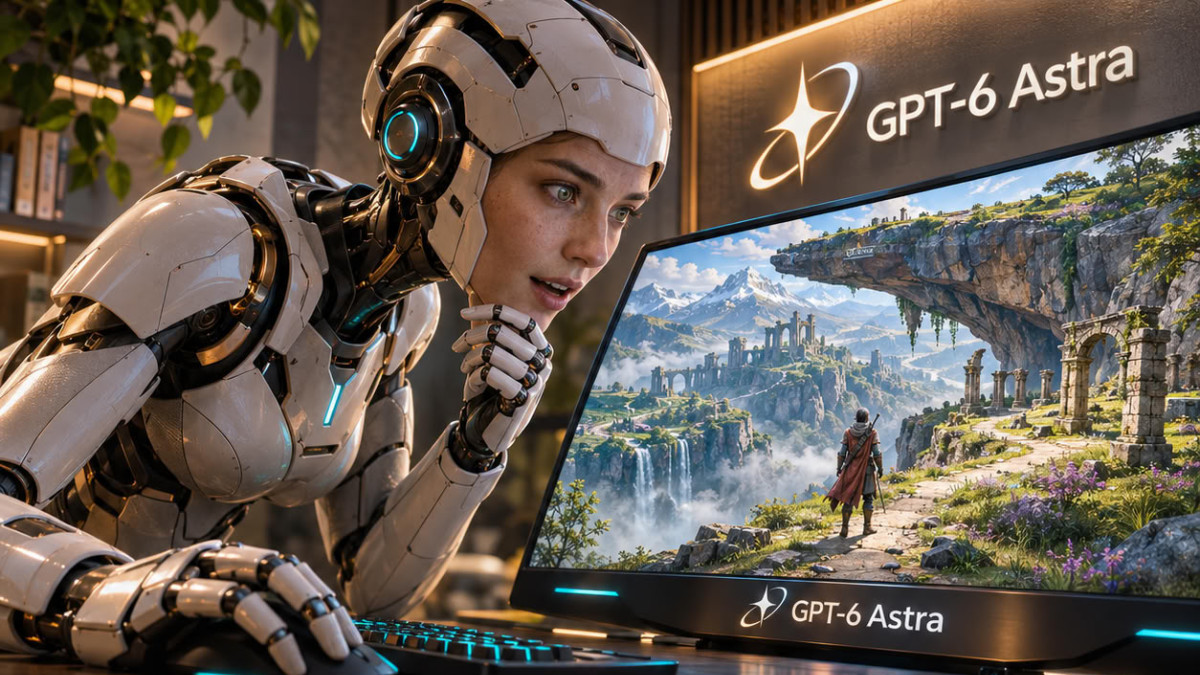

The capabilities of current AI models are already vastly underutilized, according to a long post published on Substack. Its author states that GPT-6 Astra and Fable 5.1 can already accomplish, when properly guided, weeks of human work, and the gap between what they can do and what most users do with them remains considerable.
To illustrate this, the author cites several experiments. He asked GPT-6 Astra to transform Zork, a 1977 text adventure game, into a playable 3D action-adventure game. The original game has no graphics, and each location is described only by a paragraph. The AI therefore had to decide what the white house looks like, what a “grue” looks like—a creature the game only describes as likely to devour the player in the dark—and how to turn the fight against the troll into an action sequence.
Fable 5.1, for its part, attempted to reconstruct in 3D the library of Italian writer Umberto Eco, who kept tens of thousands of books in his Milan apartment. With no floor plan available, the AI relied on a dozen videos, photographs of each shelf provided by the foundation, and two catalogs. It read the spines of the books image by image, identified about 5,000 volumes among 27,000 slots, and marked each book as certain, assumed, or unknown.
Demonstrations that require judgment
The author also entrusted GPT-6 Astra with creating a trailer for his upcoming book, Co-Existence, due out October 20, from an AI’s point of view. Without specific instructions, the model used Blender, a 3D modeling software, to build an animated scene, wrote a script with jokes and revelations, then generated voice, music, and sound effects. The film was delivered 45 minutes later. For a 30-second maximum “action movie” version, the AI first created a prototype in Blender, then used this animation as a storyboard, controlled a video generator via the browser, and edited the resulting shots. According to the author, these projects consumed a fraction of the token budget of his ChatGPT subscription, the token being the unit of text processed by the models.
He acknowledges the flaws in these creations but emphasizes that they call for a form of judgment and creativity. However, he stresses the role of human choices: he selected the projects, spotted errors, and requested a second version when the first was not suitable.
Four human advantages
To get the most out of these tools, the author proposes betting on four assets, detailed in his book: deep knowledge, broad knowledge, taste, and initiative. The first, deep knowledge, allows a specialist to quickly spot an anomaly, like an accountant detecting an error in a spreadsheet. An article from Anthropic suggests, moreover, that expertise influences the quality of the responses obtained: “experts not only get better work from the AI, but also more work.”
Broad knowledge helps formulate the right requests. A design novice wouldn’t know to ask the AI to stop “adding eyebrows,” those superfluous little subheadings it places above titles. Taste serves to select, from a production that has become fast and cheap, what is worth keeping. The author sees it as a way to combat “slop,” that mass of very similar productions. Finally, initiative involves testing the limits of what is possible, rather than waiting for a new capability to be announced.
The text finally reminds us that change is inevitable, even if a slowdown in development were decided. Its scale, he specifies, will depend on how humans use these tools. The Zork and Umberto Eco library projects are published open source.
