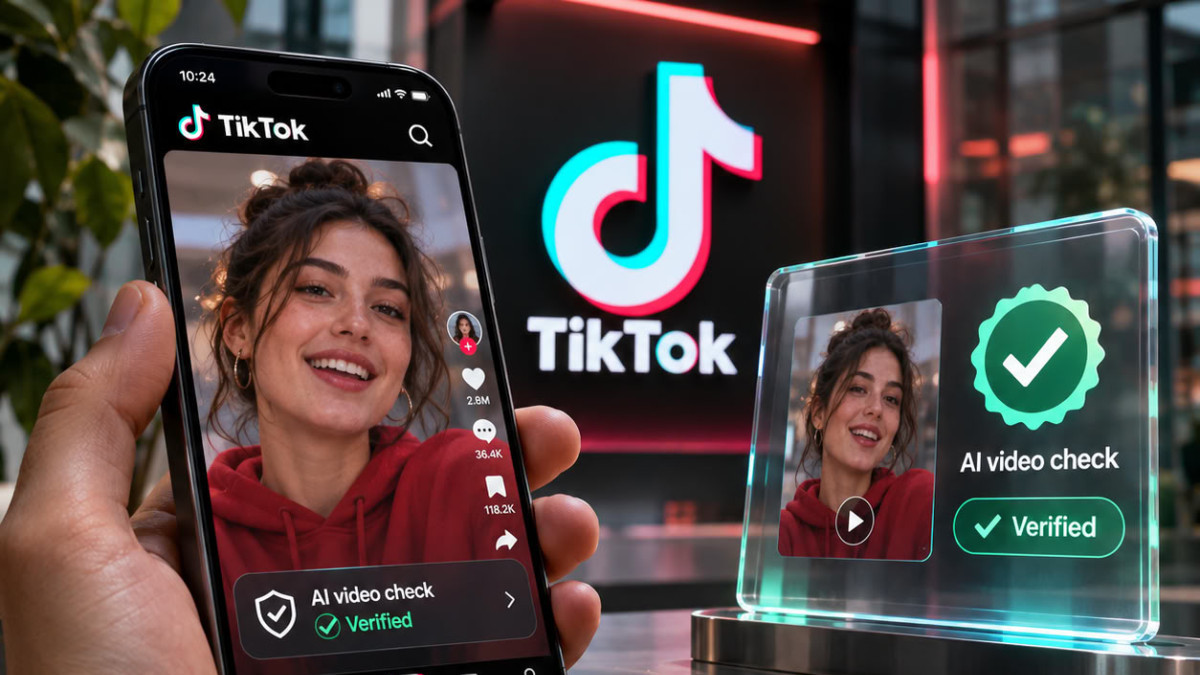

TikTok is opening up a content verification tool for AI-generated content to everyone, which allows users to know if an image, video, or audio file was generated or edited using its own tools or those of other ByteDance applications. The group is also rolling out Likeness Detection worldwide, which alerts creators when their face appears in a deepfake. The platform claims to have already labeled over 5 billion AI-generated videos.
On TikTok, AI-generated videos number in the billions, and the label that identifies them often disappears when a video is downloaded and then reposted elsewhere. To address this, the company is introducing two new tools. The first is accessible to anyone, without a TikTok account: simply upload a file to a dedicated website. The second, Likeness Detection, is aimed at creators whose faces could be used in a deepfake, meaning an AI-manipulated video that makes a real person say or do anything.
A Verifier Open to All
Since 2024, TikTok has been automatically adding Content Credentials to content created with its tools. This standard, championed by the C2PA coalition, records in the file’s metadata how it was made, allowing other platforms to label it in turn. But this information disappears when a video is downloaded, edited, and then reshared. The new tool therefore also searches for VeraDura, an invisible watermark developed by TikTok, hidden in the image and harder to remove. The site is available now. It accepts images, videos, and audio files, with a limit of 20 MB per image and 100 MB per video or audio file. TikTok assures that uploaded files are not stored anywhere.
TikTok claims to have labeled over 5 billion AI-generated videos. On July 10, the company claimed 3 billion, meaning approximately 2 billion more videos in four months. These labels come from creators who self-declare their use of AI, from Content Credentials, and from the in-house watermark.
However, the company acknowledges a significant limitation. The verifier only detects signals added by TikTok and by other ByteDance AI tools, such as CapCut or Dreamina. A video produced with another generator, then published on TikTok or elsewhere, escapes this detection. A negative result therefore does not prove a video is authentic, and the tool cannot, for example, identify a fake viral video made with OpenAI’s Sora or Google’s Veo.
Likeness Detection, an Alert for Creators
The Likeness Detection feature only activates if the creator opts in. They must first verify their identity with an external provider, then TikTok alerts them when videos or accounts appear to be using their face. The creator can review this content in the tool and report it to moderation teams, who remove content that violates the platform’s rules. TikTok assures that identity documents are not retained.
The tool had been in testing since July with a small group of U.S. creators, who used the verification company Jumio. The global rollout is now beginning, but only for “eligible creators” and public figures, including accounts of governments, political officials, and parties. TikTok has not published the list of eligibility criteria.
YouTube has taken a lead in this area. Its tool, launched in late 2025 for monetized creators, has been open to all adult creators since May 2026.
