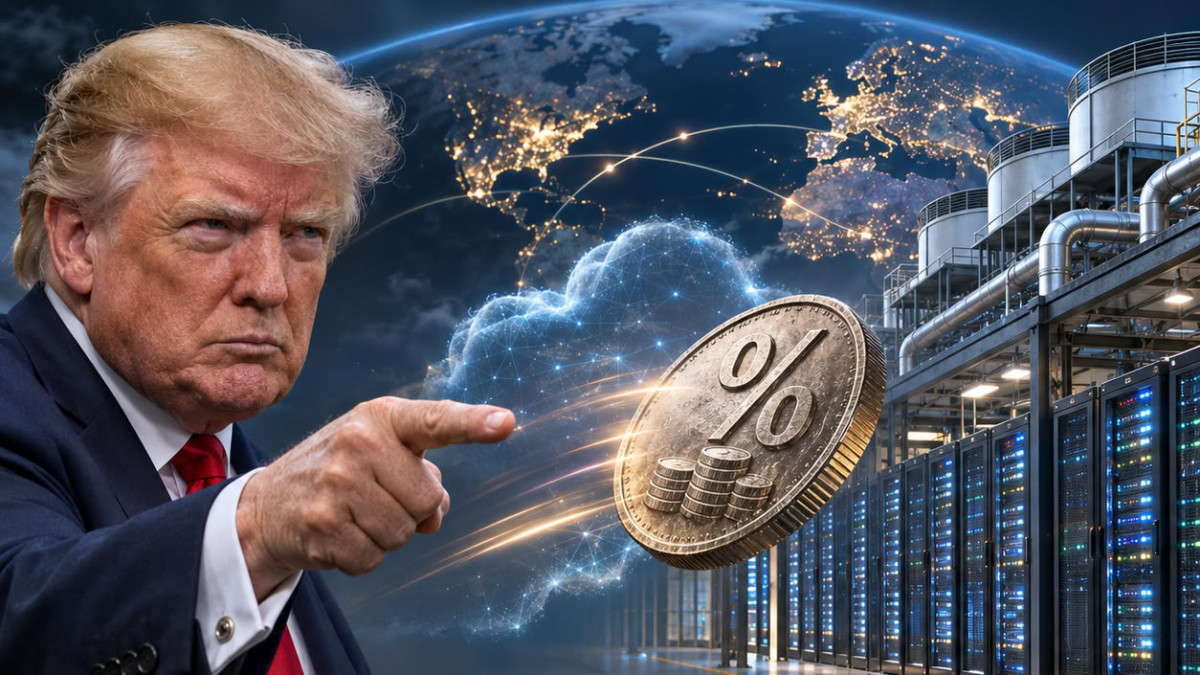

Donald Trump announced on Friday, November 20, 2026, his intention to fiscally penalize US companies that build computing infrastructure outside the United States. The president mentioned a particularly high tax, without specifying its amount, terms, or implementation timeline.
This statement comes as investment in infrastructure needed for artificial intelligence accelerates. US cloud giants are multiplying datacenter projects, these data centers that host servers and computing capacity, to meet growing demand for computing power. They are also seeking to bring these capabilities closer to their international customers.
With this threat, the Trump administration aims to encourage the location of these investments on US soil. The president considers computing infrastructure as strategic assets in the technological competition with China, on par with semiconductors.
US investments in Europe in the crosshairs
These remarks could directly concern the main US hyperscalers, namely Amazon Web Services, Microsoft and Google Cloud, which are developing significant computing capacity in Europe and Asia. During his remarks, Donald Trump mentioned the case of a company wishing to build datacenters in Finland, without naming it. Google announced, in September 2026, an investment program of 13 billion euros across four Finnish sites.
For cloud providers, deploying regional infrastructure meets several imperatives. It reduces the latency of digital services, satisfies certain data localization requirements, and offers processing capabilities close to customers. These issues are particularly important in Europe, where businesses and administrations are paying increasing attention to digital sovereignty, data protection, and control of their critical infrastructure.
An announcement without a defined tax mechanism
At this stage, the legal scope of the presidential statement remains uncertain. Donald Trump specified neither the envisaged rate, nor the tax base, nor the companies that could be affected. No regulatory text detailing this mechanism was presented following the press conference.
For now, it is a political intention, not an adopted tax measure. Its implementation could raise complex questions, particularly regarding the US administration’s ability to tax investments made abroad by companies headquartered in the United States. The chosen terms would also determine the real impact on technology groups: a tax on new investments would not have the same effects as a mechanism targeting assets already in operation or the revenue derived from them. Lacking specifics, operators cannot, at this stage, quantify the financial consequences of such a policy.
For now, Donald Trump’s statements do not directly change the rules applicable to datacenter operators. They nevertheless introduce a new factor of uncertainty into hyperscalers’ investment strategies, as global demand for computing capacity continues to increase.
