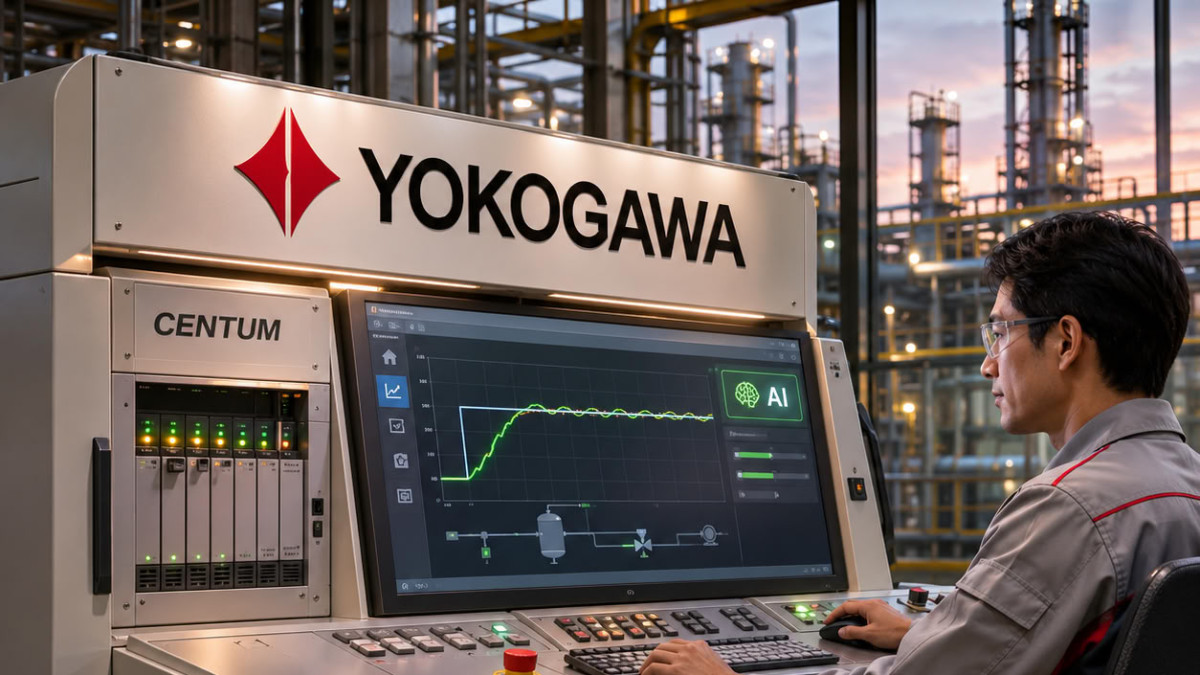

Yokogawa integrates an artificial intelligence control function, named AI Control, into version R7.02 of its CENTUM system, released on November 19, 2026. This technique, based on reinforcement learning (an algorithm that learns through trial and error), has been controlling a distillation column in a Japanese chemical plant since 2022.
Yokogawa has deployed over 30,000 CENTUM systems in more than 100 countries since 1975. This digital control system (DCS) is now paired with a standard AI function, which the manufacturer announced on November 17.
An AI control block joins the classic regulators
The function is installed in the field control station (FCS), the device that executes control loops. Its model is produced by FKDPP, an algorithm developed by Yokogawa and the Nara Institute of Science and Technology (NAIST), then imported into the FCS, where an “AI control block” calculates the commands. The operator monitors it from their usual station, like a PID control, the classic mechanism that maintains a variable at its target value.
Yokogawa targets operations that neither PID nor advanced process control (APC) can automate, and which experienced operators still adjust manually when they need to arbitrate between quality, production volume, and energy consumption. The press release describes this AI as autonomous, capable to a certain extent of handling situations it has not encountered.
The second function, AI Estimation, acts as a soft sensor. A model trained on the site’s history estimates a concentration or product quality in real time from temperatures, pressures, and flow rates, where the plant would otherwise rely on laboratory analyses or periodic measurements. It runs on a separate station, and its display indicates the weight of each variable in the result.
In the method described in November, the AI trains through repeated cycles on a simulator that replicates the process behavior. The customer then evaluates the reliability and validity of the resulting model before applying it to plant operation, with safety functions. Previous projects distributed this work differently.
The technique has been controlling a Japanese column since 2022
The first trial lasted 35 days, from January 17 to February 21, 2022, at the Yokkaichi plant, in the elastomers business of JSR, which became ENEOS Materials on the following April 1. The AI manipulated two valves on a butadiene distillation column, a raw material for synthetic rubber, to maintain the liquid level while making optimal use of waste heat. On March 30, 2023, the two companies announced the official adoption of the algorithm on this column, with 40% less steam required to maintain the level compared to manual operation.
The unit retained its safety interlocks and instrumentation, and a procedure was in place in case of AI failure, according to the March 2022 press release. The production team summarizes it in Yokogawa’s case study: “we can simply stop the AI and return to normal operation.” During these 35 days, a team member received several calls from operators asking if they could shut off the AI. It was manipulating the valves in a way they would not have thought of, and they ended up letting it run.
Yokogawa commercialized the algorithm on February 27, 2023 as a service for its e-RT3 Plus controllers. On October 29, 2025, the group announced the deployment, in three phases, of several coordinated FKDPP agents on the acid gas removal unit of the Fadhili plant, operated by Aramco in Saudi Arabia. The initial results, 10 to 15% less amine and steam and about 5% electricity saved, were then undergoing detailed evaluation. With R7.02, the algorithm enters the group’s core system. Mitsuhiro Yamamoto, who heads Yokogawa’s systems division, sees it as “the first step” towards CENTUM Future, the program announced in 2025 to move plant operation from automation to autonomy.
The European regulation leaves chemicals out of Annex III
In Europe, Annex III of the AI regulation classifies as high-risk safety components used in the supply of water, gas, heating, or electricity, sectors that Yokogawa counts among its markets. Chemicals and refining are not listed there. Since the digital omnibus adopted on July 8, 2026, Article 6 specifies that a system used solely to optimize performance, automate, or control quality is not a safety component, unless its failure endangers health and safety. Therefore, the classification of a block that controls valves will depend on the risk analysis of each facility.
The high-risk requirements will apply from December 2, 2027 for Annex III, and from August 2, 2028 for regulated products in Annex I, according to Article 113 amended by Regulation (EU) 2026/1744.
