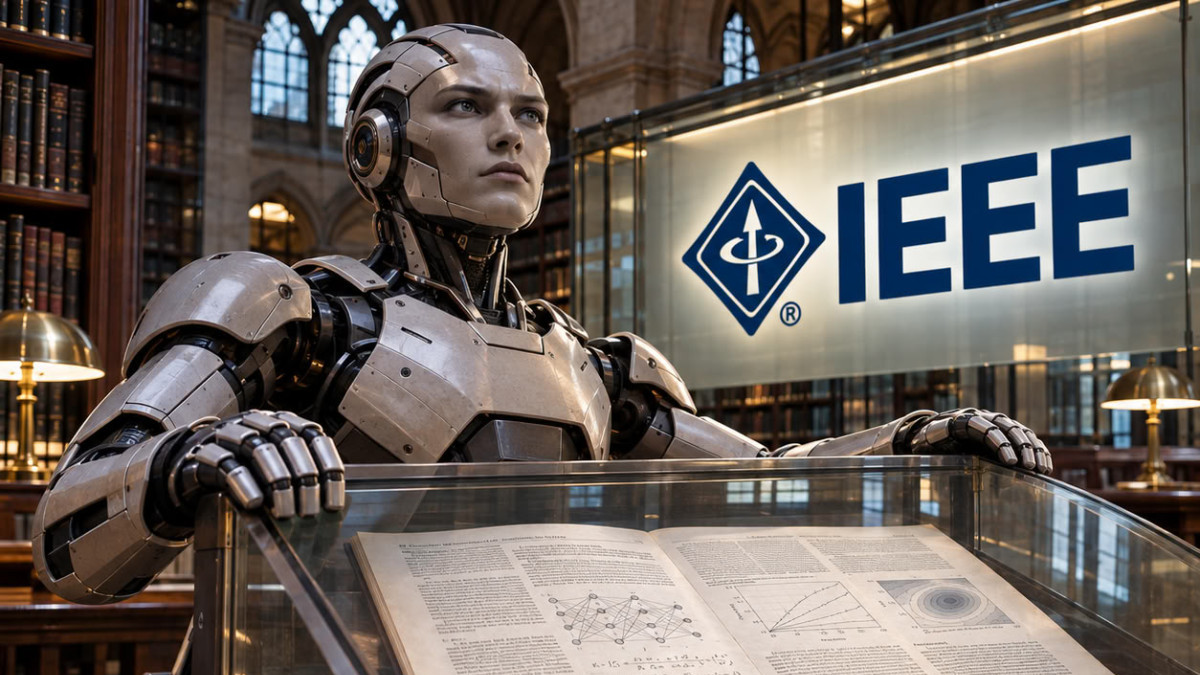

Can scientific articles entirely generated by AI pass journal filters? Journalist and doctor of applied mathematics Benjamin Skuse attempted the experiment with publisher IEEE. According to the account published by IEEE Spectrum, the publisher’s checks are holding for now, but the race between artificial content and detection tools remains tight.
Benjamin Skuse’s report, titled ‘I Used AI to Fake a Scientific Paper,’ describes the ease with which a roughly plausible and roughly scientific text can be produced. According to Eliza Strickland, editor of features and AI at IEEE Spectrum, he was surprised by the simplicity of the process. ‘He just pressed ‘run experiment’ and ‘write paper.’ And then, he didn’t do a single thing. He just threw it into the maw of the publication system,’ she recounts.
According to Benjamin Skuse, the combination of human proofreading and IEEE’s research integrity verification programs allows, for the moment, to keep pace with these attempts, which amount to a game of cat and mouse against free tools. However, the more advanced large language models no longer make the glaring errors of their free versions. Publishers are thus engaged in a race between increasingly credible content and the systems tasked with spotting it. To recall, a large language model, or LLM, is a program trained on vast volumes of text to produce language.
Wikipedia on the front line
Scientific publishers are not the only ones resisting. Wikipedia faces the same problem. As part of her ‘Five Questions’ column, Eliza Strickland interviewed Ellia Lebleu, founding member of WikiProject AI Cleanup, a volunteer initiative aimed at detecting and removing AI-generated content on the platform. Her team faces the same difficulty as commercial publishers, but with fewer people and fewer tools.
For Eliza Strickland, Wikipedia is recognized as a reservoir of information produced by humans, and the platform intends to remain so. ‘Who knows how long they’ll be able to do it?’ she wonders.
The question extends beyond these two players. If we can no longer collectively consider scientific literature reliable, or that basic facts about the world are accurate, the understanding of what is real becomes uncertain. This uncertainty weakens trust in the institutions responsible for maintaining the corpus of human knowledge.
Eliza Strickland also raises a more worrying prospect. ‘Isn’t it crazy that we have, at some point, AIs writing for other AIs? We’ll just be cut out of the loop.’
