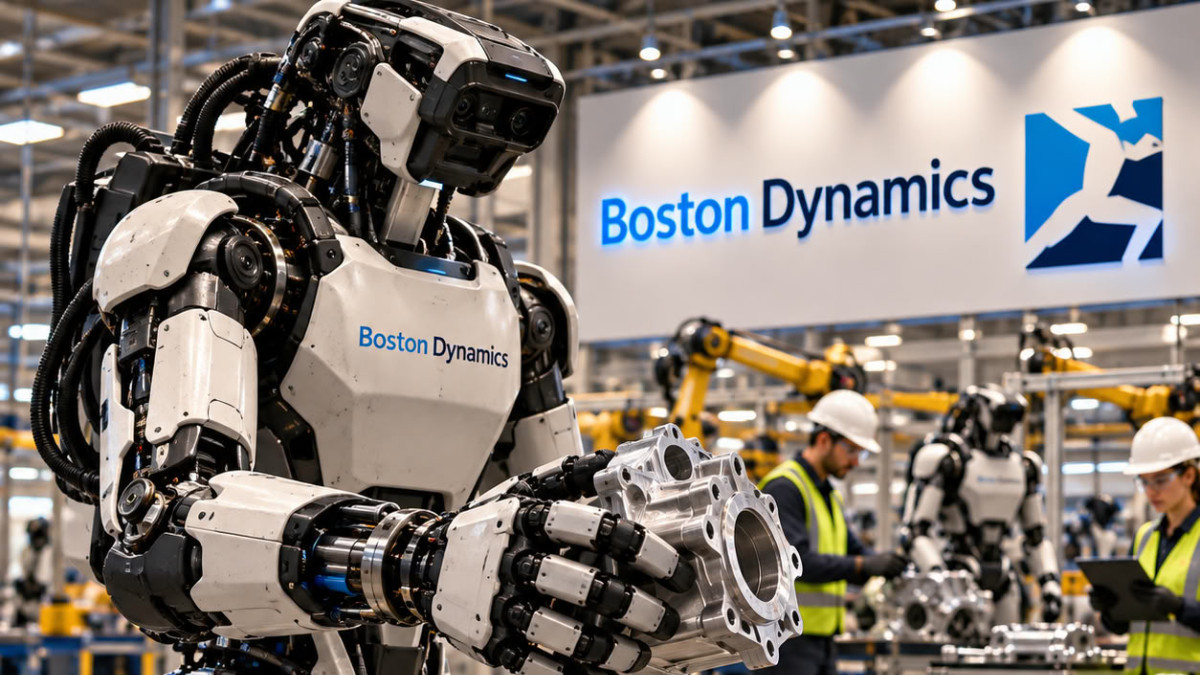

Boston Dynamics announces a completely redesigned hand for its Atlas humanoid robot. Designed for a product intended for series manufacturing, it prioritizes robustness, reliability, and cost over resemblance to a human hand.
The previous generation could perform feats one might call superhuman with its three fingers, but it was never designed for production in tens or hundreds of thousands of units. The transition from research hardware to a scalable product brought up questions that were previously secondary: how to design a hand capable of doing everything, while being sturdy, reliable, and inexpensive? It was from these questions that the new hand was drawn.
Accepted compromises
Compared to the almost disturbingly human-like hands developed by other humanoid companies, such as Clone Robotics, 1X, Unitree or Figure, Atlas’s hand appears more rudimentary. Alberto Rodriguez, Director of Robot Behavior at Boston Dynamics, summarizes the problem: “Hands are a ruthless design compromise. There’s no way around it, you always give up something.” According to him, many current models sacrifice reliability and manufacturability.
The company’s press release states that the new hand can accomplish a wide range of useful tasks, including tool use. It is presented as sturdy and robust, able to be properly simulated, manufactured in large quantities, and repaired at a cost deemed reliable and low. Its shape is also close enough to that of a human hand that human demonstrations can be used to train it.
To achieve this result, the team removed the little finger, a decision made after a day spent, according to Alberto Rodriguez, with the little fingers attached to the ring fingers. The redesign mainly focused on the number of degrees of freedom, i.e., independent movements, which increased from 7 to 13. The fingers can now splay, allowing one finger to move against another and hold the trigger handle of a tool, like a drill or a welding torch.
Motors integrated into the joints
With only 13 degrees of freedom, Boston Dynamics can use fewer actuators, which are larger and more powerful. These are integrated directly into the joints, in a direct-drive configuration, with a transmission that allows the motors to react to force and contact. Each actuator block forms a single, easily replaceable unit, and the absence of fragile tendons or cables at the joint level reduces the risk of breakage.
The company also relies on reinforcement learning, a method where a system improves through trial and reward. According to Alberto Rodriguez, “with reinforcement learning, we can discover uses for these additional superhuman movements and exploit them.” He adds: “What we’re working on now is figuring out what needs to change in the details of our design if we want to manufacture 100,000 of these hands per year.”
Boston Dynamics will not necessarily be followed by all humanoid manufacturers, and hand design still leaves a lot of room for creativity. But, as the source article points out, if humanoids equipped with hands are to scale up, difficult decisions will have to be made.