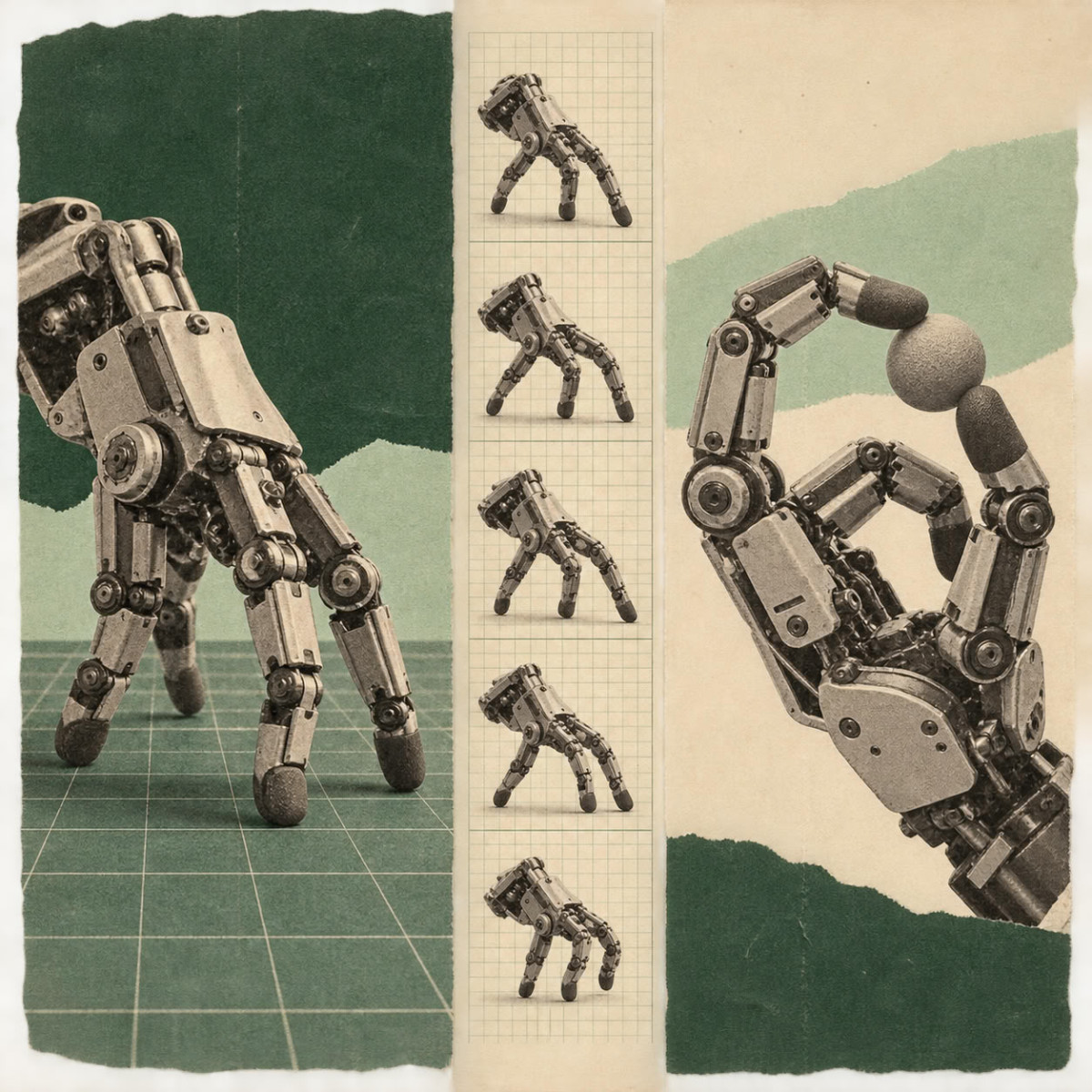

Researchers from ETH Zurich have turned a commercial robotic hand into an autonomous robot, capable of walking on the tips of its fingers while using those same fingers to manipulate its environment. According to the researchers, this approach could enable operating controls and handling objects in locations that a conventional robotic arm cannot reach.
Amirhossein Kazemipour, a PhD candidate at the Soft Robotics Lab of ETH Zurich and project lead, envisions uses in industrial maintenance, for delicate tasks, or in search-and-rescue operations. A robot could then detach its hand to explore spaces too narrow for the rest of its body. “I wanted to see what a robotic hand could do without the rest of the robot,” he told IEEE Spectrum. “Instead of this traditional view of robotic parts, what would happen if we could use them for other tasks they weren’t designed for?”
Other teams have already tried to make a robotic hand walk, but their work generally relied on specially designed hands. Here, the team selected commercial hardware supplied by Wuji Technology, to which they added an 80‑gram backpack containing a battery, an inertial measurement unit (IMU) and a Raspberry Pi Zero. According to Amirhossein Kazemipour, this choice aimed to sacrifice nothing in terms of manipulation capability, but it introduced a major challenge: a hand’s shape is optimized for grasping, not for crawling.
Learning to Walk with the Fingers
To teach the hand to walk, the researchers trained a model in simulation using reinforcement learning, a method where the model acquires skills through trial and error, receiving rewards when it approaches the desired behavior and penalties when it deviates. The methods used for other legged robots could not be reused as‑is, because a hand is not symmetric, with fingers of different lengths and an opposable thumb.
To keep the hand in a walking posture, the team assigned each finger its own target position relative to the palm, corresponding to its natural pose. Fingers are penalized when they stray too far, which the researchers describe as “virtual springs.” Penalties for forward and backward movements are far lower than those for lateral movements, making this type of motion very inexpensive for the hand.
Three additional models were trained, to right itself after a fall, press keyboard keys, and push objects toward a target. They all fit within the onboard computer, and the controller can switch between them as needed.
Real‑World Results
In real‑world tests, the hand progressed across 14 different surfaces, including smooth floors, metal grates, grass and gravel. It can turn right as well as left, at an average speed of 9 cm per second, and it righted itself unaided in 21 out of 25 attempts. Using a video feed from a camera mounted above, it autonomously pushed a 41‑gram cube toward targets up to 40 cm away, doing so 15 times in a row.
Masahiko Inami, a professor at the University of Tokyo whose group has developed hand‑shaped walking robots, finds the work especially interesting: “The same fingers can move the hand, support its weight and interact with the environment.” He nevertheless believes that a concrete deployment would require onboard perception and more robust navigation. Hideki Shimobayashi, a PhD student in his lab, notes that walking stresses the hand very differently from grasping, which could raise durability concerns.
Matei Ciocarlie, an associate professor of mechanical engineering at Columbia University, calls the result “cool” and believes it shows that robotic hands need not be limited to the capabilities of their human counterparts. “We can imagine an entirely new class of mobile manipulators, both dexterous, able to traverse complex terrain and handle loads comparable to their own size,” he says.
Amirhossein Kazemipour places this work within a longer‑term vision of robots made of parts that are not tied to a single task or a fixed body plan, which he calls “autonomous modular incarnations.” “A robot’s body parts should not be permanently assigned to a single function. They can shift from one role to another, between being components of a system and autonomous agents, depending on the task.”
