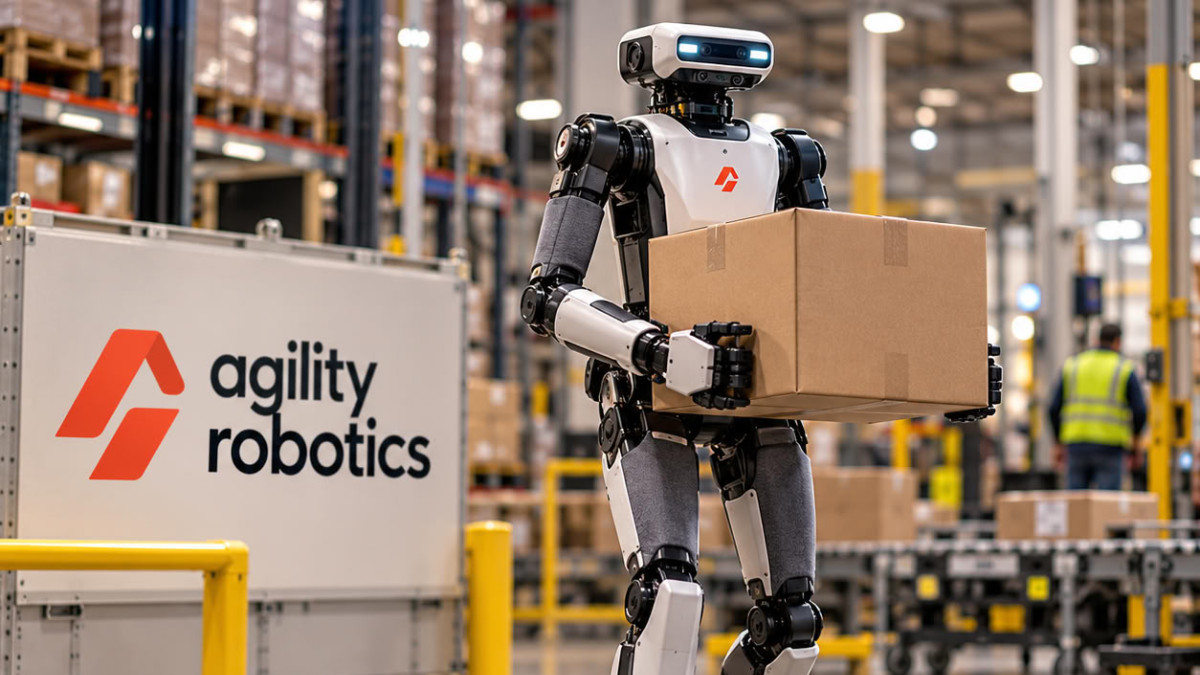

Agility Robotics has just launched Digit 5, a humanoid robot that the company presents as the first capable of performing useful work safely and economically on a large scale. In a personal account, Jonathan Hurst, co-founder of the company, retraces the journey that led to this product, which he considers far from the robot he originally envisioned.
- Agility Robotics lance Digit 5, un robot humanoïde conçu pour travailler en entrepôt.
- Le robot s’arrête, dépose sa charge et coupe ses moteurs dès qu’une personne approche.
- Son poids accru lui fait perdre la course et le saut, et ses jambes ressemblent désormais à celles de l’humain.
- Le concepteur regrette ce compromis, mais les besoins des clients le justifient, et les futures versions seront plus légères.
Digit 5 is designed to handle heavy loads in warehouses, station by station. It can lift 23-kilogram bins to high shelves, and its battery lasts 90 minutes after a 9-minute recharge. According to the author, the goal is to address the labor shortage for tasks that are too physically demanding or too repetitive for humans.
The main development concerns safety. When a person approaches, the robot is programmed to stop what it is doing, set down its load, sit on the floor, and cut power to its motors before the person can touch it. Sensors detect nearby people, and dedicated computers manage safety. Jonathan Hurst indicates that this challenge occupied the team for two years, as previous deployments required separating robots from humans with physical barriers.
A Heavier and Less Agile Robot
The robot weighs over 120 kilograms. It must comply with lifting limits recommended by the U.S. National Institute for Occupational Safety and Health, which requires powerful motors and a bulky battery. Charging is done on a station delivering 240 amps at 48 volts, and fans cool the battery, which occupies about 75% of the robot’s torso.
This mass has a direct consequence: Digit 5 can no longer run or jump like previous generations. The ostrich-like legs have been replaced by a configuration closer to the human leg, as the former caused problems during squatting. Jonathan Hurst acknowledges that this change may give the impression that the company abandoned its original style to follow competitors, which he disputes by explaining that this choice responds to functional constraints.
A Compromise Embraced
The designer does not hide his disappointment. “I can’t love Digit 5,” he writes, describing a robot “the largest, heaviest, and most expensive” the company has ever built. However, he admits that customer demands revealed what his vision did not take into account. “It’s the engineer’s curse,” he sums up.
Agility plans to expand the robot’s tasks, from item picking to machine feeding, then to assembly. According to Jonathan Hurst, Digit 5 is intended to serve both as a commercial product, an improvement platform, and a data source for training future behaviors, with subsequent versions expected to be “lighter” and “more graceful.”
