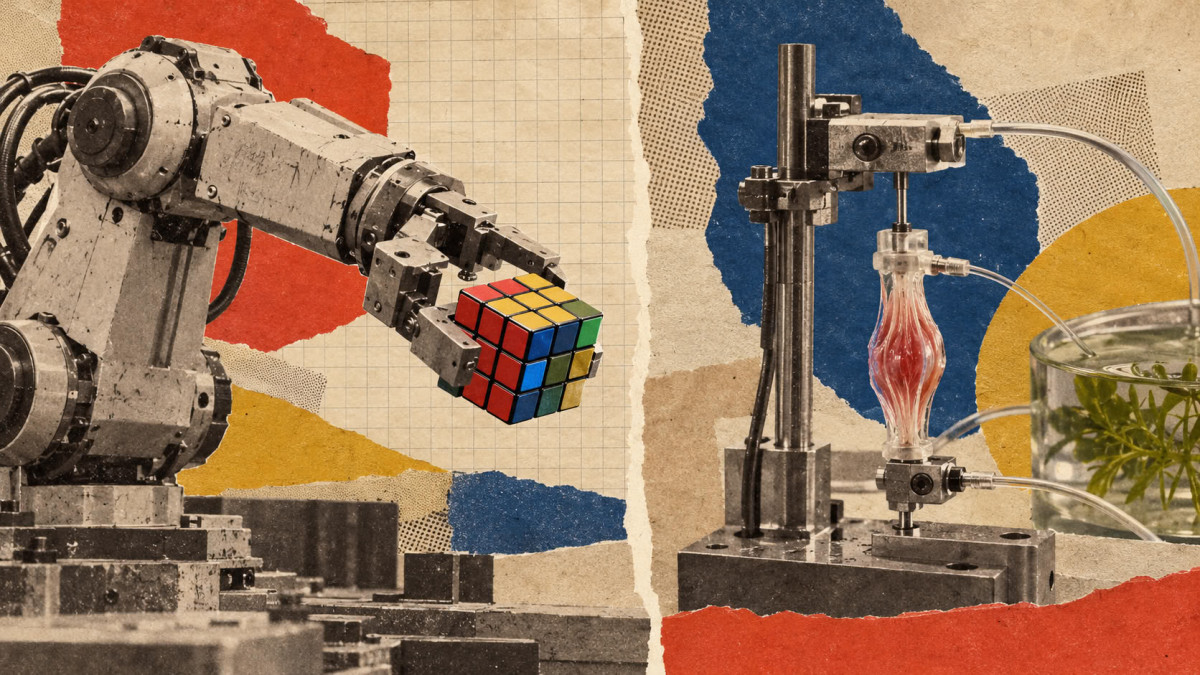

A quadruped robot that solves a giant Rubik’s Cube, a humanoid capable of moving loads of 35 kilograms, and artificial muscles that enable small robots to jump or swim. IEEE Spectrum’s weekly video selection showcases several advances in robotics, ranging from object manipulation and motion learning to combining living tissues with artificial materials.
- A quadruped robot solves a giant Rubik’s Cube using only its feet.
- The KAIST Humanoid v0.9 pushes objects up to 35 kilograms and lifts loads up to 20 kg.
- Biohybrid robots with lab-grown muscles reach up to 11 times more range of motion.
- SuperMimic surpasses a seven-day training run in three hours on a single GPU.
More responsive humanoids capable of handling heavy objects
At the Robotics Systems Lab of ETH Zurich, a quadruped robot autonomously solves a giant Rubik’s Cube using only its feet. The demonstration illustrates the manipulation possibilities offered by a platform initially designed for locomotion.
The Reflex project focuses on another challenge: the ability of humanoids to visually react to moving objects. Catching a falling cup, returning a tennis ball, or receiving a box requires anticipating a trajectory and mobilizing the body in about one second. The researchers propose a three-step learning process linked by a compact representation of object dynamics.
At the KAIST DRCD Lab, in collaboration with RAILAB, the KAIST Humanoid v0.9 robot demonstrates its simultaneous locomotion and manipulation capabilities. Using visual information gathered by its onboard sensors, it pushes objects weighing up to 35 kilograms and lifts loads up to 20 kg to arrange the letters “KAIST”.
Fast robotic hands and lab-grown muscles
The Robotics and AI Institute presents the hands of its AthenaZero robot. Each hand has three fingers actuated by tendons, with motors placed in the torso to reduce hand weight. This architecture allows grasping objects of different sizes, such as an egg or a hammer.
The fingers can close in about 80 milliseconds. High-precision barometric pressure sensors also enable adjusting the delicacy of the grip.
At ETH Zurich, the Soft Robotics Lab explores another approach with biohybrid robots, combining lab-grown skeletal muscles with a flexible 3D-printed structure. By jointly optimizing the muscles and their support, researchers report centimeter-scale bioactuators offering up to 11 times more range of motion than previous systems using a comparable volume of tissue. These devices can jump, swim, walk, and grasp objects.
Accelerated robotic training and new industrial projects
On the learning side, SuperMimic claims to surpass in three hours on a single GPU the results of a motion tracking system trained for seven days on 128 GPUs. The required GPU hours would be reduced by more than 1,000 times. Out of 129,514 benchmark movements, SuperMimic records 25 failures, compared to 179 for the reference system, then none after 9.8 hours of training on two GPUs.
On October 21, 2026, at CES Unveiled Milan, Generative Bionics announced its project to build the largest Physical AI Data Factory in Europe, with AMD as a partner for the artificial intelligence infrastructure.
Finally, NASA presents several lunar vehicles and robotic rovers intended for the early development phases of its Moon Base. They are to contribute to exploring the lunar South Pole, scientific research, and technological tests preparing future missions.
