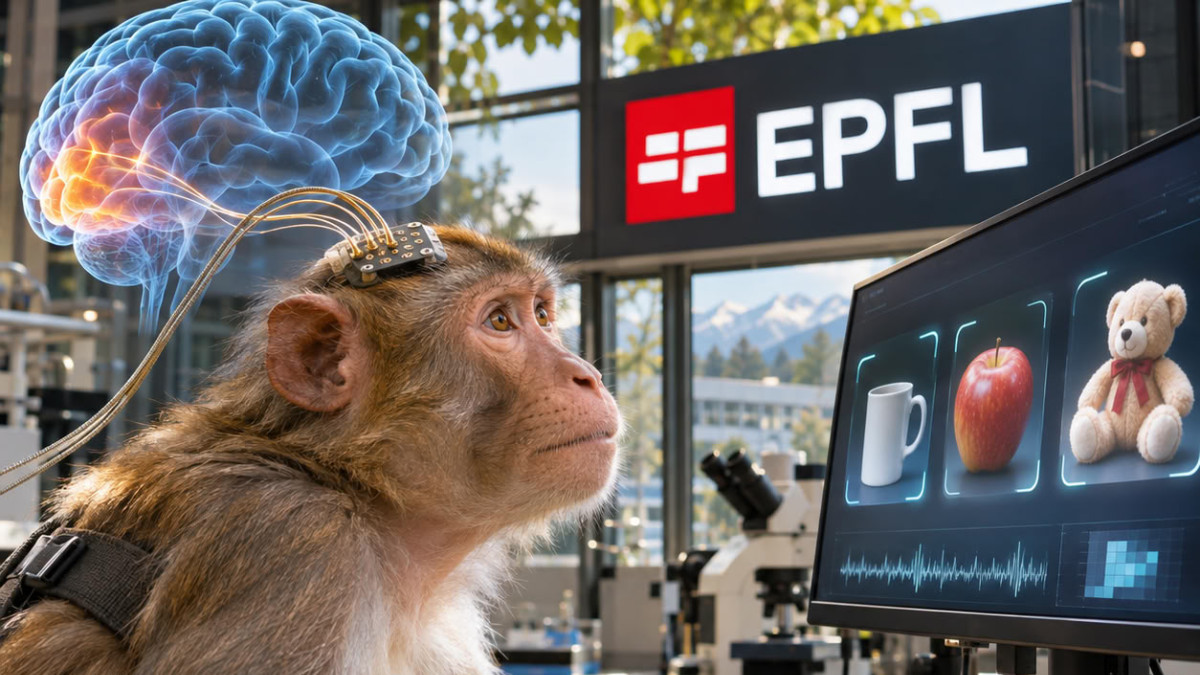

Researchers at the NeuroAI Lab of EPFL have developed artificial intelligence models capable of predicting where to stimulate the brain to evoke images of specific faces or objects, rather than simple points of light. These models were used by Dutch researchers in live trials on sighted monkeys. The initial results were presented in April at the International Conference on Learning Representations.
The limits of current visual prostheses
There are several types of visual prostheses: retinal, optic nerve, and cortical. Retinal prostheses are placed on the retina, while optic nerve ones are used when the retina is too damaged to receive an implant. When neither the retina nor the optic nerve can be implanted, cortical prostheses are used, which bypass these structures and stimulate the visual cortex using electrodes.
However, this latter approach has limitations. It targets low-level brain regions, where only light flashes and simple shapes can be projected. Material constraints add to this: several electrodes are needed to stimulate different areas at the same time, and only a limited number of electrodes can be used in a single area.
« The images they can evoke, in this case simple symbols, are very limited in their complexity, » explains Johannes Mehrer, a scientist at the NeuroAI Lab and head of the research. « Today, existing approaches do not allow evoking the perception of a more complex visual object, like a house or a car. »
A neural network to target higher regions
High-level visual regions, which process complex objects, could serve as targets for a new generation of prostheses capable of evoking faces, houses, or other objects. However, they are less accessible, as it is not precisely known where or how to stimulate them. This is where the AI model comes in.
The researchers used an artificial neural network, specifically a type called a topographic neural network, to test different brain stimulation patterns in these regions and simulate their effects. « We can then run all sorts of simulations with different combinations of parameters, which would otherwise require a lot of experimental time and be very expensive, » says Johannes Mehrer.
Working entirely on computers, the EPFL researchers designed a model tasked with selecting the best combination of images associated with a given stimulation pattern. A team of researchers in Amsterdam then decided to test these predictions on two monkeys already fitted with implants used for other experiments, which did not involve EPFL.
Still partial results
« Our model proved quite effective at predicting which stimulation pattern would have a marked effect on the monkeys’ behavior regarding visual object recognition, » says Martin Schrimpf, head of the NeuroAI Lab. « Our models can select the images, but the most crucial part is that, given an image, they can indicate what the optimal stimulation pattern is for a specific desired behavior. »
For now, the work shows that researchers can modify the perception of an object: if a visual stimulus is presented, they can influence its representation in the brain. However, they cannot yet create an object perception from nothing. Stimulating the cortex in the absence of a visual stimulus would be their next step. « The monkey had already seen an image, and then we were able to distort it to modify the perception in a fairly predictable way, » specifies Martin Schrimpf. « The most ambitious goal will be to elicit a perception from scratch. »
Thanks to a grant from the Horton Health Foundation, Martin Schrimpf and his team will also examine whether this modeling approach works for auditory stimulation. « Cochlear implants are effective, but they are also imperfect in many ways, and they don’t truly fully restore auditory processing, » he says.
