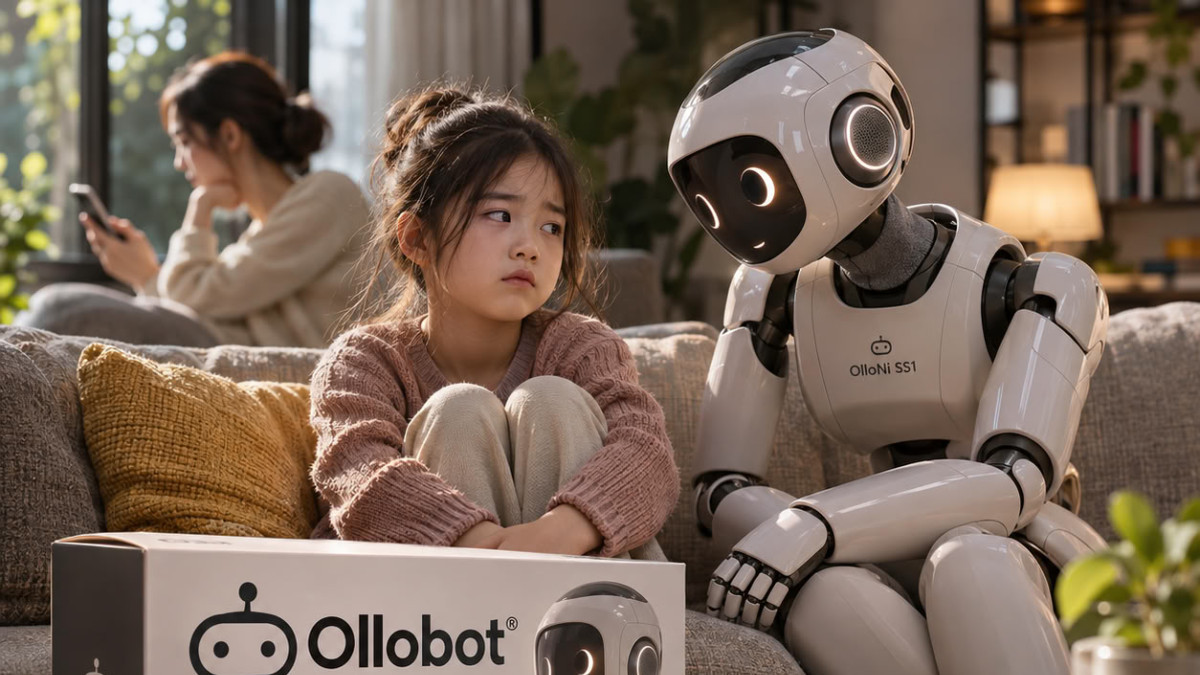

Manufacturer Ollobot presents its OlloNi SS1 companion robot as an example of a new generation of AI-powered devices designed for daily presence rather than for providing one-off services. This article is presented as sponsored by Ollobot, and the features described below are those put forward by the company.
- Ollobot presents the OlloNi SS1 as a robot designed for daily presence.
- Companion robots aim to reduce loneliness among isolated elderly people and children.
- The SS1 initiates conversation, detects falls, and records family moments.
- According to Ollobot, household data stays stored locally within its ecosystem.
From around 2017, the first companion robots won over individuals with their personality, mobility, and voice responses. Limited to simple voice commands, many quickly ended up unused on a shelf. When some of these companies ceased operations and shut down their servers, several owners compared the loss to that of a pet.
A Need for Presence
According to a study, nearly one in three older adults lives alone, meaning without daily companionship. Another research report states that children whose parents have migrated for work and are entrusted to relatives are 2.5 times more likely to feel lonely than those whose parents remain with them. Video conferencing, smart speakers, and messaging apps have attempted to address this issue, but, according to the source, they serve to communicate between people already connected and do not create a sense of presence.
Current companion robots, still according to Ollobot, are based on three evolutions. They shift from reaction to initiative: thanks to cameras, microphones, and sensors, they monitor a room, initiate conversation without prompting, and can detect emotions. They also prioritize the effect produced on the person rather than the advertised features. Finally, they integrate into connected ecosystems, with built-in software and remote access from the design stage.
A market report cited by the source values the global AI companion market at $36.8 billion US dollars in 2025. It is expected to reach $48 billion in 2026, then $318 billion in 2033, with an average annual growth rate of 31% between 2026 and 2033.
Uses and Features of the OlloNi SS1
Ollobot cites three domestic situations. For an elderly person living alone, the robot combines proactive interactions, fall detection, and continuous presence. For a child whose parents work far away, it knows their preferences, moods, and habits, and parents can remain present without scheduled calls. For a working adult living alone in the city, it adapts to routines and offers discreet social presence.
Technically, the SS1 is equipped with a multi-chip 4K vision module, capable of facial recognition and motion tracking, as well as a physical camera shutter. It moves on hardwood, tile, and short-pile carpet, with a slope climbing capability of up to 3.5 degrees. Six microphones ensure voice capture in all directions, with an effective range of up to 5 meters. Its “heart module” has 16 GB of memory and 64 GB of local storage, allowing a large part of the AI processing to be done directly on the device. The announced battery life is 12 hours on standby and about 5 hours of active interaction. The robot runs on Android and receives remote updates, known as “OTA.”
Its “2+1” display combines two circular side screens, presented as “emotional eyes,” and a main screen dedicated to information. A system for recording domestic life can capture laughter, moments of closeness, or group interactions, then an AI vlog engine assembles them into short edited videos, with an automatically generated soundtrack.
According to Ollobot, visual data is processed primarily on the device, and household memories are stored locally within its proprietary ecosystem, without sharing with third-party smart home platforms. Access to recordings is through the app, remote communications are encrypted, and the user can adjust recording preferences. Each unit, the company specifies, develops a behavioral profile unique to its household, so that two devices used for a year in different homes would have become significantly different.
