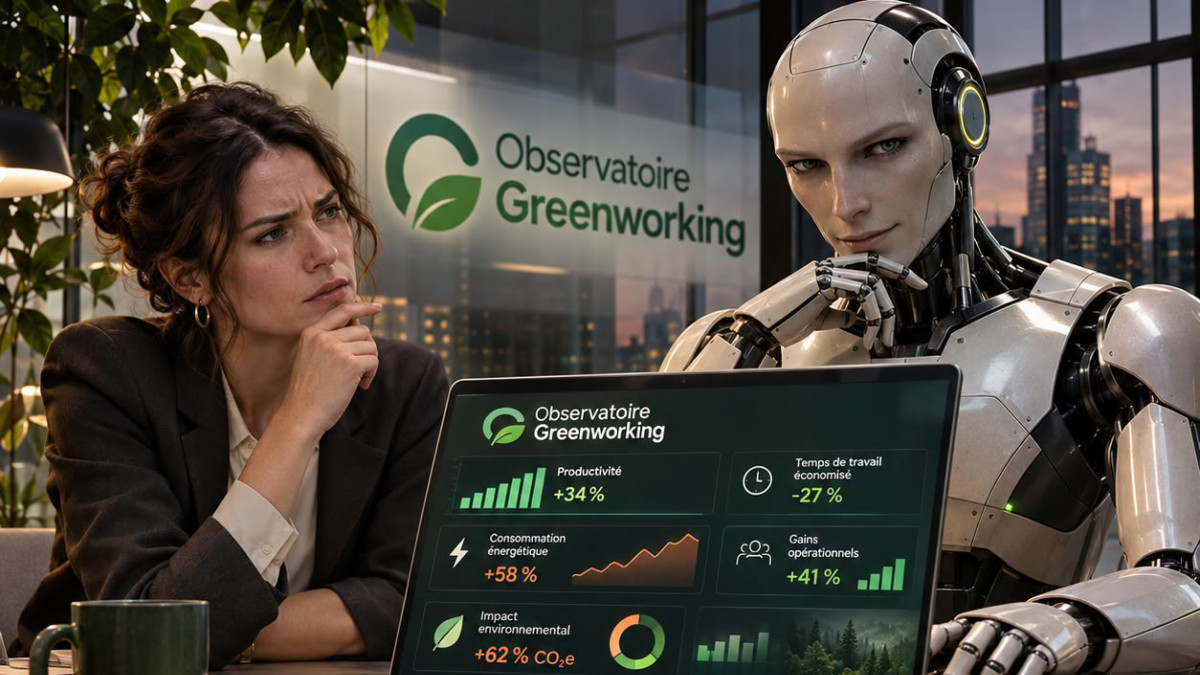

According to the Greenworking x Ipsos bva Observatory, 73% of surveyed employees report using generative AI at work. In the same survey, 75% say they gain speed and 70% believe they produce higher quality work, raising a question: what does the organization actually lose when everyone produces faster?
- AI speeds up individual work, but faster output does not guarantee better collective results.
- Convincing answers are harder to challenge, even when their reasoning is weak.
- Managers absorb the extra checking, which builds a managerial debt.
- Widespread use proves little; the real test is what the organization does better.
Debates on AI have quickly highlighted well-identified risks: hallucinations (false answers presented as true), biases, and errors. As models improve, their responses become more coherent, fluent, and convincing. Yet a higher-quality answer is also harder to challenge, even when it rests on shaky reasoning.
A report can thus be better written and better structured without being more accurate. The risk is therefore not only that AI ‘hallucinates,’ but that it gives the right answer too quickly. As production becomes easier, distinguishing what is truly relevant from what merely appears to be so becomes more demanding.
A company can see individual gains multiply without them automatically adding up to collective performance. Some of the production gains can ricochet when it comes to assessing the quality of the result, choosing between several options, or assuming the consequences.
The Managerial Debt of AI
This tension is already apparent in managers’ work: 58% of them report having to challenge or verify outputs produced with AI assistance more often. Some of the effort saved in production thus shifts to evaluation, arbitration, explanation, or accountability for the result.
This is how a managerial debt builds up. The company cannot define all the good uses of AI in advance, given the variety and rapid evolution of professions, situations, and tools. Unanswered questions then fall to managers: what can be delegated? What needs to be checked? How to assess work done with AI? How to prevent gaps in proficiency from widening?
The manager then risks becoming the after-sales service for AI, tasked with resolving daily questions that the organization has not yet clarified.
Mass Adoption of Uses and Scaling Up
This is likely one of the most common confusions. Multiplying licenses, users, or use cases shows that AI is spreading, but it does not yet prove that the company derives more value from it. Scaling up is more demanding: it begins when the benefits perceived individually also enable better decision-making, cooperation, learning, or production. A company can therefore have widely adopted AI without having successfully achieved this scaling.
The real criterion is not the number of people using AI, but what the organization can do better thanks to it. The most demanding question remains this: what does our organization actually do better than before?
