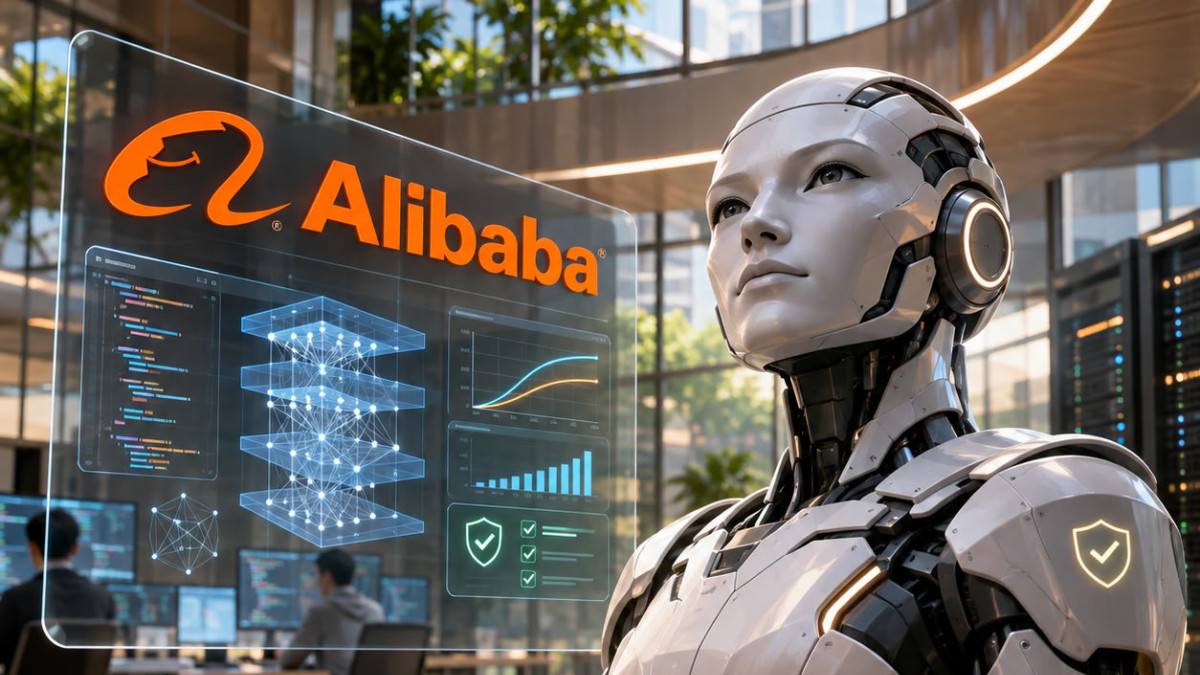

Alibaba officially launched Qwen4-Max on November 16, 2026, its new flagship artificial intelligence model designed for professional and scientific applications. The Chinese giant announces a 62% reduction in the average cost per task, improved reasoning capabilities, and enhanced security measures, in a context of increased competition in the generative AI market.
Available to the public since November 16 at 3:01 AM Paris time, the model had already been the subject of an open preview on November 11 for subscribers to Alibaba’s Token Plan. This trial version remains available until November 25, before its scheduled withdrawal. Qwen4-Max specifically targets the finance, healthcare, legal, industrial manufacturing, and scientific research sectors.
A 2.4 Trillion Parameter Model
Qwen4-Max is based on a Mixture-of-Experts (MoE) architecture, which allows only a portion of the model’s parameters to be mobilized for each operation. Out of a total of 2.4 trillion parameters, 71 billion are activated per token, the unit of text processed by the model, which is 25% less than its predecessor Qwen3.8-Max-Base, according to Alibaba. The group presents this approach as a way to improve efficiency without mobilizing all of the model’s resources.
The system also integrates native visual comprehension capabilities and a context window that can reach one million tokens, meaning the amount of text it can process in one go. It can thus analyze long documents, process images, and respond to complex requests. Alibaba highlights its applications in 3D modeling, programming, industrial design, and scientific work.
Costs Reduced by 62%
According to Alibaba, Qwen4-Max outperforms Qwen3.8-Max on Work360, its internal benchmark, i.e., an in-house performance test covering 721 specialized domains. In advanced reasoning mode, the new model would consume 35% fewer tokens. However, these results had not yet been confirmed by independent evaluations at the time of launch.
The efficiency improvement is accompanied by a price drop. Qwen4-Max is offered at $1.50 per million input tokens and $4.50 for output, compared to $2 and $6 respectively for Qwen3.8-Max. According to Alibaba’s tests, this combination would bring the average cost of a task from $4.43 to $1.67, a 62% reduction, an argument that can matter for companies deploying AI on a large scale.
Enhanced Security
Alibaba claims to have integrated additional security controls during the model’s training, particularly to limit vulnerabilities related to code injection, memory safety flaws, and access control issues.
The group indicates it has excluded certain training data associated with cyber-offensive activities, while retaining data dedicated to vulnerability detection and correction. Specific mechanisms have also been added to reduce risks related to chemical, biological, radiological, and nuclear uses. However, the effectiveness of these measures remains to be confirmed by independent evaluations.
With Qwen4-Max, Alibaba continues its offensive against major AI developers, notably OpenAI, Anthropic, and Google, as well as Chinese players like DeepSeek. The group seeks to differentiate itself by combining technical performance, cost control, and security measures.
For businesses, this competition broadens the choice of available solutions but makes their evaluation more complex. Beyond the announced performance, reliability, data protection, real usage costs, and integration conditions remain essential criteria.
