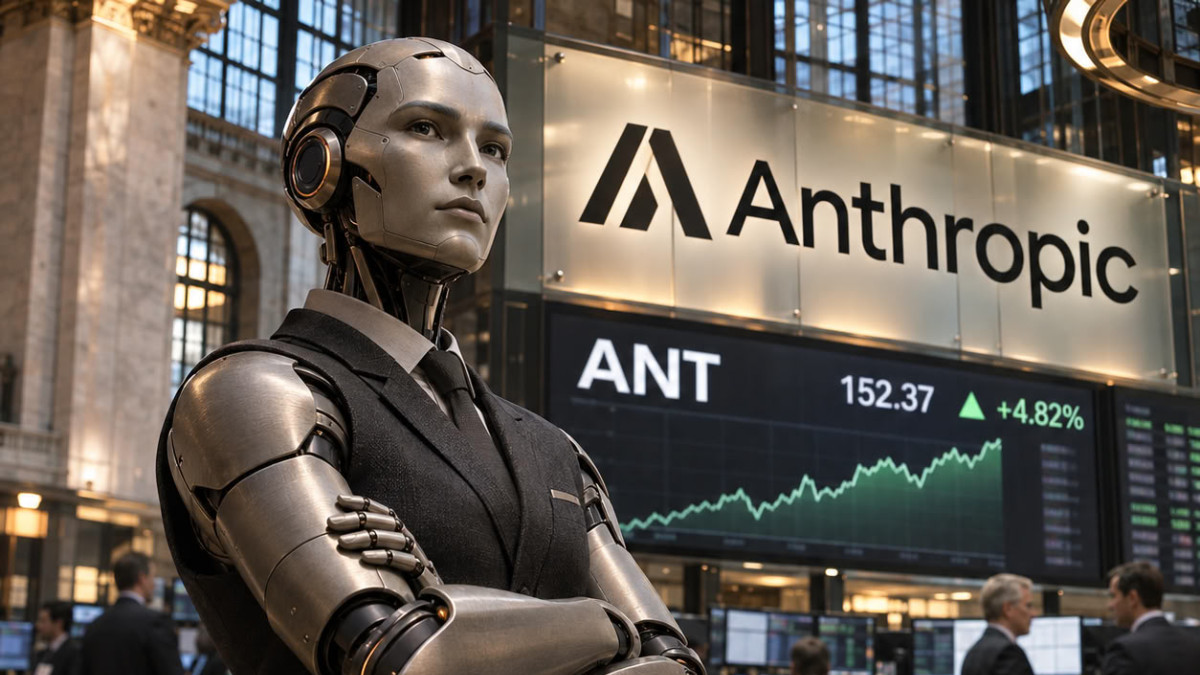

Anthropic is set to list on the Nasdaq on November 19, 2026, under the symbol ANT, with a valuation nearing $1.4 trillion. For companies using Claude, the question isn’t just about the stock price: it’s about how their AI provider will operate once it becomes a public company.
More transparency, but more pressure
A public company publishes its accounts every quarter, and Anthropic’s prospectus, the official document presented to investors, has already revealed several figures. Revenue reached $33.2 billion in the first nine months of 2026, over 11,900 customers spend more than $100,000 per year, and net revenue retention, which measures revenue growth from existing customers, stands at around 900%. For a CIO who must justify the choice of a supplier, these elements allow for a better assessment of the risk of the service disappearing abruptly.
The trade-off lies in profitability. A public company must account to its shareholders for its margins, while the same prospectus mentions nearly $900 billion in expenses already incurred, mostly in compute power. So far, competition among providers has driven down the price of models with each new version, with no guarantee that this trend will continue, at Anthropic or its competitors, who are also following the path to an IPO.
The main risk is operational
Discussions about the financial strength of AI providers obscure a more concrete risk for customers. In June 2026, by decision of US authorities, two of Anthropic’s models were suspended for all customers for about two weeks. The prospectus also cites, among its risks, a dispute with the Pentagon and dependence on chips manufactured in Taiwan.
According to the author of this op-ed, the IPO does not create these risks, it makes them visible. A public company may also reorganize its offerings more frequently, retire its older models faster, and adjust its commercial terms to the rhythm of the quarters. The author, who assists small and medium-sized businesses with their automation projects, states that the AI model has never been the decisive factor in these projects. What mattered were the quality of the instructions, data, and tests, i.e., elements that belong to the company itself.
Three checks before November 19
The first is to know where your instructions and data are located: the instructions given to an assistant, the knowledge bases, the response examples. If these elements only exist in an account with the provider, it is advisable to export them and keep a copy.
The second is to ask in writing if your tool can switch models. Many so-called “AI-powered” tools rely on a single model. You should then ask the provider about the time and cost of switching to another provider, because, according to the author, “a vague answer is already an answer.”
The third is to create a test suite. Twenty to fifty real requests, accompanied by the expected response, are enough to verify in one day that another model can do the job. Without this test suite, every change becomes a full-fledged project.
The author clarifies that this is not about leaving Claude. In his view, Anthropic’s models are among the most performant for code and agents, and the IPO does not call into question their quality or the continuity of service. He believes the same reasoning applies to OpenAI, Google, or Mistral. The approach he recommends is to use the most suitable tool at the moment while building projects in a way that allows for switching.
