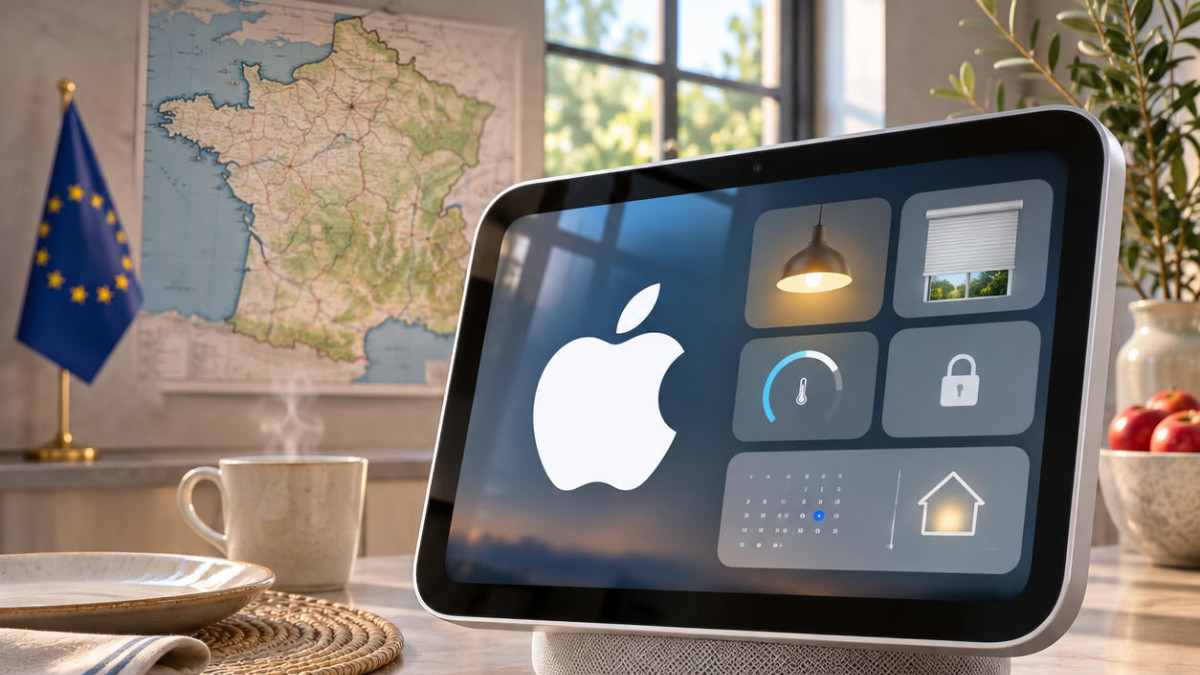

Apple has been selling its first smart display, the HomeView, in eight English-speaking markets since November 13, but not in any European Union country. The first US tests reveal genuine strengths in home automation, as well as significant software and privacy limitations within the home.
American journalist Joanna Stern spent a week with this 7-inch display on her countertop. In her video review for the Wall Street Journal, she tried asking the HomeView to open her garage door, without success. Siri refused to comply and claimed the device had no camera, even though its 12-megapixel front-facing lens was just a few centimeters away. Apple stated that, for security reasons, locks and garage doors can only be unlocked for now by tapping the screen, and an update to enable voice control is promised for next month.
This launch is particularly important for Apple. It is the first major hardware product outside the iPhone under John Ternus, who succeeded Tim Cook as the company’s CEO on September 1. Priced at $299 before tax in the US, in both stand and wall-mounted versions, the device aims to compete with Amazon’s Echo Show and Google’s Nest Hub. It features the Thread radio chip and Matter controller, two home automation standards, and promises to identify up to six family members by face or voice to display their personal messages and calendars.
Powerful in home automation, but intrusive in family life
At The Verge, smart home specialist Jennifer Pattison Tuohy gave it a score of 7 out of 10 after a very comprehensive test. For home control, lighting responds as instantly as a wall switch, and the cooking mode breaks down recipes found on the web into steps with multiple timers.
However, family cohabitation raises privacy questions. Standing in front of the display, the journalist was able to read and scroll through her 15-year-old daughter’s private text messages, with the wide-angle lens still capturing the silhouette of the teenager sitting at the back of the sofa. On the artificial intelligence front, Siri invented a travel time of 1 hour 47 minutes to reach an appointment that was actually five hours away, prompting the remark: “I’d fire her for being slow.”
The AppleInsider editorial team sums up the product’s ambiguity in its headline, “imperfect, I want three more.” It laments the lack of a dedicated App Store and home automation buttons limited to simple on/off. According to the Short Circuit channel, the HomeView’s facial recognition has nothing to do with the Face ID on iPhones. The camera relies on 2D image analysis, lacks an infrared projector, and could, in theory, be fooled by a simple photograph.
Should it be imported to France?
Compared to the Echo Show, Apple’s display retains two advantages: an interface without advertising banners and an included Siri AI assistant, whereas Amazon charges $20 per month for its Alexa+ on top of a Prime subscription. However, personalized functions, such as reading messages, the calendar, or reminders, depend on a nearby iPhone. Furthermore, Siri AI only understands English on this display.
Above all, the Siri AI engine remains locked on iPhones linked to a European Apple ID, a restriction Apple attributes to the DMA, the European Digital Markets Regulation. Without switching one’s primary account outside the European Union, only the home automation part—namely Matter, Apple Home, and HomeKit Secure Video cameras—would function normally in France. An imported version would also pose practical problems: the adapter for the stand version is in US or UK format, while the wall mount is designed for North American electrical boxes. The wall-mounted version is sold bare, requiring at least an additional $60 for the mount and power supply. Finally, 20% VAT and customs duties are added, with no guarantee of support in a French Apple Store.
In the meantime, the HomePod mini 2, sold for €169, and Apple TV 4K, sold for €349, fulfill the same role as a Matter and Thread hub, without a touchscreen. As long as the dispute between Apple and Brussels remains deadlocked, Apple’s smart display will not be sold in Europe.
