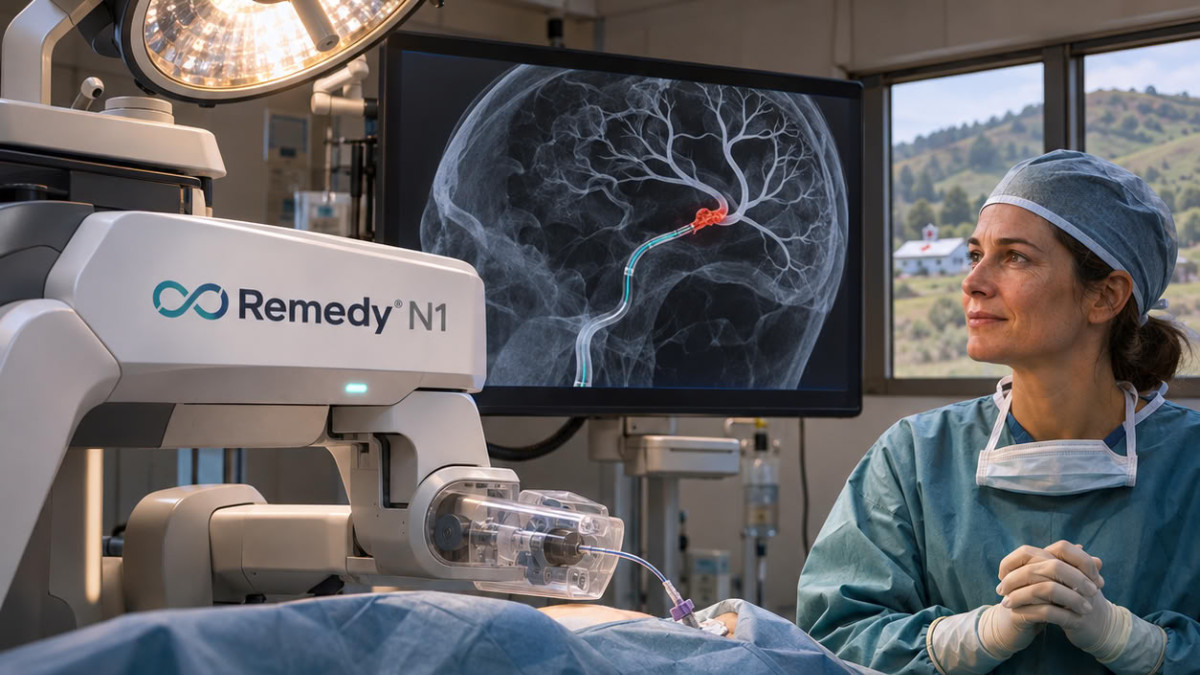

San Francisco-based startup Remedy Robotics is developing a telesurgery robot, the Remedy N1, intended for treating ischemic strokes via thrombectomy. Initial patient trials were conducted in Toronto in September 2025, and the company announced $62 million in new funding for its upcoming clinical trials.
The principle relies on a catheter, a flexible tube inserted into blood vessels, guided to the brain to remove a clot. According to the source, thrombectomy is the standard intervention for an ischemic stroke, the most common form, caused by restricted blood flow. Today, only about one in ten eligible patients receives one. The co-founders, surgeon David Bell, a former cardiac surgery intern from Australia, and engineer Jake Sganga, who leads the technology side, aim to reduce this gap by enabling a specialist to operate remotely.
The system works as follows: the catheter is steerable, allowing it to advance without relying solely on a guidewire. Miniature wires pull its tip in the desired direction, while a robotic arm advances the assembly. Computer vision software tracks the catheter’s rotation inside the body and automatically translates the surgeon’s intent, allowing them to simply indicate “right” on the radiological image. For Bell, the central question remains access to care: “Fluidity and precision are not clinical outcomes. Nor is surgeon ergonomics.”
The main challenge lies in the network. The transmission delay, called latency, can drop to a few tens of milliseconds in a well-connected major city but exceed 100 milliseconds in some rural areas. Remedy aims for a round-trip latency of at most 150 milliseconds, below the average human reaction time of 200 milliseconds, and pauses any surgical action beyond this threshold. Mike Teodorescu, an information systems researcher at the University of Washington, notes that experts generally consider 100 milliseconds a safe threshold and that his team found many rural communities, and even most countries, struggle to reach it.
First Patient Trials
In September 2025, ten patients agreed to a non-urgent procedure performed with the robot in Toronto. Six were operated on from a nearby room, two from another department in the hospital, and two from a facility across town. According to the company, the procedures were successful and performed nearly twice as fast as the current standard. Previous animal tests had suggested the robot hits vessel walls less often than the human hand.
Remedy now announces $62 million in funding. Part of it comes from the University of California system, which is slated to host the clinical studies. The initial trials will focus on on-site procedures, such as treating unruptured aneurysms, before remote operations in Australia or within the University of California, towards the end of 2027. Sganga believes the stakes go beyond telesurgery: “If doctors don’t use the system, they won’t acquire the expertise needed to operate remotely.”
Open Questions Remain
Bell also questions the effects of remote practice on surgeons’ skills, on interns’ dependence on a given platform, or on the choice to make if two patients need the same remote surgeon at the same time. For now, no robotics company has obtained full regulatory approval for telesurgery, and no patient has been operated on remotely in the United States, according to the source. Remedy, which has 25 employees, now hopes this technology will enable bringing thrombectomy to all who need it, wherever they are.
