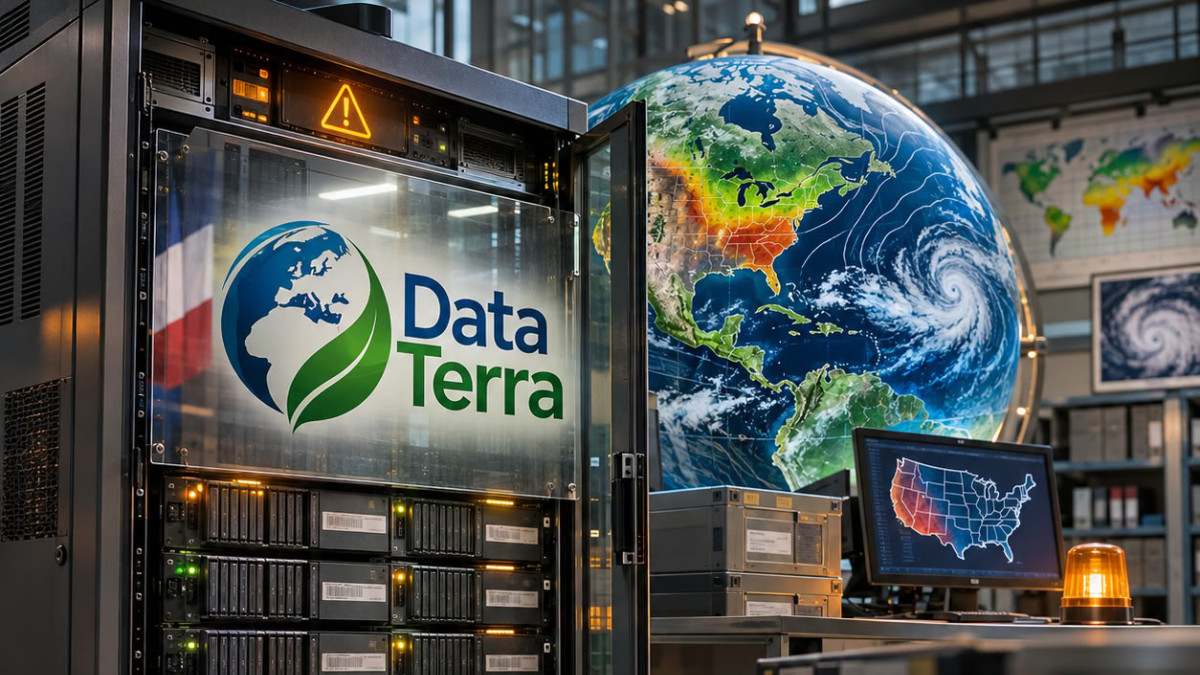

While the U.S. administration is scaling back certain climate data collection programs, France could host part of these scientific archives. To achieve this, the national Data Terra infrastructure would need to multiply its storage capacity sixfold, an operation the CNRS estimates at around 17 million euros.
In the United States, the Trump administration has decided to reduce, or even terminate, certain environmental data collection programs. This decision worries scientists, as these archives constitute an irreplaceable record of climate evolution.
Faced with this risk, France intends to strengthen its capacity to preserve this information. A legislative proposal was tabled in the Senate on February 26 by Senator and CNRS researcher Pierre Ouzoulias and by Laurent Lafon, chair of the culture committee, along with colleagues from all parliamentary groups. Its aim is to entrust public research with a mission to collect, disseminate, and preserve scientific data on the Earth, climate, and environment.
To host it, France is not starting from scratch. Data Terra, a national digital research infrastructure recognized at the European level, already exists. To accommodate the threatened American archives, however, it would need to scale up. CNRS Terre & Univers estimates that operational capacity would need to increase from 100 to 600 petabytes, knowing that one petabyte equals one million gigabytes.
Data impossible to reconstitute
Data Terra already hosts a large amount of information, distributed among five hubs dedicated to oceans, biodiversity, the atmosphere, solid Earth, and continental surfaces. “Data Terra houses national data, but it could also host, if it became essential, data from foreign countries,” explains Jean-François Doussin, former director of CNRS Terre & Univers, in an article published in the newsletter La lettre du CNRS.
The stakes go beyond the mere question of storage. Some observations simply cannot be reproduced, such as the concentration of CO2 in the atmosphere, measured continuously since the 1950s. If part of these records disappears, it is impossible to go back and reconstruct the missing data. “We observe what we cannot put in a test tube,” summarizes Jean-François Doussin, citing objects “too large like the ocean or space” or that evolve too slowly. He also warns that “we are entering an unknown climatic era.”
France already contributes to several major international programs, such as Copernicus, the Group on Earth Observations (GEO), or the World Meteorological Organization. It must also be able to guarantee the continuity of its own measurement series.
A scientific collection still fragile
This is precisely one of the objectives of the legislative proposal. “We are fortunate to possess a very great wealth of data, often collected over long periods. But there are, to date, no organizations responsible for a public service mission for the conservation, preservation, and valorization of this data,” emphasizes Pierre Ouzoulias. The authors of the text therefore call for ensuring the continuity of these series and preserving them in a sovereign manner. “Remaining sovereign over the data ensures that we can never be deprived of it,” insists Jean-François Doussin.
Today, this mission largely relies on research project calls, typically funded for three years, sometimes five. This timeline is hardly compatible with observing phenomena measured over several decades. The CNRS national observation services thus monitor glacier evolution, coastal dynamics, or greenhouse gas emissions from peatlands. These monitoring efforts also require sustainable equipment and human resources, such as oceanographic vessels, high-altitude stations, or installations in Arctic and Antarctic regions. “Budgetary uncertainties and changes related to the organization of the higher education and research system could undermine this mission,” worries Pierre Ouzoulias.
Data useful far beyond laboratories
These records are not only used by researchers. They are also mobilized by insurers, construction professionals, or farmers, and can help anticipate certain natural risks and adapt cities to climate changes. To study urban heat islands and pollution, scientists need uninterrupted measurement series. Wind and rain are essential parameters for understanding pollutant dispersion, explains Gilles Gesquière, a researcher at the Laboratory of Computer Science, Image and Information Systems and co-director of the Sustainable City and Innovative Buildings research program.
Yet, it is also necessary to be able to find and use this information. “We must ensure that data remains easy to find, accessible, interoperable, and reusable,” he emphasizes. However, part of these resources remains scattered across computers, hard drives, or even field notebooks. “These are veritable gold mines,” considers Cécile Callou, scientific delegate at CNRS Écologie & Environnement. The goal is to make them accessible to the scientific community, but also to all potential users.
France, however, will not be able to preserve everything. Storing these volumes represents a financial cost, but also an environmental challenge related to the footprint of data centers. It will therefore be necessary to select the information to preserve with the help of scientific committees, taking into account their potential utility in several decades.
