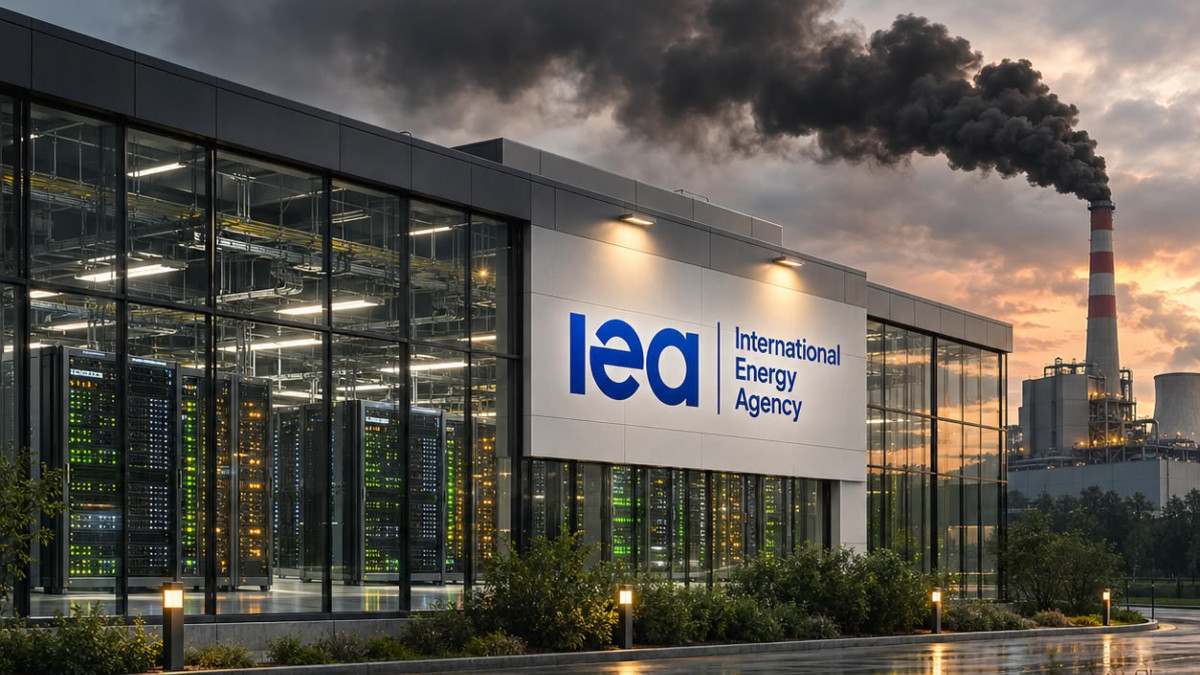

The International Energy Agency (IEA) warns of the risks posed by data centers, which rely heavily on fossil fuels. In its World Energy Outlook 2026 report, the organization estimates these infrastructures will generate 70% more carbon emissions by 2030.
To power the numerous data center projects worldwide, major countries, including China and the United States, are heavily reliant on fossil fuels. According to the report, this represents twice the electricity consumption. IEA calculations indicate that data centers dedicated to AI are expected to consume an additional 350 terawatt-hours (TWh) of electricity annually, nearly as much as Iran’s annual consumption in 2024, based on 2024 IEA data. France consumed 410 TWh that same year.
IEA Executive Director Fatih Birol stated: ‘I see no credible pathway for the world’s energy system to return to what it was before,’ according to The Guardian. He believes the war in the Middle East, combined with Russia’s invasion of Ukraine, represents the biggest disruption to the energy market in history. The agency adds that tomorrow’s energy will revolve around three elements: energy for a growing global population, air conditioning in the era of global warming, and the booming AI economy.
Data centers are among the main buyers of renewable energy, but their sheer number forces some countries to continue using fossil fuels. By 2030, half the electricity needed to power Chinese data centers will come from coal-fired power plants, the IEA revealed, with the other half composed of renewables, nuclear, and gas.
An explosion of AI factories
Lacking reliable data on an opaque industry, the IEA indicates it uses ‘satellite imagery to track the construction of 93 large ‘AI factories’,’ the name given to data centers specifically designed for artificial intelligence. The agency observes ‘rapid development of these infrastructures’: the estimated potential capacity of these centers has increased tenfold in just 24 months, reaching 17 GW. Once these 93 centers are completed, their combined capacity is expected to approach 50 GW.
Currently, all data centers combined have a total capacity of 120 GW, with nearly 80% located in China, the United States, and the European Union, according to the report. If the STEPS scenario (Stated Policies Scenario, based on announced policies) is followed, ‘an additional 120 GW should be built by the end of the decade, more than three-quarters of which will be dedicated to powering servers optimized for AI.’ The report also highlights that ‘the rapid growth in data center capacity is pushing power grids to their limits.’
The United States will draw on its gas-fired power plants to supply 60% of the electricity needed for its data centers and plans an additional 180 GW, equivalent to the entire EU’s gas capacity. The EU could be seen as the best performer: 70% of the electricity used for data centers would come from renewables. The remaining 30% would be provided by nuclear, gas-fired plants, and some coal-fired plants. Nuclear is considered low-carbon, but it releases waste harmful to the environment.
