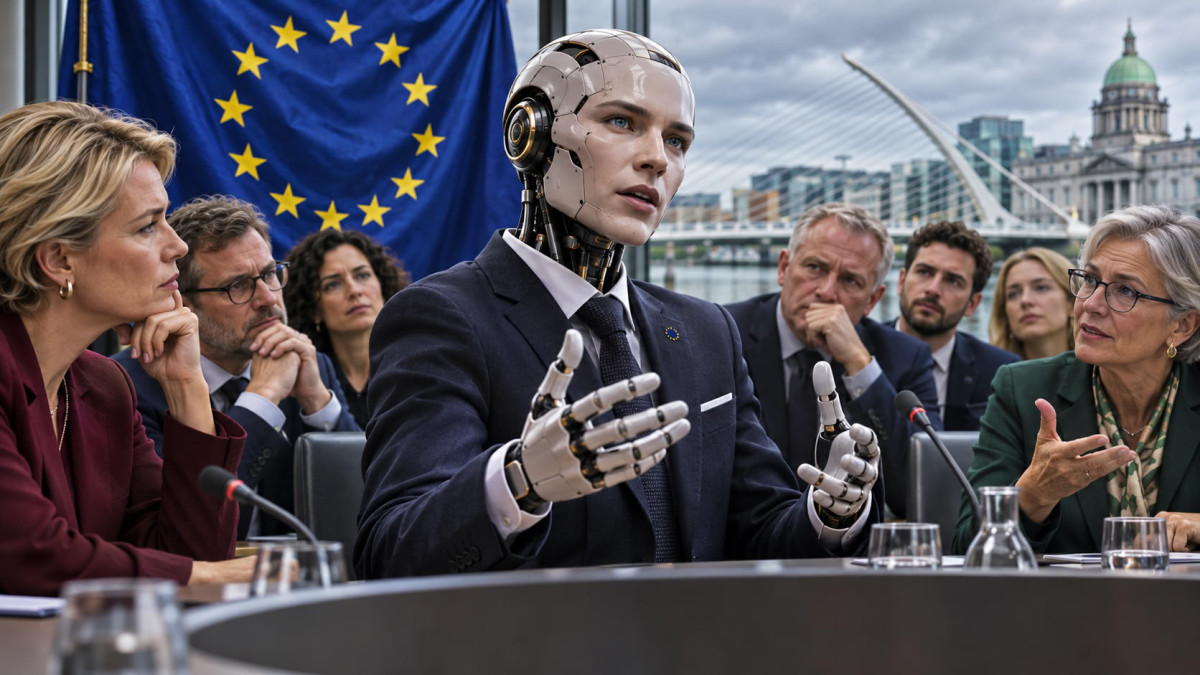

The leaders of the 27 European Union countries are debating for the first time the risks and promises of artificial intelligence, at a summit this Friday, November 13 in Dublin. As Europe tries to stay in the race against the United States and China, no major decisions are expected from this informal meeting.
The summit takes place in a climate of uncertainty for the AI industry. Revelations about the extramarital affairs of Nvidia CEO Jensen Huang forced him to step down from the helm of the global processor giant on Thursday. While US stock markets and those of other countries heavily exposed to tech stocks were shaken by his departure, the affair is not on the agenda of European leaders. However, a European official cited by AFP indicated that they could “put the topic on the table”, particularly due to the implications of this scandal for cybersecurity.
Balancing protection and investment
The European Union is seeking to reconcile two objectives. On the one hand, it aims to develop initiatives to protect society from the risks posed by artificial intelligence. On the other hand, it aims to encourage investment to reap economic benefits and avoid being overtaken by American and Chinese competition.
Mistral CEO Arthur Mensch is expected to remind heads of state and government of the immense potential of AI for a European economy lacking growth, and to present his ideas for helping the sector take off in Europe. Mistral, presented as producing the continent’s most advanced AI models, did not join the calls to slow down the sector’s development made this year by Sam Altman, head of OpenAI, and by Dario Amodei, head of Anthropic. Arthur Mensch, on the contrary, had called on Europe to step up its efforts, seeing these calls as an attempt by Americans to preserve their technological lead.
A European strategy awaited
For James Green, a researcher at the Centre for European Reform, a UK-based think tank, the EU is in dire need of a strategy to address the major challenges of AI. “States, companies and citizens are increasingly experiencing the consequences of the most advanced AI models, and at the same time Europe is far behind the United States and China in their development,” he says. In his view, the EU should promote responsible deployment of AI, while tackling its regulation and forging international partnerships to limit its dangers.
Researcher Geoffrey Hinton, 2024 Nobel Prize in Physics and 2018 Turing Award winner, an AI pioneer, is expected to warn of the risks of artificial intelligence in terms of cybersecurity, as well as the need to preserve jobs and human rights. In 2023, he made headlines by leaving Google, warning of “profound risks to society and humanity”.
Estonia and Finland, for their part, have argued for the EU to establish a common mechanism to “respond to serious incidents” involving AI, while advocating its benefits. “We need to invest in new technologies, and we know very well that we must not shy away from them,” Estonian Prime Minister Kristen Michal said in an interview with AFP on Wednesday.
