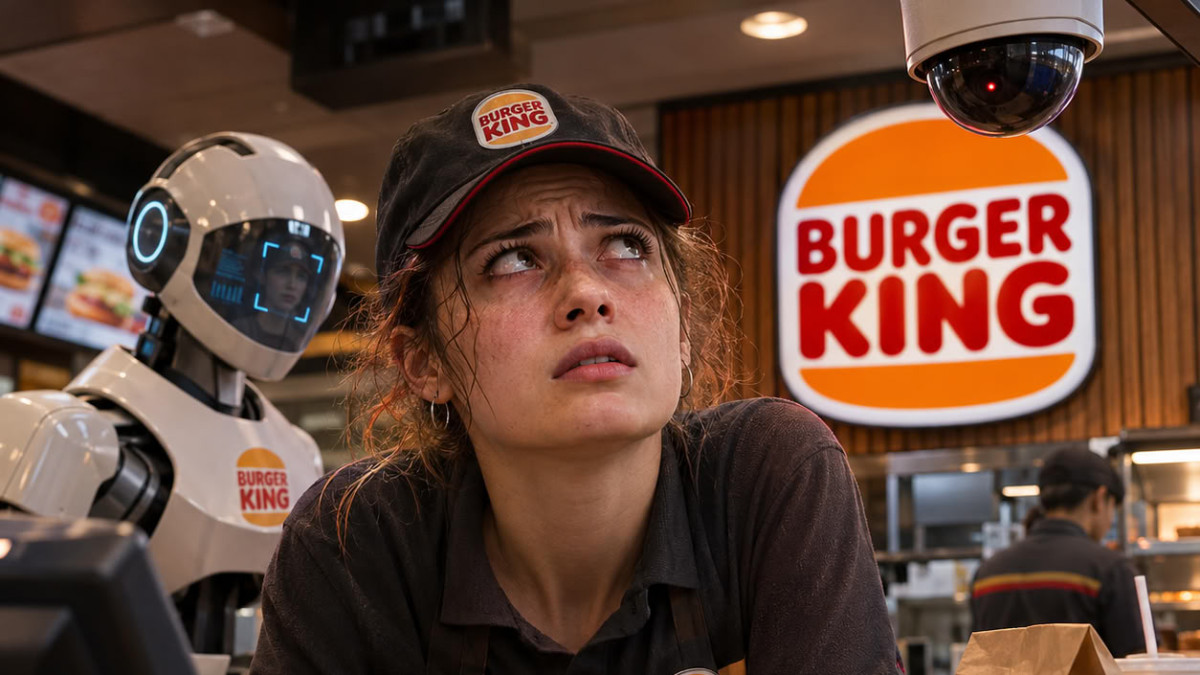

Several fast-food chains are now using artificial intelligence to monitor and rate their employees. In an investigation published on November 16, 2026 by Capital & Main, employees from Burger King, Domino’s and other chains describe an algorithmic assessment of their daily work life. Some rating criteria are, according to them, particularly unexpected.
Conversations Rated by an AI
At Burger King, the system is called Patty. Developed using OpenAI’s technologies, this conversational assistant began to be deployed in February in no fewer than 500 American restaurants, with a stated goal of covering all the chain’s outlets in the country before the end of 2026. Initially presented as a tool to facilitate drive-thru order-taking, it has gradually transformed into an instrument for employee surveillance.
Every conversation with a customer can be analyzed and rated according to several criteria: politeness, warmth of welcome, or the ability to suggest additional products to improve sales figures. Employees have a screen displaying their results in real time, with green boxes for good behaviors and red boxes for mistakes. A simple hesitation, a phrase to make the customer wait, or a sentence deemed less warm can lower their score.
According to a former employee interviewed by Capital & Main, managers demanded a friendliness rate above 70%, and employees with poor results could be removed from the schedule. The system also evaluates “human warmth,” a notion that doesn’t depend solely on tone of voice. Some employees claim they had to artificially modify their way of speaking to satisfy the algorithm, to the point where customers mistook them for robots. Others denounce rating differences between colleagues based on their accent or manner of speaking.
Burger King states it is not aware of any penalties related to origin or gender. The chain claims to have disabled the friendliness and human warmth rating features to improve them.
Driving, Speed, and Travel Time Under Surveillance
Burger King is not the only chain involved. At Domino’s and Papa John’s, an application developed by Drivosity uses GPS and artificial intelligence to rate drivers’ performance. Acceleration, braking, turns, and speed are analyzed to assign a score out of 100 for each trip. In some outlets, employees must maintain a score above 85 under penalty of sanctions, or even exclusion from the chain’s computer system.
Drivosity also offers HustleTime, a tool that measures the time needed to get to one’s car, deliver a pizza to the customer, and return to the restaurant. Managers can then compare their teams’ performances in rankings. Other solutions, like that from Solink, use surveillance cameras to spot delays, overly long breaks, phone use during service, or employees remaining inactive.
In France, this is already a technique used by some companies where transportation is central to the business. This constant surveillance raises questions about working conditions and respect for privacy. In California, several laws were adopted in September 2026 to regulate these practices, notably by prohibiting reliance exclusively on an AI to fire or sanction an employee.
