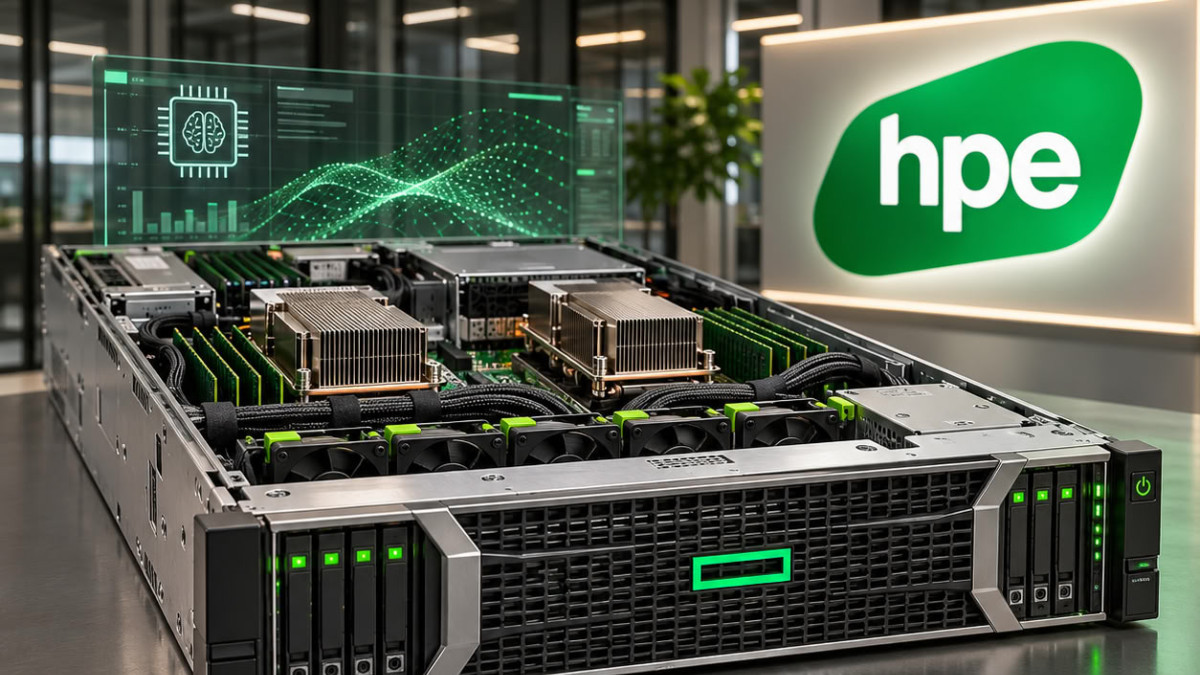

Hewlett Packard Enterprise (HPE) has unveiled the first of its next-generation ProLiant servers, the ProLiant Gen 13, designed for enterprise AI inference and agentic AI workloads. These machines are part of an infrastructure race that several analysts consider unprecedented.
In a report, analysts at Bain & Co forecast that annual spending on AI infrastructure could reach $1.5 trillion by 2031. This sum covers new data centers, compute capacity, GPU upgrades, memory, and networking equipment. The power capacity of the most advanced data centers is approaching 1 gigawatt and could double next year, before exceeding 9 GW by the end of the decade.
Hyperscalers, the major cloud providers like Microsoft, Amazon, Google, Oracle, and Meta, are expected to allocate $780 billion to their investments this year, roughly five times the amount from three years ago, according to the same analysts. Server manufacturers are following this demand. For John Carter, vice president of product management at HPE Compute, the first four 13th-generation ProLiants target the highest-performing workloads, whether dense compute or GPU-based.
Servers designed for agentic AI
The flagship model, the ProLiant DL585a, is a 10U server that can accommodate up to eight double-width GPUs from Nvidia, AMD, or Intel, as well as two AMD Epyc processors, each with up to 256 cores. It also incorporates sixth-generation PCIe connectivity and will be available in March 2027. According to John Carter, it is designed to meet the growing token throughput and PCIe demands of inference, retrieval-augmented generation (RAG), and agentic AI.
“Most of our customers using PCIe-form-factor GPUs are actually telling us: ‘We run out of power long before we run out of space, so make it bigger’, ” he explains. The system remains air-cooled, an option he says targets mid-sized enterprises and service providers.
The ProLiant DL525, a 1U single-processor air-cooled server, features a single 256-core AMD processor with 16-channel memory, compatible with DDR5 and MRDIMM. It is intended for high-data-throughput workloads, such as inference, electronic design automation (EDA), or fraud detection. It fits into a standard 19-inch rack. “We are moving from a GPU orientation to a CPU orientation, ” says John Carter, who predicts the ratio of CPUs to GPUs will shift from two-to-eight to one-to-one.
The two XD systems, slated for release next year, succeed the Apollo 2000 and XD 2000 series. The XD245 combines four dual-processor half-width nodes and is liquid-cooled, while the XD285 has two and uses air cooling. Both occupy a 2OU chassis and fit into a 21-inch ORV3 rack.
Security and management
These machines come with enhanced management software, including iLO 8. Hard drives or SSDs automatically encrypt and decrypt data upon system boot. A multi-party authorization requires high-impact actions, such as key provisioning or secure erasure, to be approved by two human approvers, even when triggered by an AI or agent. Chris Bradley, director of customer advocacy and technical activation for consumer computers at HPE, notes that these rules have been built into every node.
HPE has also extended its post-quantum cryptography (PQC), intended to protect data against future quantum computers. The company cites the ‘harvest now, decrypt later’ risk, where malicious actors store stolen data to decrypt it when quantum computing is within their reach.
For Bain & Co, the central question goes beyond mere installed capacity. “The unprecedented scale and speed of AI buildout, with billions invested in chips, data centers, networks, and power systems, has focused attention on the challenge of building capacity, ” the analysts write. “But perhaps the most important question is whether enough economic value can be created to justify it.”
