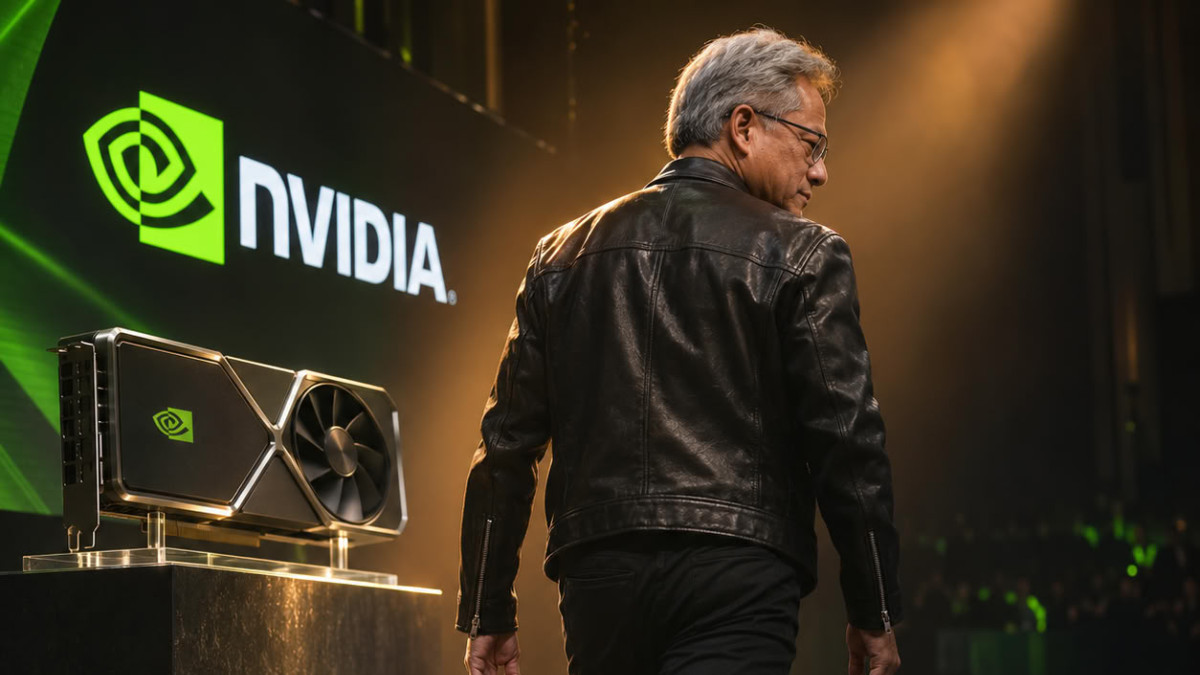

Jensen Huang, co-founder and CEO of Nvidia, has left the company he founded 33 years ago. An iconic figure in the artificial intelligence chip sector, he leaves behind a company that alone represents about 6% of the S&P 500 stock index, with no designated successor.
On January 6, 2025, during his CES keynote speech, Jensen Huang made a notable entrance in front of a crowd of 14,000 people, wearing his signature black leather jacket. His departure comes in a completely different climate. He is alleged to have facilitated two chip smuggling deals and is said to have had three alleged extramarital affairs, one with a person presented as a suspected Chinese spy, at a time when he was associating with President Donald Trump.
The issue extends beyond the company alone. Huang was running the first company valued at $5 trillion, and its graphics processing units, or GPUs, power the global AI boom. He had not planned for succession and had stated he preferred to die in office. According to CNBC, around sixty employees reported directly to the CEO.
“Jensen is Nvidia, and Nvidia is Jensen,” summarizes Jon Peddie, an analyst who has followed the company since its inception. For Pat Moorhead of Moor Insights & Strategy, he was “both the visionary and the tactical leader, the closest thing to Steve Jobs that tech has seen.” Huang also adopted the codes of great presenters, from keynotes to the uniform jacket, though he did not have the same aura as Jobs.
A succession of other bets
Before the AI era, Nvidia came close to bankruptcy in 1996, while working on a graphics chip for the Sega Dreamcast console. According to the Wall Street Journal, in 2024, Huang then convinced Sega to invest $5 million. The Riva 128, launched shortly after, was executed with a speed that forced the company to lay off more than half of its roughly 100 employees, according to The New Yorker in 2023. It sold one million units in four months.
Huang then bet on CUDA, a feature allowing a GPU to be used for computations other than graphics display. According to him, it increased the cost of each GeForce card by 50%. “Originally, there was no market,” notes Jon Peddie. When the Great Recession hit in 2007-2009, Nvidia lost 80% of its market value, but Huang continued to invest. In 2012, researchers at the University of Toronto trained AlexNet, a neural network on Nvidia, often cited as the starting point of the AI revolution. In 2022, ChatGPT was launched on Nvidia hardware.
Nvidia without its founder
Despite this departure, several analysts do not see an immediate crisis. “It’s a stock shock, not a business shock, for the coming year,” says Pat Moorhead, who notes that the roadmap and manufacturing are locked in until 2027. Ben Bajarin of Creative Strategies states: “We don’t think anything changes strategically.”
Tom Mainelli of IDC believes Huang will be difficult to replace, but that “the company will survive.” Dave Altavilla of HotTech Vision and Analysis believes his departure leaves a void in strategic vision, while the technologies and teams remain in place. Jon Peddie expects the stock to experience turbulence before investors regain stability.
