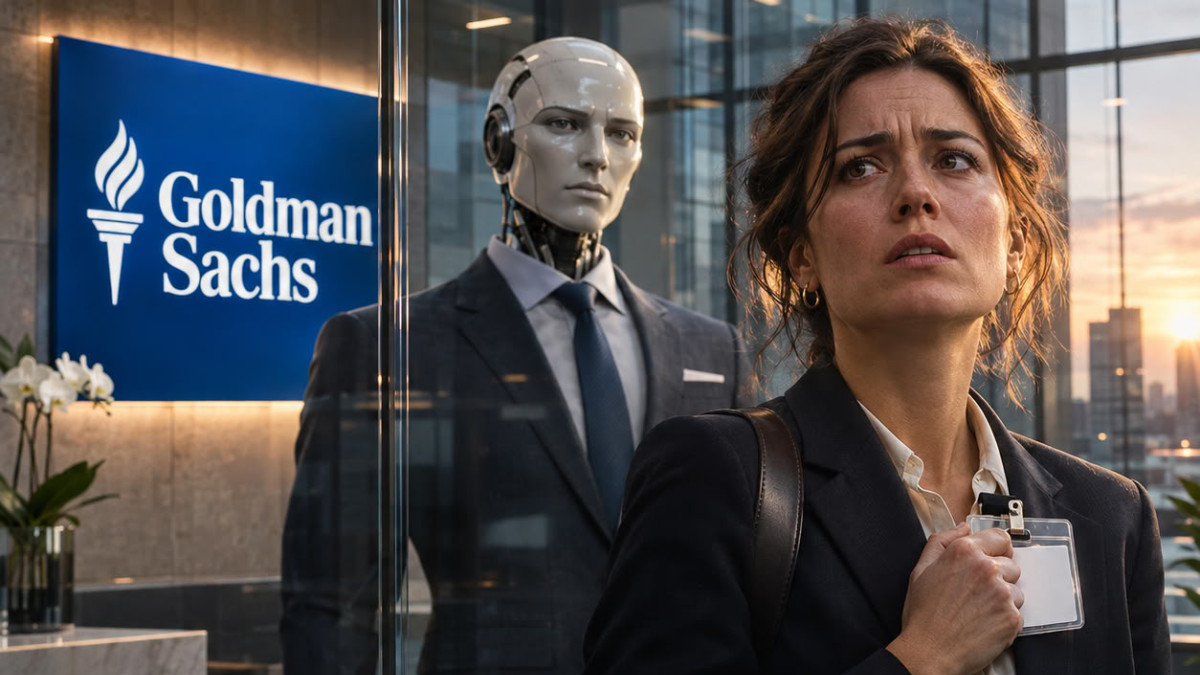

According to Goldman Sachs, artificial intelligence could eventually cause 9% of employees to lose their jobs. The bank believes these cuts will occur mainly during the next economic downturn, even as layoffs attributed to AI fell sharply in the autumn of 2026 in the United States.
Joseph Briggs, an economist at Goldman Sachs, has published a new estimate of AI’s effect on employment, reported by Fortune. While AI will ultimately increase productivity by 15% in the US and other developed countries, up to 9% of employees could lose their jobs during the transition, and about 3% more would be affected by a slowdown in hiring. That’s roughly one in eleven employees. In August 2025, Joseph Briggs and Sarah Dong gave a range of 6 to 7%, while in June 2026, Joseph Briggs mentioned around 9%, or 15 million American employees over ten years.
Cuts Linked to a Slowdown
In his note, Joseph Briggs writes that “labor market disruptions from automation remain limited when the economy is doing well, but accelerate during downturns.” In October 2025, two other Goldman Sachs economists, David Mericle and Pierfrancesco Mei, already estimated that the full consequences of AI “might not appear until a recession.” In this scenario, companies would keep their employees as long as growth holds, before replacing some positions with AI during the next crisis.
121,401 Cuts Citing AI in 2026
The firm Challenger, Gray & Christmas tracks announced job cut plans by US companies each month. In its report published on November 5, 2026, it counts 617,189 job cuts between January and October 2026, 44% less than the same period in 2025. AI was cited as the reason in 121,401 cases, about 20% of the total. In July, it was the top reason given by employers for the fifth consecutive month, with 10,970 cuts in that month alone. In October, it was cited for only 1,265 positions, its lowest level of the year, and “economic and market conditions” became the top reason again. Tech remains the hardest-hit sector, with 171,501 jobs cut since January, 21% more than in 2025. “It’s an environment where there is little layoff activity,” summarizes Andy Challenger, the firm’s senior vice president.
Several studies also doubt that AI is the real cause of the layoffs attributed to it. On January 7, 2026, Oxford Economics noted that US productivity was slowing instead of accelerating: “If AI were already replacing labor on a large scale, productivity growth should be accelerating. Generally, it is not.” The firm suspected some companies of presenting their layoffs as a technological advance rather than a sign of difficulties. In February, the Yale Budget Lab reached the same conclusion. Its director, Martha Gimbel, believes companies may highlight AI to avoid talking about tariffs, immigration, or political uncertainty.
Some recent cuts have been justified by other reasons. Epic Games, publisher of Fortnite, cut over 1,000 jobs as part of a $500 million cost-saving plan. Its CEO, Tim Sweeney, stated that AI was not to blame and wrote to his teams: “We are spending way more money than we earn.” In January 2026, Amazon announced 16,000 job cuts in its offices, on top of the more than 30,000 announced since October 2025, justifying them by a desire to reduce bureaucracy, not by AI.
