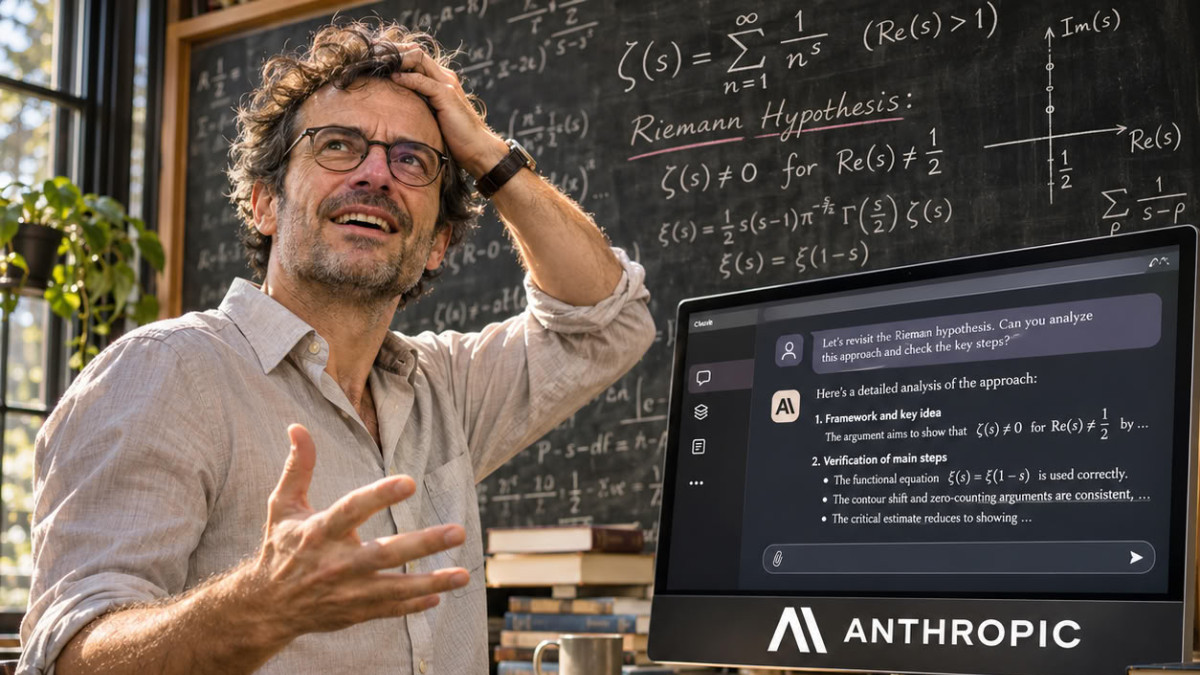

Researcher Levent Alpöge claims to have solved the Riemann hypothesis with the help of an artificial intelligence (AI) model from Anthropic. His proof has so far only been published in the form of a narrative, and no other mathematician has been able to verify it. A few hours later, a professor at Stanford University reported that a postdoctoral student from the same faculty had independently submitted his own proof.
Turkish-American researcher employed by Anthropic, Levent Alpöge, published a narrative of his work on his personal website on Friday, November 20, not the full proof. According to him, the full proof is over 250,000 pages long. He states he used the Claude AI interface, without specifying which version. Contacted by AFP, Anthropic did not respond immediately, nor did Ravi Vakil, a mathematics professor at Stanford, or the student mentioned by the latter.
“This is a monumental moment in human history,” Brian Conrey, considered one of the leading authorities on work related to the Riemann hypothesis, told AFP. He has not yet been able to verify the proof. Some saw this announcement as an illustration of increasingly powerful AI, which presents heightened risks. On social network X, researcher Eliezer Yudkowsky, among the most alarmist tech figures regarding the threats AI could pose to humanity, wrote: “The Riemann hypothesis was the challenge most often cited as a warning.”
An Iconic Problem
The Riemann hypothesis was formulated in 1859 by German mathematician Bernhard Riemann. It concerns the distribution of prime numbers, and many theorems and algorithms are based on it. It is one of the seven so-called Millennium Problems, a list established in 2000 by the Clay Mathematics Institute research organization, which promised one million dollars for the solution of any one of them.
This list also includes the so-called Navier-Stokes equations. According to OpenAI, one of its AI models solved it in early September, in less than four days. The company, which develops GPT models including ChatGPT, also announced in early October that it had solved 377 different problems.
