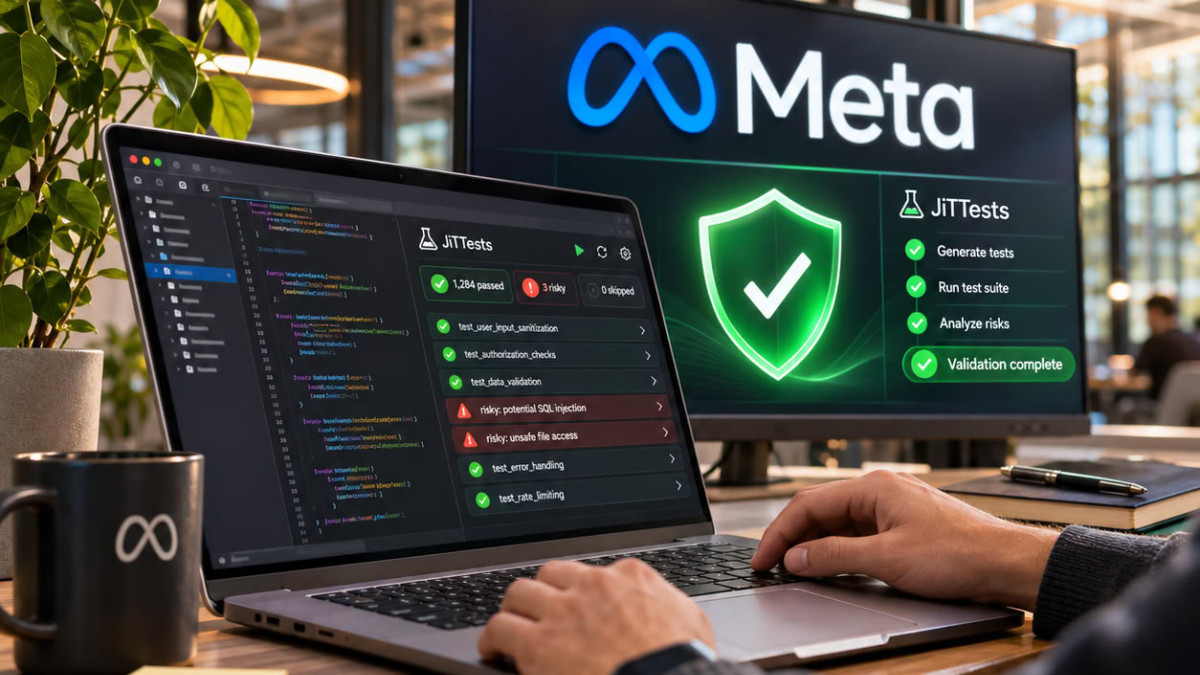

Meta has moved JiTTests from a research prototype to its production infrastructure. This system, based on a large language model (LLM, an AI trained on vast volumes of text and code), writes executable tests designed to fail when a code change poses a risk. According to Meta’s team, it has enabled the detection of 74 privacy-related incidents at the change stage during the first half of 2026.
A failing test provides concrete proof that a change, called a “diff”, has altered the software’s behavior. The method is described in a research paper titled “Just-in-Time Catching Test Generation at Meta”, presented at FSE 2026. Most AI bug detection tools act like faster reviewers: they read the diff and leave comments. JiTTests, however, executes the code and highlights a concrete behavioral difference. The team acknowledges this approach requires more computational steps, but argues it catches categories of bugs that LLM or agent-based review can miss.
A Five-Step Pipeline
In production, the system runs overnight, on unused compute capacity, and selects risky diffs from the previous day using a mechanism comparable to Meta’s Diff Risk Score. Two workflows then generate candidate tests. The first, called “dodgy diff”, assumes every change contains a bug and treats it as a variant of the previous version. The second, called “intent-aware”, first deduces the change’s intent from its code, title, and summary, then writes tests for the identified risks.
Several LLMs then act as judges: they score each failing test based on its code, error trace, diff, and deduced intent. The models mentioned in the paper are Llama3.3-70B, Gemini 3 Pro, and Claude Sonnet 4. A deterministic rule filter, dubbed RubFake, then spots patterns like reflection, failing mock objects, or “not implemented” exceptions. Finally, the system decides, based on the combined ranking, whether to alert an engineer.
Results in Research, Then in Production
The analysis covers 22,126 generated tests. Methods considering the diff produced four times more candidate catches than hardening tests, and twenty times more than tests that failed by chance. The intent-aware workflow produced “weak catches”, meaning candidate failures and not confirmed bugs, in 6.4% of its tests (52 out of 811) and on 7.9% of diffs. These figures are in the research paper’s table and are self-reported by Meta.
The initial deployment was more modest: 41 candidate catches were reported to engineers, of which 8 were confirmed true positives, or 19.5%. Four of these would have caused serious failures in production. In an engineering blog post published in October 2026, Meta states that 589 engineers interacted with JiTTests, representing 64% of those alerted, and that they report a true positive rate of 60%. Over the same period, the overall occurrence of privacy-related incidents dropped by 20%.
An Internal Tool
In this model, engineers set criteria and monitor results globally, without examining each test. According to the team, they rarely read the test code and only confirm whether an observed behavior change was intended. Meta has released no code, models, or API: JiTTests remains an internal tool.
