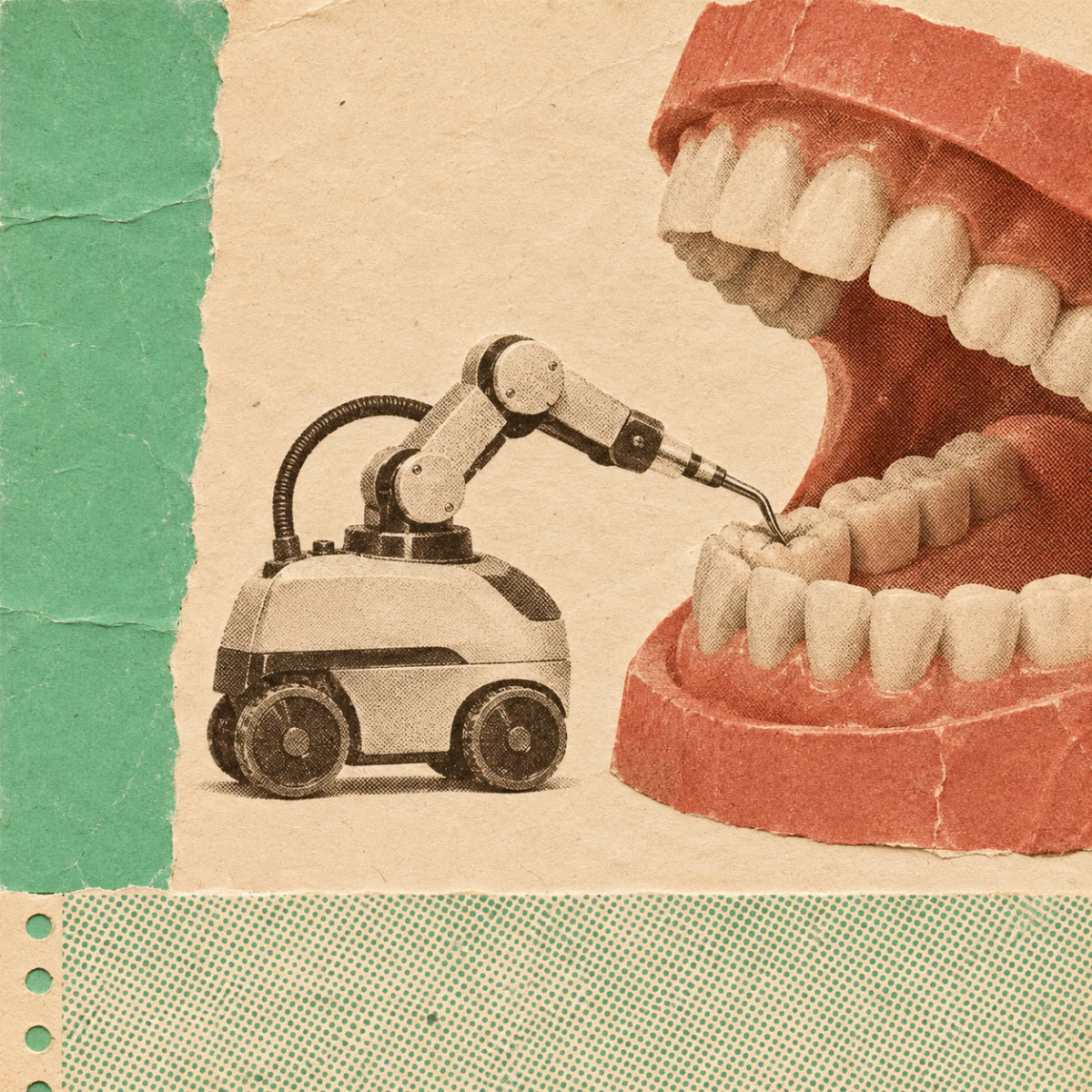

Researchers at the University of Basel have developed MIR, a small robot capable of preparing a tooth for a crown. This prototype could ultimately reduce the number of appointments needed for this type of treatment.
Multiple appointments for a crown
Today, fitting a dental crown after a major cavity requires several visits. During the first appointment, the dentist removes the decay, fills the cavity, and prepares the tooth. They then take an impression and fit a temporary crown. The final crown is manufactured from this impression and can only be fitted at a subsequent appointment.
The robot developed within the Department of Biomedical Engineering at the University of Basel could shorten this process. The idea originated with researchers at the University of Zurich, who are also involved in the development. The prototype, named ‘MIR’ for ‘Miniature Intraoral Robot’, is designed to prepare teeth according to a digital plan. After a scan during the first appointment, dentists could thus precisely program how the robot should remove tooth material, then order the crown immediately.
A very compact robot
The prototype measures 43 by 26 by 28 millimeters, roughly the size of a wine cork. Its motors and control system are located externally and are connected to the robot via flexible drive shafts, cables, and tubes. ‘It is designed to be small enough to fit comfortably in an open mouth,’ explains Yukiko Tomooka, first author of the paper published in IEEE Transactions on Medical Robotics and Bionics, in which the team presents the robot.
For testing, the researchers used synthetic resin tooth models, as well as a ceramic material whose hardness is close to that of tooth enamel. The robot proceeds in two steps. It first uses a wide drill to reduce the tooth surface by removing material from the top. In a second step, a longer, thinner drill works on the sides of the tooth.
The robot is not yet equipped with sensors to directly measure or correct its position. Despite this, the positioning error observed during testing is less than 0.2 millimeters, a margin that should decrease further once sensors are integrated. The forces generated during drilling remained below five newtons, roughly equivalent to the force of gravity on a half-liter water bottle. The team is also studying the noise produced by the system to assess its suitability for use in a dental practice.
Sensors and camera to come
Before any use in a dental practice, further work is needed. The researchers plan to integrate sensors and a camera into the robot so the system can track its position and the progress of the treatment. ‘Even after a power outage, MIR would know where it is and where to resume, based on sensor data,’ explains Georg Rauter, head of the research group and professor. The goal is to achieve this without increasing the size of the robot.
The project was developed with funding from Innosuisse, in collaboration with the Center of Dental Medicine at the University of Zurich, the Basel-based company Camlog Biotechnologies GmbH, and the University of Bern.
