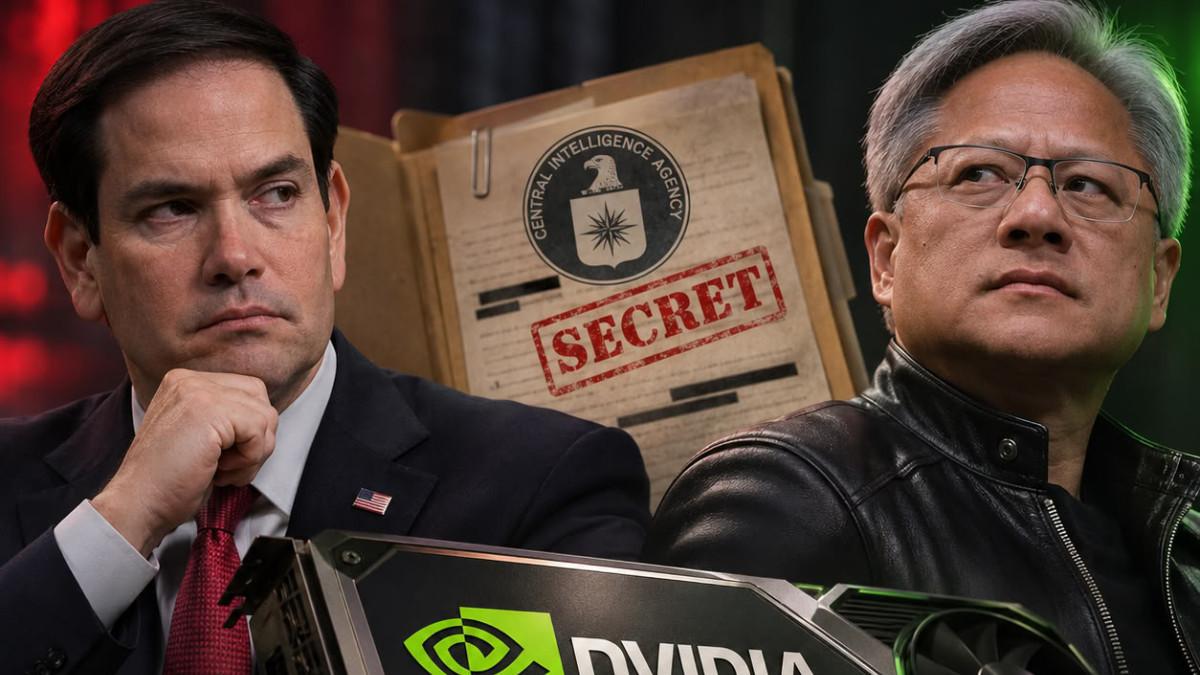

According to the Washington Post, Marco Rubio, Secretary of State and National Security Advisor to Donald Trump, is said to have personally hardened the conclusions of a CIA report at the origin of the scandal involving Jensen Huang. Does the resignation of the Nvidia CEO stem from counter-espionage, a political settling of scores over chips sold to China, or both? The question remains open in Washington.
According to a source close to the case cited by the American daily, a confidential CIA memo focusing on the relationship between Jensen Huang and Alice Huang landed on Marco Rubio’s desk. Rather than simply forwarding it, he reportedly used it to draft his own memo, rephrasing the agency’s conclusions in significantly more assertive terms. It was the leak of this revised text that triggered the series of events leading to Jensen Huang’s resignation on November 12.
The Washington Post also reports the words of a former senior semiconductor policy official, who said that the Nvidia CEO’s detractors were primarily seeking to ‘destroy the influence’ he wielded directly over the President of the United States. For the newspaper, this ouster marks a victory for a transpartisan coalition of lawmakers, national security hawks, and analysts who had been trying for years to cut off the executive’s privileged access to the Oval Office.
Yet Jensen Huang had obtained, in December 2025, the green light from Donald Trump to export his H200 chips to China, in exchange for a 25% levy on revenues for the benefit of the U.S. Treasury. The president never publicly condemned him and said he took him at his word. On the evening of his departure, he hailed a ‘legend.’
Espionage not demonstrated at this stage
The case is not, however, reduced to a political machination. According to CNN, the FBI had warned several lawmakers nearly a year earlier that the founder of Nvidia could be the target of a foreign intelligence operation, intrigued in particular by Alice Huang’s lifestyle and unusual financial means.
The network specifies, however, that CIA analysts remained divided until November 12. Some of them still consider the young woman a serious threat, while others believe the intercepted communications do not prove she was knowingly passing information to Beijing. Chinese diplomacy denounces a smear campaign, and no public evidence to date demonstrates that Nvidia’s industrial secrets have been compromised.
The Washington Post’s account, which relies on a single source, primarily highlights a hardening of tone between the CIA’s cautious analysis and the offensive summary signed by Marco Rubio. To claim that the label ‘spy’ was fabricated out of whole cloth by the Secretary of State would go further than any document currently allows.
Bills tighten export rules
Legislative consequences were not long in coming on Capitol Hill. Three bills directly targeting chip exports to China have been incorporated into the Senate version of the NDAA, the Pentagon’s major annual military programming bill. The Chip Security Act provides for geographic tracking of exported processors, the AI Overwatch Act restores a congressional veto over export licenses, and the MATCH Act pressures U.S. allies to stop selling lithography machines to Beijing.
Republican House Speaker Mike Johnson and Democratic Leader Hakeem Jeffries are jointly pushing for their adoption, while Senate Majority Leader John Thune now considers further tightening very likely. Nvidia had been fighting these bills behind the scenes for months, after already opposing the GAIN AI Act in 2025, which aimed to prioritize chip supplies for U.S. customers. The interim leadership of CFO Colette Kress will now have to defend the company’s commercial export interests. In January, the new Democratic majority resulting from the midterm elections will take control of both houses of Congress, with the promise of opening its own investigative committees.
