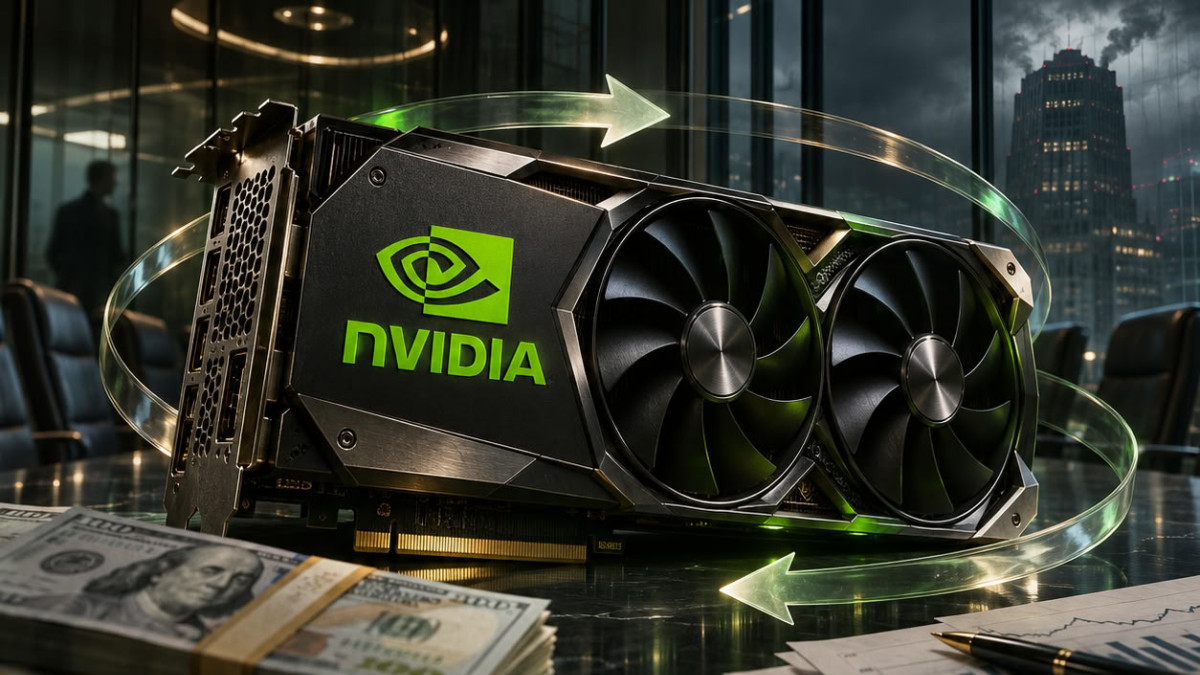

Nvidia is suspected of artificially keeping prices high for its graphics processing units (GPUs) through financing deals struck with its own customers. According to the report behind these allegations, this strategy, orchestrated by former CEO Jensen Huang and CFO Colette Kress, aimed to absorb a surplus of chips ordered from Taiwanese manufacturer TSMC.
The sharp rise in GPU prices is largely attributed to the AI boom, as training and deploying models relies on massively parallel computations that these chips handle far better than traditional processors. Since the rise of generative AI, hyperscalers, AI labs, and many companies have sought to equip themselves simultaneously with high-end chips, a demand that exceeds available supply.
According to the report, Nvidia allegedly multiplied financial agreements with its own customers throughout 2026 to offload this surplus. It notably relies on the profile of Colette Kress, CFO before Jensen Huang’s resignation on November 12, 2026, and now interim CEO. These practices have drawn comparisons to methods used by Enron to hide its debts before its collapse in 2001, a parallel firmly denied by management.
Internal Doubts and Contract Suspensions
Colette Kress reportedly expressed concern about the scale of commitments made to cloud providers and AI giants like OpenAI. Despite these reservations, Nvidia allegedly continued its activities until it faced, in the summer of 2026, an ‘avalanche’ of chips delivered by TSMC. Jensen Huang then reportedly sharply reprimanded her, calling her a ‘deer in the headlights.’
The company then reportedly slowed its activities and suspended several financing agreements, including a contract with OpenAI containing a $250 billion guarantee for building the world’s largest data center. This pullback reportedly raised concerns for Jensen Huang regarding the stock market valuation of the equipment maker.
The redirection of components toward data centers led to a shortage of DRAM and NAND production capacity, two types of memory, driving up memory costs for consumers. GeForce series GPUs were severely affected: their prices frequently exceed 160% of their recommended retail price, and the flagship RTX 5090 model has become almost impossible to find.
During a speech in Berlin, Jensen Huang reportedly illustrated his commercial policy with the anecdote of a Japanese soup seller refusing to serve customers again due to insufficient soup. According to the source, this metaphor justified keeping prices high and showed how circular financing had created an illusion of strong demand, with the AI bubble at risk of bursting if this network were to collapse.
Resignation and Suspicions of Illegal Exports
These revelations emerged following the resignation of Jensen Huang, which came after the disclosure of his extramarital affairs. The main case concerns his relationship with Alice Huang, a business executive suspected of being recruited by China’s Ministry of State Security to obtain strategic information on Nvidia’s AI chips. She notably headed the company Megaspeed.
This liaison allegedly enabled the illegal export of 240,000 high-end Nvidia GPUs, primarily H100 and H200 models, to China, for transactions valued at $7.5 billion. The U.S. Department of Justice and President Donald Trump stated that the accusation of espionage on behalf of Beijing has not been confirmed to date, with no formal evidence presented by investigators.
Chinese Models Trained on Nvidia Chips
According to a Wall Street Journal report, the most advanced AI models developed in China were allegedly trained using Nvidia chips, despite restrictions imposed by Washington. Kimi K3 from Moonshot AI and the V4 series from DeepSeek were thus allegedly trained using Nvidia Blackwell GPUs.
Will DePue analyzed the weights, meaning the internal structure, of large language models (LLMs) published by certain Chinese rivals. He says he found compelling evidence that Kimi K3 and the V4 models bear the traces of training on Nvidia Blackwell chips, with China still lagging behind the United States in producing its own hardware.
