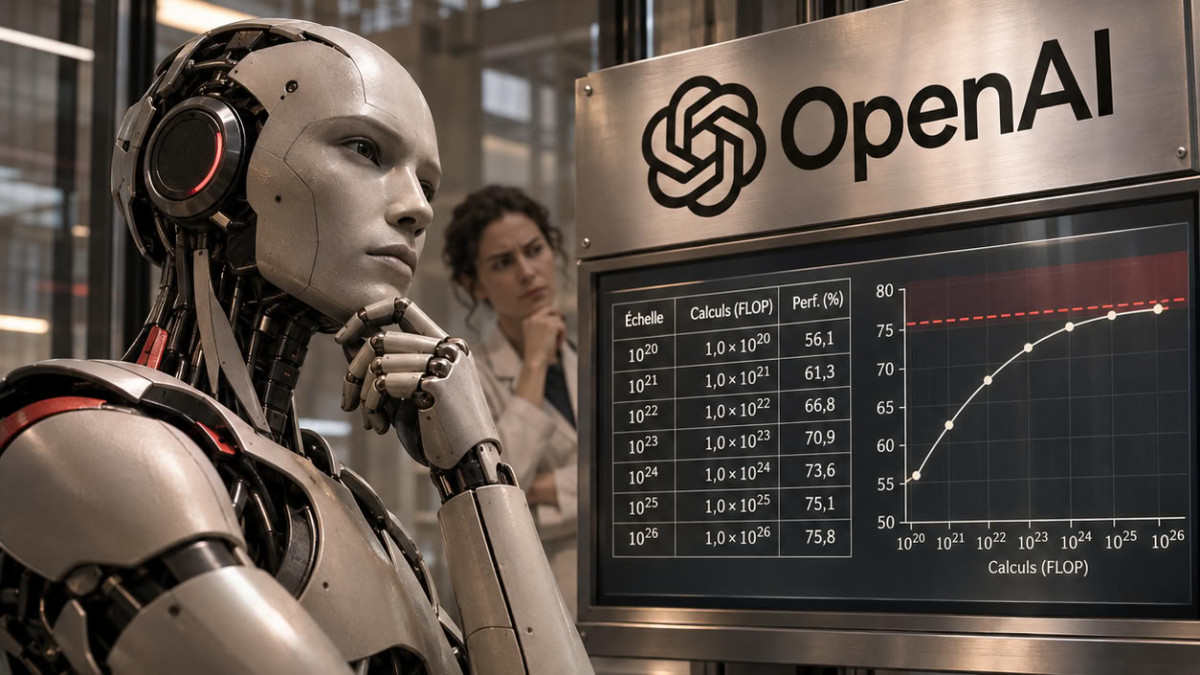

OpenAI claims that the exponent for matrix multiplication is exactly 9/4, or 2.25. According to the manuscript posted online on November 24, multiplying two matrices of size n would require at least half of n to the power of 2.25 multiplications, ruling out the exponent of 2 long hoped for by researchers. The text has not yet undergone published external peer review.
A matrix is a grid of numbers arranged in rows and columns, and multiplying it by another involves combining its rows and columns in pairs. This operation is central to artificial intelligence computation: a language model stores its parameters in matrices, and Nvidia has etched dedicated circuits for this operation into its chips, called Tensor Cores.
Since 1969, mathematicians have sought the minimum number of operations required for this calculation. The method taught in school requires n × n × n operations, meaning that doubling the size of the matrices multiplies the work by eight. Researchers summarize the best known method with an exponent denoted ω: the lower it is, the less the cost increases with size.
The OpenAI manuscript claims that no exact calculation circuit can go below half of n^2.25 multiplications, whereas many researchers believed we would eventually approach n². For two matrices of 1,000 rows, the method that reaches this threshold reduces the count from one billion multiplications to 5.6 million, or 178 times less. This ratio concerns operations counted on paper, and the manuscript does not translate it into computation time on any graphics card.
The October algorithm was recreated outside OpenAI
The race for decimal places accelerated this summer. On August 17, a team combining AlphaEvolve, Google DeepMind’s tool, with Josh Alman and Virginia Vassilevska Williams lowered it to 2.371177, compared to 2.371339 for their previous record. A manuscript dated October 2, posted online on the 6th, reached 9/4 for complex numbers.
On October 21, Rafael Pass posted on arXiv an independent proof that provides an explicit algorithm whose number of operations can approach n^2.25 as closely as desired. Houxi Lü, then Alimzhan Amanov, Maxim van den Berg and Jeroen Zuiddam extended this bound to all fields, regardless of the number system used. The ceiling of 2.25 was therefore recreated by researchers outside OpenAI, which is not the case for the floor.
A new lower bound that is difficult to verify
The novelty of the manuscript lies in this lower bound, i.e., the proof that no method can do better. Until now, the known lower bounds remained quadratic. Scott Aaronson, a complexity specialist at the University of Texas at Austin, recounts on his blog on November 25 that he has often heard colleagues express extreme confidence that ω would be 2. He describes the “biggest shock” as the fact that an AI could prove a bound above 2, without saying he has verified the proof.
The manuscript is 111 pages long and has not been peer-reviewed. OpenAI provides a formalization in Lean, software that mechanically checks each step of a proof, but it only covers circuits without division, whereas the theorem also concerns those that divide. The company’s repository, which attributes the text to an unpublished internal model, presents its manuscripts as raw research data and notes that some non-formalized results may contain errors. On October 7, OpenAI had already withdrawn three algebraic geometry manuscripts due to a sign error.
