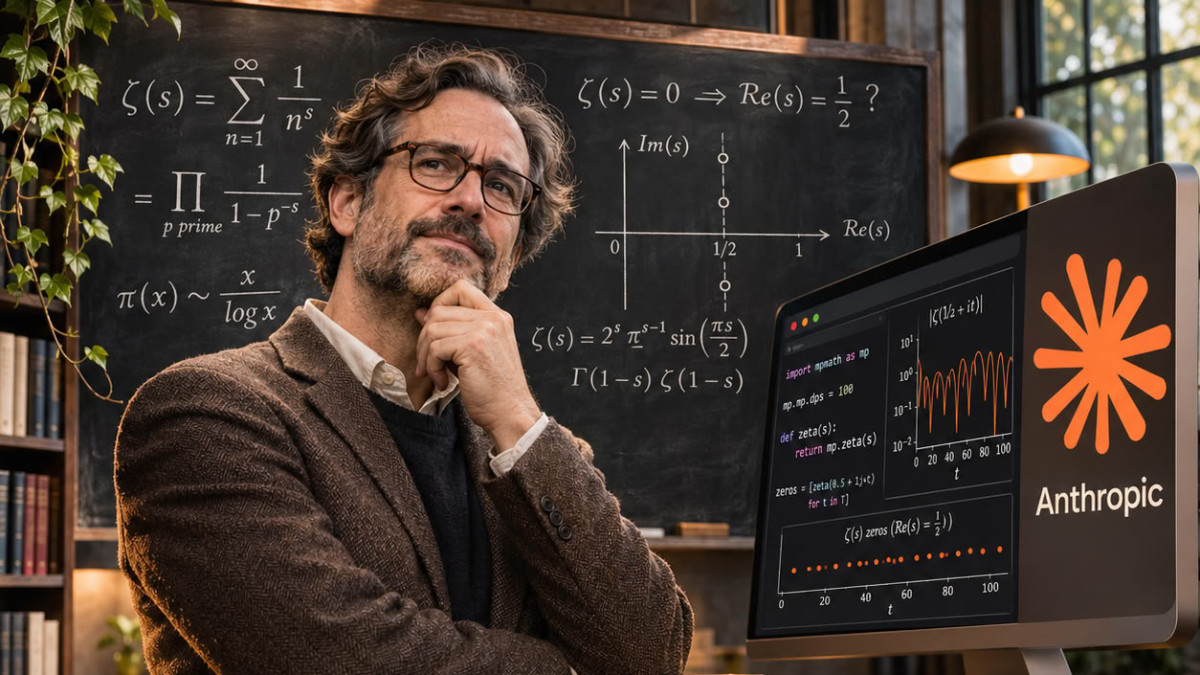

Mathematician Levent Alpge, an Anthropic employee, claims a proof of the Riemann hypothesis achieved with the help of the Claude model. His solution, disseminated as computer code, has been confirmed by two independent organizations, but it has not yet been peer-reviewed and rekindles debates on the use of AI in mathematics.
On November 20, 2026, this Turkish-American mathematician announced he had established this proof in a four-page article published on his website. He describes the Riemann hypothesis as “the sacred object of mathematics in my eyes since my childhood”. He indicates he wished to publish earlier but had to delay the announcement due to a “constraint” to be respected, likely related to Anthropic’s IPO, which occurred on November 19 and raised over $100 billion.
This announcement follows a series of major proofs achieved with AI over the last six months. In October, OpenAI had angered mathematicians by publishing around 400 AI-generated proofs all at once, spread across more than 700 manuscripts covering numerous disciplines.
A Hypothesis Over a Century Old
First formulated by German mathematician Bernhard Riemann in 1859, the hypothesis concerns the Riemann zeta function, denoted ζ(s). According to mathematicians, this function plays a major role in number theory, as it is linked to the distribution of prime numbers and notably allows estimating the number of primes less than a given number. The hypothesis states that the “non-trivial” solutions to the equation ζ(s) = 0, called the zeros of the function, lie on a specific vertical line.
Levent Alpge claims to actually prove the broader statement known as the generalized Riemann hypothesis, likely first formulated around 1884. He says he worked collaboratively with an AI as an assistant. In his official statement, he summarizes the culmination of his work as follows: “I believe I have discovered, while working with Claude, a proof of the Riemann hypothesis”.
Code Verified by Two Organizations
Rather than publishing a paper in natural language, he disseminated his result in Lean, a programming language designed to automatically verify the logical validity of each step of a proof. He justifies this choice by the length of the argument: his attempts to obtain an English explanation generated by AI reached, according to him, over 250,000 pages, and publishing such a version seemed “manifestly inappropriate”.
Two independent organizations, the Lean Focused Research Organization and the Mathlib Initiative, examined the entire code and confirmed the correctness of the proof. In a joint statement, they write: “we are fully convinced that Alpge’s proof of the Riemann hypothesis is correct, and we congratulate him on this achievement”. Steven Strogatz, a mathematics professor at Cornell University, compares the human-machine relationship to “a very skilled jockey on a really fast horse”. Andrew Sutherland, a mathematician at MIT, believes that “the world has changed”.
Reservations and a Rivalry
Mathematicians generally agree that formalization in Lean alone is not sufficient to confirm a proof. Canadian mathematician Daniel Litt states that “the proof of the Riemann hypothesis formalized using the Lean method has a very high chance of being correct. No one understands it yet”.
In this climate, Ravi Vakil, president of the American Mathematical Society, made public another proposed proof of the generalized Riemann hypothesis, from Stanford mathematician Alessandro Maria Masullo. Presented in a 940-page manuscript titled “The Music of the Primes”, this proposal is described by Ravi Vakil as “entirely human, without any AI”. It was still under verification, and potential issues were identified a few hours after its publication. Levent Alpge, for his part, indicates he will strive to “understand and make others understand the AI’s argument”.
