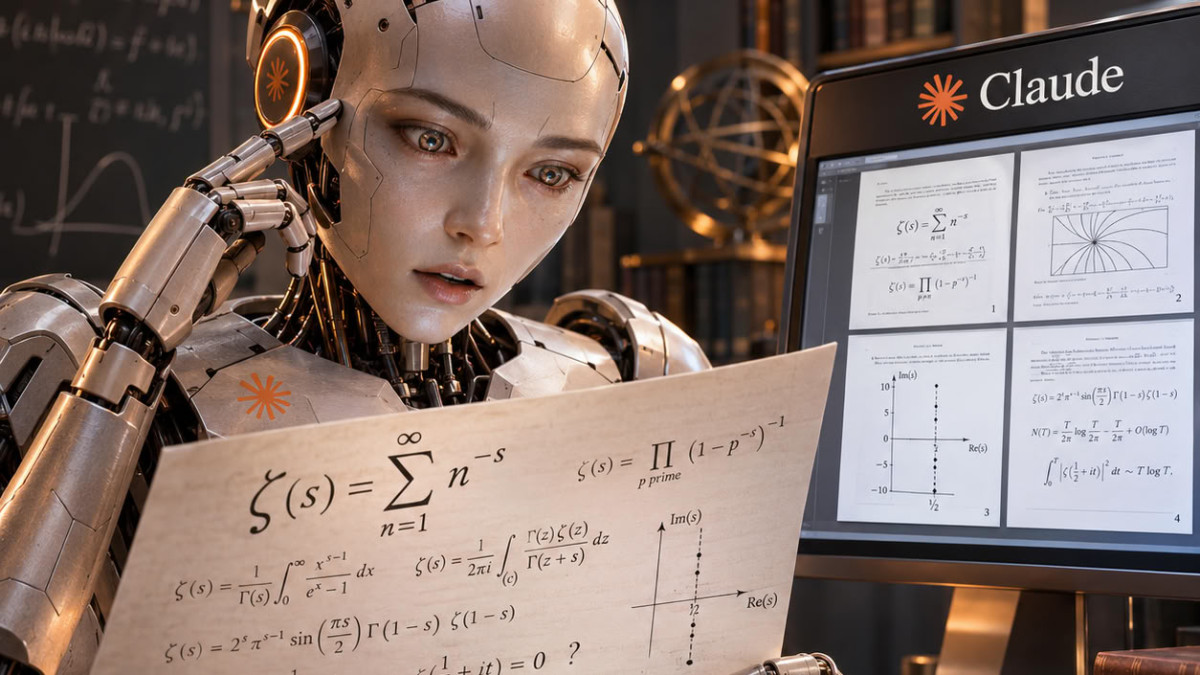

Anthropic researcher Levent Alpöge claims to have demonstrated the Riemann hypothesis with the help of the AI Claude. In a note published Friday, November 20, 2026, he describes a method that, according to him, also solves the generalized Riemann hypothesis. Brian Conrey, a specialist on the subject, sees it as “a monumental moment in the history of humanity,” while acknowledging he has not yet seen the proof.
A Four-Page Note
The note, published on Levent Alpöge’s website, is four pages long and opens with this sentence: “I believe I have discovered, while working with Claude, a proof of the Riemann hypothesis.” A specialist in number theory, he is part of Anthropic’s technical team. He had previously worked on fluid mechanics problems with Tristan Buckmaster, a mathematician at New York University.
Levent Alpöge has not published a classic mathematical paper. He wrote a version of the proof with Claude, in Lean, a formal verification language. He explains to AFP that a complete write-up would be extremely long and that he does not yet master all the mathematics involved. He says he wants to write up the proof later, without a specific date.
A Problem Posed in 1859
German mathematician Bernhard Riemann formulated his hypothesis in 1859, in a paper on the distribution of prime numbers. In 1900, David Hilbert placed it on his list of 23 major problems of the century. In 2000, the Clay Institute included it among its seven “Millennium Problems,” each endowed with a million dollars. According to AFP, the institute requires publication in a peer-reviewed journal, as well as two years of examination, before awarding the prize.
In August 2026, Anthropic had announced that an unpublished version of Claude had improved an old result related to the Riemann hypothesis, without proving it. Three months later, Brian Conrey reacted to AFP: “This is truly the biggest thing that has happened in mathematics, I think.” He specifies that he has only seen what Levent Alpöge published on his website and has requested a copy of the manuscript. “It looks seriously complicated. I don’t think a human was about to find this,” he adds, estimating that “there will be simpler ways to do it.”
Nestor Guillen, a visiting professor at New York University, judges that Levent Alpöge’s frankness, in admitting he does not fully understand his own proof, shows an AI being used “more as a tool.” A few hours after the announcement, Ravi Vakil of Stanford University indicated that a postdoctoral researcher in his department had, for his part, submitted another proof. Neither Nestor Guillen nor Ravi Vakil have responded to AFP at this time.
A Contested Timing
The announcement came the day after Anthropic’s stock market listing, which occurred on November 19. Levent Alpöge acknowledges that this timing “could be perceived cynically.” He indicates he consulted Dario Amodei, CEO of Anthropic, before publishing. Two months earlier, OpenAI had claimed to have solved another Millennium Problem, concerning fluid mechanics equations. According to AFP, mathematicians estimate that Anthropic’s result appears correct, without having been fully verified yet.
