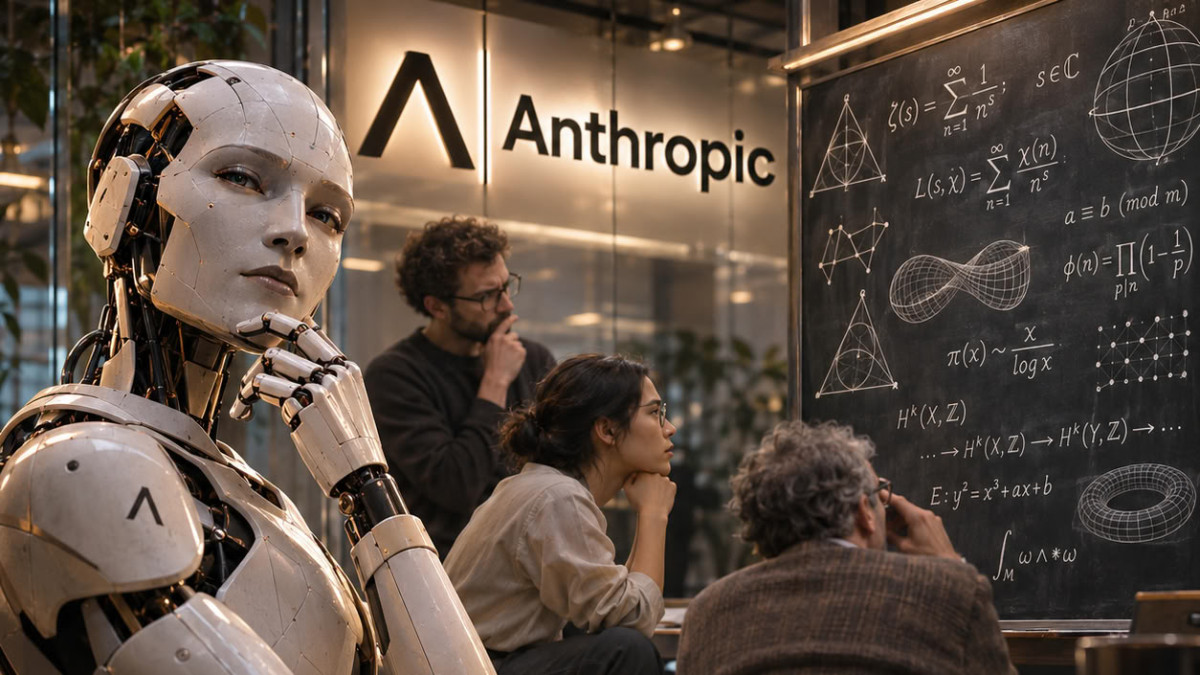

Several recent announcements report mathematical problems solved with the help of artificial intelligence models. Among them, the claim by researcher Levent Alpöge, who states he solved the Riemann hypothesis thanks to Claude, Anthropic’s model, has not yet been verified.
On Friday, November 20, Levent Alpöge claimed to have solved this problem, considered by some to be the most important in the world, with the help of an artificial intelligence (AI) model from Anthropic, the developer of Claude. He only published an account of this work on his personal site, not the full proof, which no other mathematician has yet been able to verify. In this discipline, the examination of a method can only take place two years after publication in a qualified scientific journal, and once it has been accepted “by the mathematical community.”
The Riemann hypothesis is one of the seven so-called “Millennium” problems, drawn up in 2000 by the Clay Mathematics Institute, which promised one million dollars for the solution of each. Formulated in 1859 by German mathematician Bernhard Riemann, it concerns the distribution of prime numbers, those integers that can only be divided evenly by 1 and themselves. “It’s the most important thing ever seen in mathematics,” Brian Conrey, considered one of the leading experts on the subject, who has not yet been able to verify the proof, told AFP. Nestor Guillen, a professor at NYU (New York University), believes that “this result in itself will not have an immediate impact,” but that “the understanding it brings will have many, many applications in the coming months and years.”
This announcement is part of a series. In early September, a model from OpenAI, the creator of ChatGPT, was presented as having solved the Navier-Stokes equation, a problem over a century old. Posed by Frenchman Henri Navier in 1822, then completed by physicist and mathematician George Gabriel Stokes, who gave it its definitive form in 1845, it describes the motion of fluids and is used in weather models or aircraft wing design, among other things. OpenAI indicated it obtained this result in less than four days, with over 10,000 AI agents working together and over 130 billion “tokens,” a unit used to measure the volume of generated content.
Alleged Plagiarism and Fermat’s Last Theorem
The company is, however, suspected of plagiarism. Australian mathematician Tristan Buckmaster, co-leader of work with Levent Alpöge, believes he sees similarities with his own research. OpenAI admitted it could not “rule out” the scenario that anonymized data from the duo of researchers “may have helped improve (its) models,” while stressing that its AI’s proof differed “significantly” from theirs.
On September 4, the American startup Anthropic announced that Claude had achieved the “first complete, computer-verified proof of Fermat’s Last Theorem.” This theorem, written in 1637 by French mathematician Pierre de Fermat, involves determining whether certain additions of numbers with exponents can be exact or not. Its first proof, achieved by Sir Andrew Wiles in 1995, “was 129 pages long and required months of meticulous work to verify,” according to Anthropic. The model, according to the company, formalized this reasoning “in 11 days, working largely autonomously,” writing “13 million lines of code” and proving “29,500 intermediate theorems.”
A Computer Science Hypothesis Refuted
On October 26, OpenAI and Anthropic each claimed that one of their models had refuted the so-called Exponential Time Hypothesis (ETH). This conjecture, little known to the general public but central to computer science, posits that certain problems can only be solved by trying almost all possible combinations, like a padlock whose code is unknown. Hundreds of works in computer science or genomics rely on it. If it were false, rapid analysis of complex genomes or the decryption of a strong code would become conceivable, even if no one yet knows how.
This discovery could also affect encryption, which underpins the security of blockchain transactions, the foundation of cryptocurrencies. However, one of the co-authors of the hypothesis, Russell Impagliazzo, wanted to reassure: “This result does not threaten computer security, but the work that follows from it could force the strengthening of encryption and make data protected years ago readable.”
